Brachiaria reptans
(L.) Gard. ex C. E. Hubbard
Fine armgrass
iNaturalist· cc-by-nc
(c) Wen-Hsiang Cheng, some rights reserved (CC BY-NC)
iNaturalist· cc-by-nc
(c) Wen-Hsiang Cheng, some rights reserved (CC BY-NC)
iNaturalist· cc-by-nc
(c) Wen-Hsiang Cheng, some rights reserved (CC BY-NC)
Description
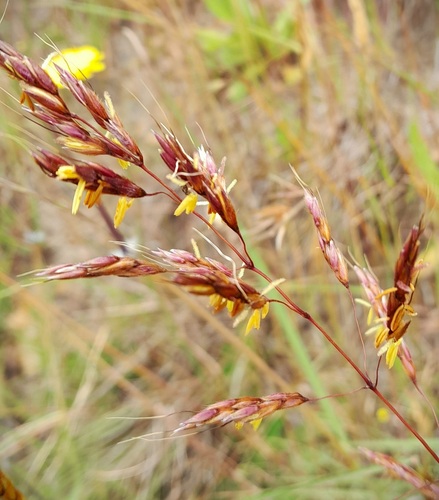
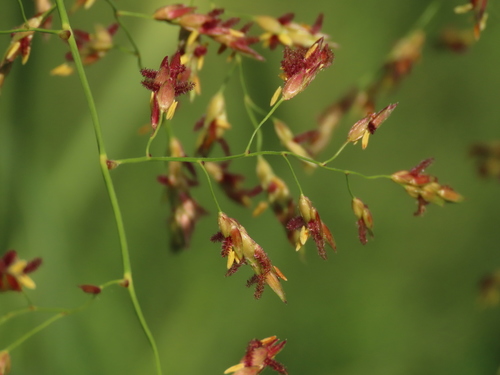
An annual grass. The base is creeping and there are several slender stems. The nodes have beards. The leaf sheaths are shorter than the internodes. They are hairy and loose. The leaf blades are short and 5-8 mm wide. They are rounded at the base and have crinkly edges. The flower stalk has several slender racemes. The spikelets are arranged in an irregular fashion. They are less than 3 mm long.
Edible Uses
The grains are eaten when food is scarce and serve as a famine food.
Traditional Uses
The grains are eaten when food is scarce.
This uses section is brief — help expand it
Medicinal Uses
Ashes from the whole plant are used as a treatment against snake bite. The rhizomes are diuretic. A paste made from the rhizome is used in the treatment of kidney problems.
Known Hazards
The seed is said to contain cyanide.
Distribution
A tropical plant. They occur on slightly better soils in medium rainfall areas.
Where It Grows
Africa, Asia, Australia, East Africa, India, Northeastern India, Mozambique, Pakistan, St. Kitts and Nevis, Taiwan,
Cultivation
The plant is a weed of agricultural fields, moderately common amongst sugarcane, and also invades lawns and heavily-grazed pastures.
Other Information
It is a famine food.
Notes
There are about 100 Brachiaria species.
Synonyms
Also Known As
Shani pillu
References (6)
- Ambasta, S.P. (Ed.), 2000, The Useful Plants of India. CSIR India. p 80
- Flora of Pakistan. www.eFloras.org
- Hooker's Icon. Pl. 34: t. 3363. 1938
- Petheram, R.J. and Kok, B., 2003, Plants of the Kimberley Region of Western Australia. UWA Press p 69
- Singh, H.B., Arora R.K.,1978, Wild edible Plants of India. Indian Council of Agricultural Research, New Delhi. p 84
Show all 6 references Hide references
- Wild edible plants of Himachal Pradesh