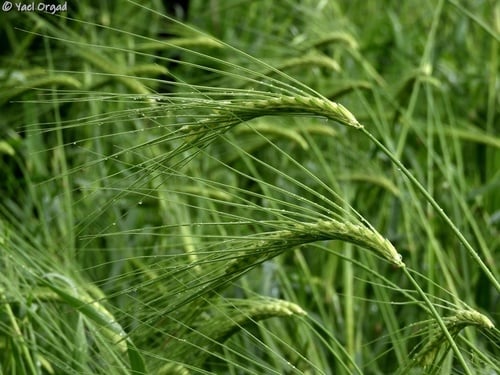
Triticum georgicum
Dekaprelew.
No photos yet for Triticum georgicum
Sign in to contribute a photoSummary
An annual wheat that flowers June to July with seeds ripening August to September. Wind-pollinated hermaphrodite species. Grows in sandy, loamy, or clay soils with good drainage, tolerating mildly acid to mildly alkaline conditions. Requires full sun and prefers consistently moist soil. Not frost tender.
Description
An annual wheat that flowers June to July with seeds ripening August to September. Wind-pollinated hermaphrodite species. Grows in sandy, loamy, or clay soils with good drainage, tolerating mildly acid to mildly alkaline conditions. Requires full sun and prefers consistently moist soil. Not frost tender.
Edible Uses
The seed is cooked, most commonly ground into flour for use as a cereal in making bread, biscuits, and similar products.
Medicinal Uses
None known
Distribution
It is a temperate plant.
Where It Grows
Georgia, Russia,
Cultivation
Succeeds in most well-drained soils in a sunny position. Cultivated for its edible seed in S. Russia.
Propagation
Sow seed in early spring or autumn directly in situ, barely covering it. Germination should occur within a few days.
Other Uses
The straw serves many purposes, including as a biomass fuel, thatching material, and garden mulch. Fibre extracted from the stems can be used to make paper: stems are harvested in late summer after seed collection, cut into usable pieces, soaked in clear water for 24 hours, cooked for 2 hours in lye or soda ash, then beaten in a ball mill for 1½ hours, producing a green-tan paper. Starch from the seed is used for laundering and sizing textiles, and can also be converted to alcohol for use as a fuel.
Synonyms
References (1)
- Plants for a Future database, The Field, Penpol, Lostwithiel, Cornwall, PL22 0NG, UK. http://www.scs.leeds.ac.uk/pfaf/