Syzygium claviflorum
(Roxb.) A. M. Cowan and Cowan
Trumpet satinash, Watergum myrtle
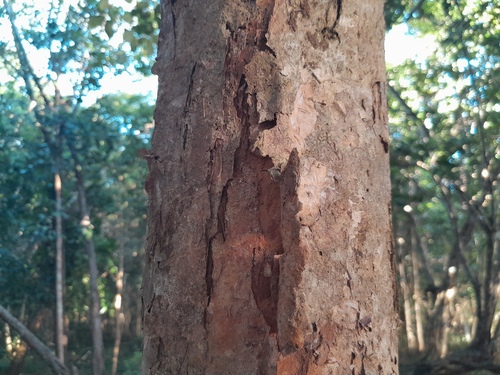
iNaturalist· cc-by-nc
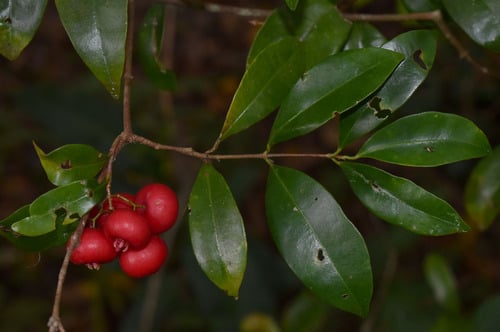
(c) Russell Cumming, some rights reserved (CC BY-NC), uploaded by Russell Cumming
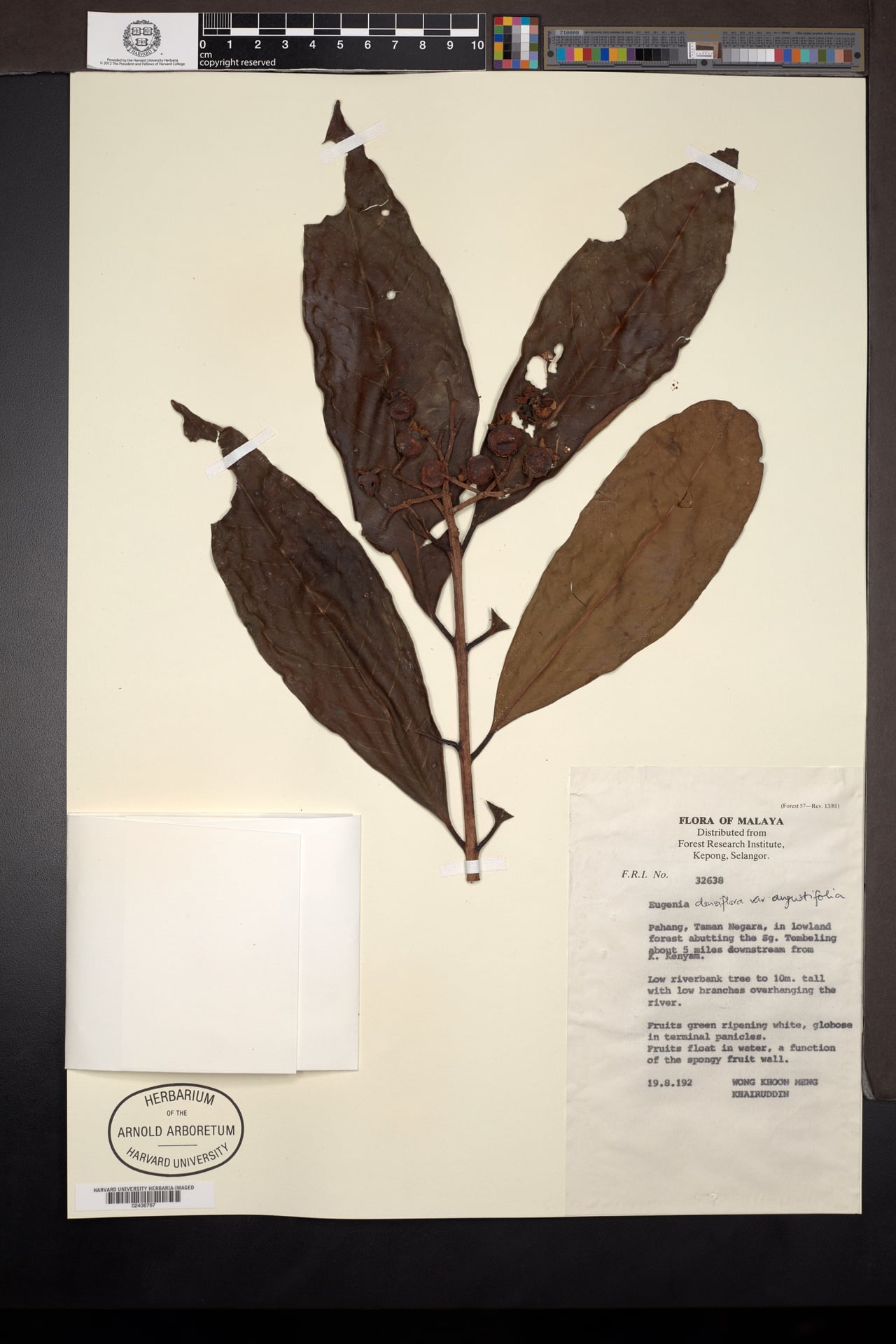
iNaturalist· cc-by-nc
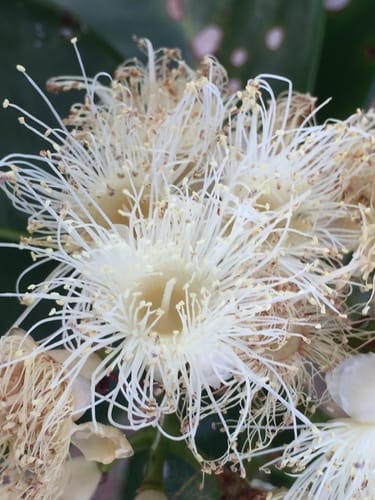
(c) Russell Cumming, some rights reserved (CC BY-NC)
Summary
Source: WikipediaSyzygium claviflorum is a tree in the Myrtaceae family. It is native to northern and northeastern Australia and to tropical and subtropical Asia. It is used for timber, as fuel, as human and cattle food, and for dye. Stunted specimens can be found on the top of the plateau of Bokor National Park, Cambodia.
Description
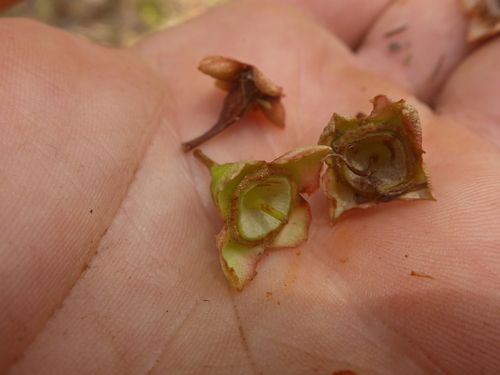
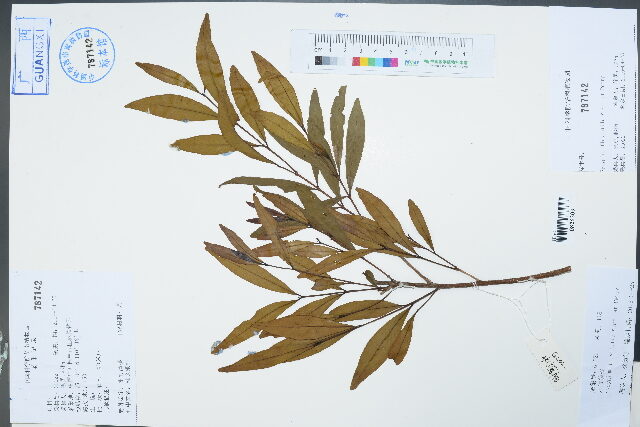
A tree. It grows to 35 m high. The trunk is 60 cm across. It has small buttresses. The bark is pale whitish grey. It is smooth or finely cracked. It sometimes peels in small patches. The leaves are thinly leathery. They are oval or sword shaped. They are 5.5-22 cm long by 2-8.5 cm wide. They are broadest in the middle. The edges roll in slightly. They taper to the base. There are 12-25 (-37) pairs of secondary veins. The leaf stalk is 2-8.5 mm long by 2 mm wide. The flowering arrangement is below the leaves or in the axils of leaves. The flowers do not have stalks. The petals are white. The fruit is reddish to purple. They vary in shape. They can be 2 cm long. The tip is deeply hollowed. The outer layer is pulpy and juicy.
Edible Uses
The wood is a useful structural timber, and in Australia is marketed under the name grey satinash. People who live in the Bung Khong Long Non-Hunting Area (Nong Khai Province, Thailand) use the bark for dyeing nets (to enhance their strength) and the fruit as cattle feed. In Cambodia the fruit are eaten and the wood is good firewood for heating. In the Chittagong region of Myanmar and in Kerala and the Sikkim Himalaya, the fruit are eaten locally.
Traditional Uses
The fruit are preserved as a pickle. They are acidic. The ripe fruit are also eaten raw.
This uses section is brief — help expand it
Distribution
A tropical plant. It grows in lowland rainforest beside streams and on rocky ground. It grows up to 1200 m altitude in Indonesia. In Sikkim it grows between 500-1,000 m above sea level. It grows at 1350 m altitude in Yunnan in China. It grows in subtropical broadleaved evergreen forest. In tropical Queensland it grows from sea level to 840 m altitude.
Where It Grows
Andamans, Asia, Australia, Bangladesh, Bhutan, China, Himalayas, India, Indochina, Indonesia, Malaysia, Myanmar, New Guinea, Northeastern India, Pacific, Papua New Guinea, PNG, Philippines, SE Asia, Sikkim, Thailand,
Cultivation
Plants can be grown from seeds.
Propagation
Seed - best sown as soon as it is ripe.
Other Uses
The creamy-coloured wood is used locally and also traded. We do not have any more specific information for the wood of this species, but the various species of Syzygium tend to have somewhat similar timber. The general description of syzygium timber is as follows:- The heartwood is a golden brown, greyish brown or brown, with pink or purplish glints; it is not clearly demarcated from the 1 - 4cm wide band of sapwood. The texture is fine; the grain slightly interlocked, sometimes wavy or irregular; there are resin deposits. The wood is heavy; moderately hard; somewhat durable, being moderately resistant to fungi and termites, but susceptible to dry wood borers. It seasons slowly, with a high risk of checking and distortion; once dry it is moderately stable in service. It works well with ordinary tools, nailing and screwing are good so long as the wood is pre-bored; gluing is correct. The wood is used for musical instruments, tool handles, furniture components, ship building, heavy carpentry, flooring, joinery etc.
Production
In NE India plants flower and fruit March to May.
Synonyms
Also Known As
Bangkoh, Chambu, Gelam, Grey satinash, Harejamun, Kauliakong, Kelat merah, Lamba nali jam, Lenceh, Luat, Obah, Pichil-i-mim, Pohon jambu gelam, Sedong, Thabye-kywe-gaung, Thabye-pin-bwa, Thabye-yit-pauk, Ubah, Wa hin
References (25)
- Ambasta, S.P. (Ed.), 2000, The Useful Plants of India. CSIR India. p 614
- Argent, G et al, nd, Manual of the Larger and More important non Dipterocarp Trees of Central Kalimantan Indonesia. Volume 2 Forest Research Institute, Samarinda, Indonesia. p 470
- BARC, 2016, State of Biodiversity for Food and Agriculture in Bangladesh. Bangladesh Agricultural Research Council.
- Burkill, I.H., 1966, A Dictionary of the Economic Products of the Malay Peninsula. Ministry of Agriculture and Cooperatives, Kuala Lumpur, Malaysia. Vol 1 (A-H) p 980 (As Eugenia claviflora)
- Cooper, W. and Cooper, W., 2004, Fruits of the Australian Tropical Rainforest. Nokomis Editions, Victoria, Australia. p 341 (As Acmenosperma claviflorum)
Show all 25 references Hide references
- Craven, L. A., et al, 2006, Acmena, Acmenosperma, Cleistocalyx, Piliocalyx and Waterhousea formally transferred to Syzygium (Myrtaceae). Blumea 51:131-142 (As Acmenosperma claviflorum)
- Gardner, S., et al, 2000, A Field Guide to Forest Trees of Northern Thailand, Kobfai Publishing Project. p 197
- Hartley, T. G. & Perry, L. M., 1973, Syzygium (Myrtaceae) from Papuasia J. Arn. Arb. Vol 54 p 210
- INFOODSUpdatedFGU-list.xls
- Jackes, B.R., 2001, Plants of the Tropics. Rainforest to Heath. An Identification Guide. James Cook University. p 68 (As Acmenosperma claviflorum)
- Jeeva, S., 2009, Horticultural potential of wild edible fruits used by the Khasi tribes of Meghalaya. Journal or Horticulture and Forestry Vol. 1(9) pp. 182-192 (As Eugenia claviflora)
- Jin, Chen et al, 1999, Ethnobotanical studies on Wild Edible Fruits in Southern Yunnan: Folk Names: Nutritional Value and Uses. Economic Botany 53(1) pp 2-14 (As Syzygium leptanthum)
- Kar, A., et al, 2013, Wild Edible Plant Resources used by the Mizos of Mizoram, India. Kathmandu University Journal of Science, Engineering and Technology. Vol. 9, No. 1, July, 2013, 106-126
- Norrington, L., & Campbell, C., 2001, Tropical Food Gardens. Bloomings Books. p 88 (As Acmenosperma claviflorum)
- Pasha, M. K. & Uddin, S. B., 2019, Minor Edible Fruits of Bangladesh. Bangladesh J. Plant Taxon. 26(2): 299–313
- Reis, S. V. and Lipp, F. L., 1982, New Plant Sources for Drugs and Foods from the New York Botanical Garden herbarium. Harvard. p 208
- Sawian, J. T., et al, 2007, Wild edible plants of Meghalaya, North-east India. Natural Product Radiance Vol. 6(5): p 416 (As Eugenia claviflora)
- Singh, D. B., et al, 2001, Nutrient composition of some wild edible fruits of Andaman and Nicobar Islands. J. Appl. Hort., 3(1):60-62, January-June, 2001
- Singh, H.B., Arora R.K.,1978, Wild edible Plants of India. Indian Council of Agricultural Research, New Delhi. p 79
- Slik, F., www.asianplant.net
- Sukarya, D. G., (Ed.) 2013, 3,500 Plant Species of the Botanic Gardens of Indonesia. LIPI p 532
- Sundriyal, M., et al, 1998, Wild edibles and other useful plants from the Sikkim Himalaya, India. Oecologia Montana 7:43-54
- Sundriyal, M., et al, 2004, Dietary Use of Wild Plant Resources in the Sikkim Himalaya, India. Economic Botany 58(4) pp 626-638
- Tiwi Plants and Animals. 2001, Aboriginal flora and fauna knowledge from Bathurst and Melville Islands, northern Australia. Northern Territory Botanical Bulletin; No. 24 p 22 (As Acmenosperma claviflorum)
- World Checklist of Useful Plant Species 2020. Royal Botanic Gardens, Kew