Sinopodophyllum hexandrum
(Royle) T. S. Ying
Himalayan May apple, Chinese may-apple
iNaturalist· cc0
no rights reserved
iNaturalist· cc0
no rights reserved
iNaturalist· cc0
no rights reserved
Description
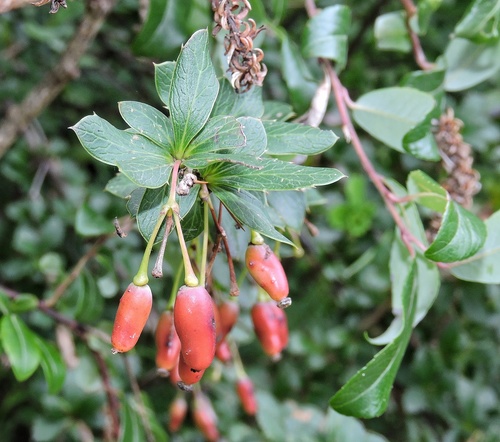
A small herb which grows 45 cm tall. It keeps growing from year to year. It has creeping rhizomes or underground stems. They are 8-10 cm long and 5-8 mm thick. Shoots arise from this with two shiny leaves. These leaves hang down at first but then expand and are held horizontally. The leaves are deeply lobed and rounded. The stem is fleshy and cylinder shaped and 20-30 cm long by 5-8 mm across. There are 2 leaves and a flower at the end. The leaves are simple, round and 6-15 cm long by 10-25 cm wide and have 3-5 lobes. They are are green and blotched. There is a single flower with white petals. It is cup shaped. The fruit is 2-4 cm long by 1.5-2.5 cm wide. The fruit is oval and red. It is like a small tree tomato. There are many seeds. It is edible.
Edible Uses
The ripe fruit are sweet and eaten fresh.
Traditional Uses
The ripe fruits are sweet and eaten fresh. CAUTION: The roots and leaves are poisonous.
This uses section is brief — help expand it
Medicinal Uses
The root and rhizome of the plant are poisonous, but used traditionally for medicine. They are composed of aryltetralin lignans that have anticancer, antifungal, and immunomodulatory properties. The rhizome of the plant also contains a resin, known generally and commercially as Indian Podophyllum Resin, which can be processed to extract podophyllin (podophyllotoxin), a neurotoxin. Rhizomes contain up to 15% podophyllin. In carefully administered doses, the resin can be applied topically to treat genital warts.
Known Hazards
The roots and leaves are poisonous.
Distribution
It is a cool temperate plant. It needs to grow in shade. It grows in Yunnan in China. It grows between 2,200-4,300 m above sea level. It suits hardiness zones 4-6. In Sichuan.
Where It Grows
Afghanistan, Asia, Australia, Bhutan, China, Himalayas, India, Nepal, Northeastern India, NW India, Pakistan, Sikkim, Tasmania, Tibet,
Production
In Sikkim fruit are available June to July.
Other Information
The fruit are eaten by children.
Notes
There are 7-11 Podophyllum species. Most are in Asia. The rhizome has a toxic element useful in the treatment of cancer. This is putting the plant at risk due to over harvesting.
Synonyms
Also Known As
Agabule, Bakrachimaka, Balugu, Balulu, Bamasisi, Bandkakri, Bankakri, Banwangan, Bhavanbakra, Bunkakri, Demokusu, Dong na long dong, Ghee charpu, Gheechupru, Goegabetapi, Guo duo, Laghu patgra, Limosisi, Meme gudruk, Ol-mose, O-thang-sa, Padwel, Papra, Papri, Patvel, Ramasisi, Ulu-lu, Upala, Venivel, Wanwagun, Wolmose, Xi bi guo duo ke, You mu sei sei
References (38)
- Ambasta, S.P. (Ed.), 2000, The Useful Plants of India. CSIR India. p 473 (As Podophyllum hexandrum)
- Awan, M. R., et al, 2011, Studies on traditional knowledge of economically important plants of Kaghan Valley, Mansehra District, Pakistan. Journal of Medicinal Plants Research Vol. 5(16), pp. 3958-3967 (As Podophyllum hexandrum)
- Ballabh, B., et al, 2007, Raw edible plants of cold desert Ladakh. Indian Journal of Traditional Knowledge. 6(1) pp 182-184 (As Podophyllum hexandrum)
- Boesi, A., 2014, Traditional knowledge of wild food plants in a few Tibetan communities. Journal of Ethnobiology and Ethnomedicine 10:75
- Chen, W., et al, 2021, Wild plants used by the Lhoba people in Douyu Village, characterized by high mountains and valleys, in southeastern Tibet, China. Journal of Ethnobiology and Ethnomedicine (2021) 17:46
Show all 38 references Hide references
- Cundall, P., (ed.), 2004, Gardening Australia: flora: the gardener's bible. ABC Books. p 1065 (As Podophyllum hexandrum)
- Davis, S.D., Heywood, V.H., & Hamilton, A.C. (eds), 1994, Centres of plant Diversity. WWF. Vol 1 or 2. p 99 (As Podophyllum hexandrum)
- Ding, X., 2021, Collection calendar: the diversity and local knowledge of wild edible plants used by Chenthang Sherpa people to treat seasonal food shortages in Tibet, China. Journal of Ethnobiology and Ethnomedicine 17:40
- Facciola, S., 1998, Cornucopia 2: a Source Book of Edible Plants. Kampong Publications, p 184 (As Podophyllum emodi)
- Flora of Pakistan. www.eFloras.org (As Podophyllum emodi)
- Ghimire, S. K., et al, 2008, Non-Timber Forest Products of Nepal Himalaya. WWF Nepal p 31
- Guo, C., et al, 2022, An Ethnobotany Survey of Wild Plants Used by the Tibetan People of the Yadong River Valley, Tibet, China. Journal of Ethnobiology and Ethnomedicine
- Hedrick, U.P., 1919, (Ed.), Sturtevant's edible plants of the world. p 509 (As Podophyllum emodi)
- Hibbert, M., 2002, The Aussie Plant Finder 2002, Florilegium. p 237 (As Podophyllum hexandrum)
- Hu, Shiu-ying, 2005, Food Plants of China. The Chinese University Press. p 395 (As Podophyllum emondii var chinense)
- Ill. bot. Himal. Mts. 1(2):64. 1834 (As Podophyllum hexandrum)
- Ju, Y., et al, 2013, Eating from the wild: diversity of wild edible plants used by Tibetans in Shangri-la region, Yunnan, China, Journal of Ethnobiology and Ethno medicine 9:28
- Khan, D. & Shaukat, S.S., 2006, The Fruits of Pakistan: Diversity, Distribution, Trends of Production and Use. Int. J. Biol. Biotech., 3(3):463-499 (As Podophyllum emodi)
- Khan, W., et al, 2013, Ethnomedicinal plants of Kakul Hills, District Abbottabad, KPK, Pakistan. (As Podophyllum emodi)
- Khan, M. & Hussain, S., 2014, Diversity of wild edible plants and flowering phenology of district Poonch (J & K) in the northwest Himalaya. Indian Journal of Sci, Res. 9(1): 032-038 (As Podophyllum hexandrum)
- Kang, J. et al, 2016, Wild food plants and fungi used in the mycophilous Tibetan community of Zhagana (Tewo Country, Gansu, China) Journal of Ethnobiology and Ethnomedicine. 12:21
- Li, F., et al, 2015, Ethnobotanical study on wild plants used by Lhoba people in Milin County, Tibet. Journal of Ethnobiology and Ethnomedicine, 11:23
- Mir, M. Y., 2014, Documentation and ethnobotanical survey of wild edible plants used by the tribals of Kupwara, J & K, India. International Journal of Herbal Medicine. 2(4): 11-18 (As Podophyllum hexandrum)
- Morley, B. & Everard, B., 1970, Wild Flowers of the World. Ebury press. Plate 91 (As Podophyllum hexandrum)
- Negi, P. S. & Subramani, S. P., 2015, Wild Edible Plant Genetic Resources for Sustainable Food Security and Livelihood of Kinnaur District, Himachal Pradesh, India, International Journal of Conservation Science. 6 (4): 657-668
- Rana, P. K., et al, 2014, Uses of Local Plant Biodiversity among the Tribal Communities of Pangi Valley of District Chamba in Cold Desert Himalaya, India. The Scientific World Journal. Volume 2014, Article ID 753289, 15 pages (As Podophyllum hexandrum)
- Rashid, A., Anand, V.K. & Serwar, J., 2008, Less Known Wild Plants Used by the Gujjar Tribe of District Rajouri, Jammu and Kashmir State. International Journal of Botany 4(2):219-244 (As Podophyllum hexandrum)
- Rawat, G.S., & Pangtey, Y.P.S., 1987, A Contribution to the Ethnobotany of Alpine Regions of Kumaon. J. Econ. Tax. Bot. Vol. 11 No. 1 pp 139-147 (As Podophyllum hexandrum)
- Savita, et al, 2006, Studies on wild edible plants of ethnic people in east Sikkim. Asian J. of Bio Sci. (2006) Vol. 1 No. 2 : 117-125 (As Podophyllum hexandrum)
- Singh, H.B., Arora R.K.,1978, Wild edible Plants of India. Indian Council of Agricultural Research, New Delhi. p 79 (As Podophyllum hexandrum)
- Slocum, P.D. & Robinson, P., 1999, Water Gardening. Water Lilies and Lotuses. Timber Press. p 130 (As Podophyllum hexandrum)
- Sundriyal, M., et al, 1998, Wild edibles and other useful plants from the Sikkim Himalaya, India. Oecologia Montana 7:43-54 (As Podophyllum hexandrum)
- Sundriyal, M., et al, 2004, Dietary Use of Wild Plant Resources in the Sikkim Himalaya, India. Economic Botany 58(4) pp 626-638 (As Podophyllum hexandrum)
- Tanaka, (As Podophyllum hexandrum)
- Upreti, K., et al, 2010, Diversity and Distribution of Wild Edible Fruit Plants of Uttarakhand. Bioversity Potentials of the Himalaya. p 180 (As Podophyllum hexandrum)
- Uprety, Y., et al, 2016, Traditional use and management of NTFPs in Kangchenjunga Landscape: implications for conservation and livelihoods. Journal of Ethnobiology and Ethnomedicine (2016) 12:19
- Watt, (As Podophyllum hexandrum)
- Yeshi, K. et al, 2017, Taxonomical Identification of Himalayan Edible Medicinal Plants in Bhutan and the Phenolic Contents and Antioxidant Activity of Selected Plants. TBAP 7 (2) 2017 pp 89 - 106 (As Podophyllum hexandrum)