Morinda coreia
Buch.-Ham.
Dyer's mulberry
iNaturalist· cc-by-nc
(c) Shiwalee Samant, some rights reserved (CC BY-NC), uploaded by Shiwalee Samant
iNaturalist· cc-by-nc
(c) Gaurav S. Soman., some rights reserved (CC BY-NC)
iNaturalist· cc-by-nc
(c) Gaurav S. Soman., some rights reserved (CC BY-NC)
Summary
Source: WikipediaMorinda coreia is a species of flowering plant in the coffee family, Rubiaceae. It was described by Francis Buchanan-Hamilton in 1822.
Description
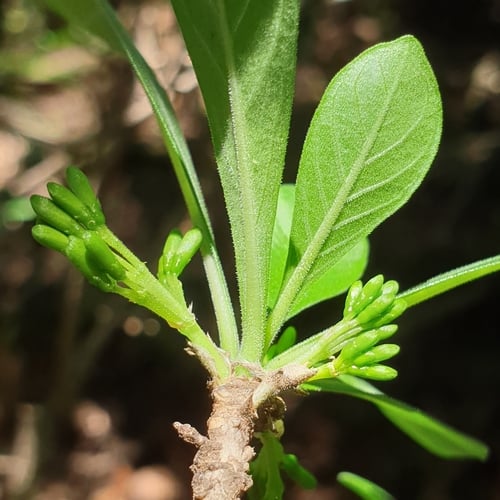
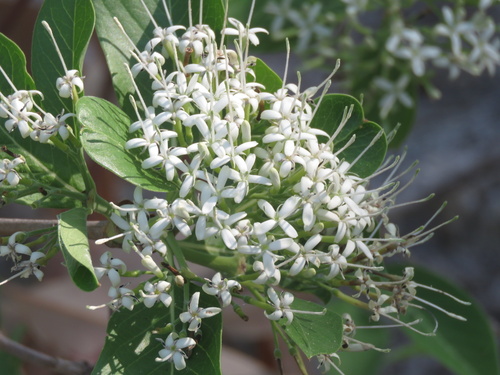
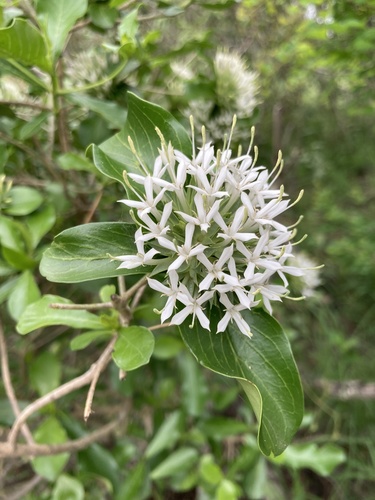
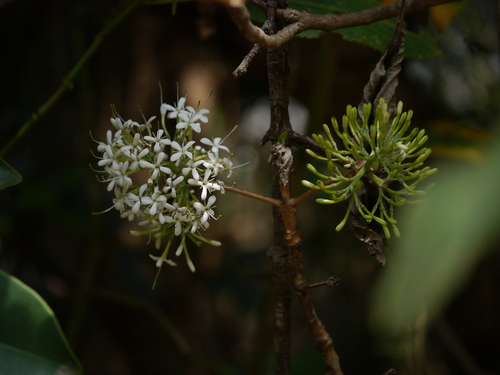
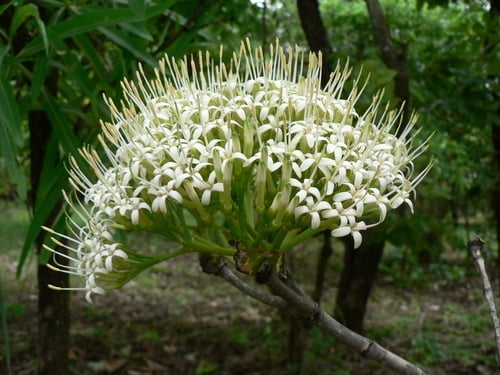
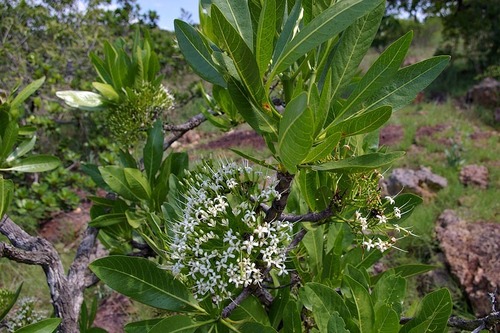
A shrub or small tree. It grows up to 8 m high. The young branches are 4 angled. They are hairy. The leaves are broadly oval and bright green. They are hairy on both surfaces. They are 10-15 cm long by 5-8 cm wide. They have a pointed tip. The flowers are white and in ball-like clusters. The fruit is round and 2 cm across. They appear to have 12 faces to the fruit. They are white when ripe.
Edible Uses
The green fruits are pickled and eaten with curries.
Traditional Uses
The green fruit are pickled and eaten with curries.
This uses section is brief — help expand it
Medicinal Uses
The plant has been extensively used in Thai traditional medicine. In general, the core of wild forest noni (does this mean the trunk?) has been used to treat menstrual disorders, as a tonic for stomach and blood stasis. The fruit is rarely used medicinally because it has an unpleasant smell. However, it has been shown that the beverage produced by fermenting the fruits was able to inhibit enteropathogenic bacteria and also had a high amount of potassium.
Distribution
A tropical plant. They grow in lower hills in Western India.
Where It Grows
Asia, India, Indochina, Indonesia, Malaysia, SE Asia, Thailand,
Other Uses
A dye obtained from the root bark is used for colouring linen and woollen goods. The bark of the root is used for dyeing items red or yellow. The morindone dye obtained from the root bark is sold under the trade name 'Suranji'. It is used for dyeing cotton, silk and wool in shades of red, chocolate or purple. The colouring matter is found principally in the root bark and is collected when the plants reach three to four years of age. The fruit can be fermented with molasses to make a liquid manure. A glycoside, morindin-6-primeveroside, has been obtained from the root bark. This has insecticidal properties and has been found to be lethal to cockroaches and houseflies when applied topically. The handsome wood can be red or yellow with red streaks. It is moderately hard, close-grained and durable. It is used for plates and dishes.
Notes
There are about 80 Morinda species. They grow in the tropics.
Nutrition
| Part | Moisture | kJ | kcal | Protein | Vit A | Vit C | Iron | Zinc |
|---|---|---|---|---|---|---|---|---|
| Fruit | 78.3 | — | — | 0.2 | — | 18.9 | — | — |
References (10)
- Ambasta, S.P. (Ed.), 2000, The Useful Plants of India. CSIR India. p 380
- Bole, P.V., & Yaghani, Y., 1985, Field Guide to the Common Trees of India. OUP p 5 (As Morinda tinctoria)
- Hedrick, U.P., 1919, (Ed.), Sturtevant's edible plants of the world. p 419 (As Morinda tinctoria)
- Kachenchart, B., et al, 2008, Phenology of Edible Plants at Sakaerat Forest. In Proceedings of the FORTROP II: Tropical Forestry Change in a Changing World. Bangkok, Thailand.
- Kaewjampa, N., et al, 2014, Investigation Species of Edible Tree and Medicinal Plants in Faculty of Agriculture, Khon Kaen University. International Journal of Environmental and Rural Development (2014) 5-1
Show all 10 references Hide references
- Kiran, K. C., et al, 2019, Diversity and Seasonal Availability of Potential Wild Edible Plants from Vidarbha Region of Maharashtra State, India. Int.J.Curr.Microbiol.App.Sci (2019) 8(2): 1434-1446 (As Morinda pubescens)
- Mahapatra, A. K., et al, 2012, Nutrient Analysis of some selected wild edible fruits of deciduous forests of India. Advance Journal of Food Science and Technology 4(1):15-21 (As Morinda tinctoria)
- Pullaiah, Y., Krishnamurthy, K. V. & Bahadur, B., (Eds.), 2016, Ethnobotany of India, Volume 1: Eastern Ghats and Deccan. (As Morinda pubescens)
- Reddy, K. N. et al, 2007, Traditional knowledge on wild food plants in Andhra Pradesh. Indian Journal of Traditional Knowledge. Vol. 6(1): 223-229 (As Morinda pubescens)
- Singh, H.B., Arora R.K.,1978, Wild edible Plants of India. Indian Council of Agricultural Research, New Delhi. p 77 (As Morinda tinctoria)