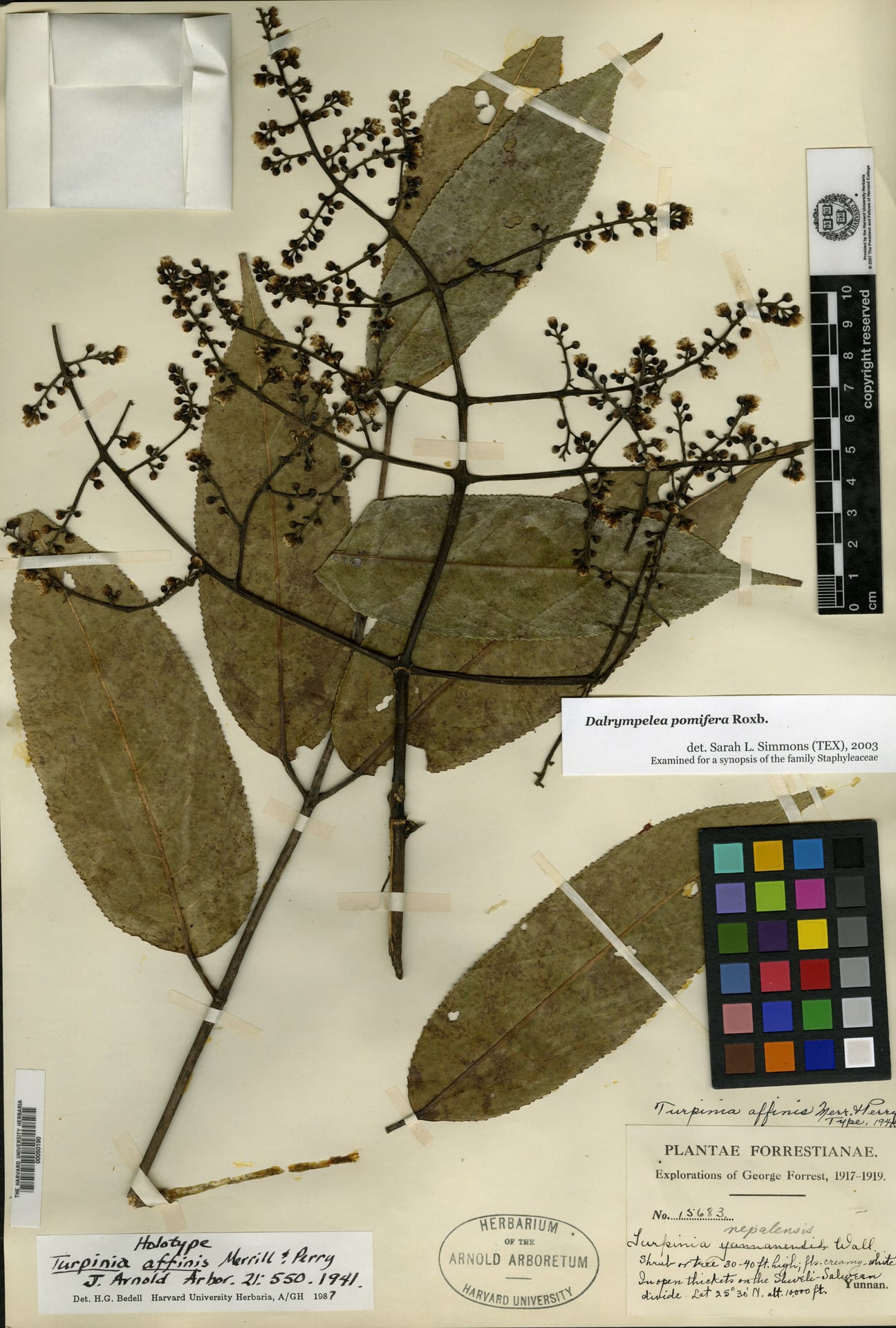
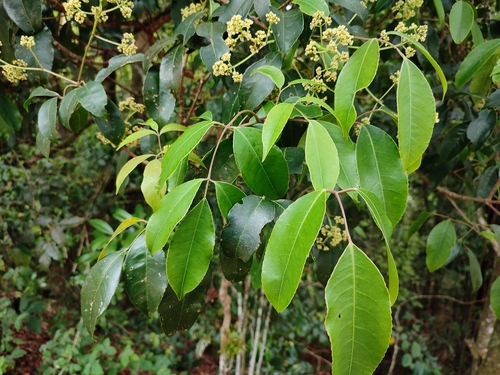
Turpinia pomifera
Wall. ex DC.
iNaturalist· cc-by-nc
(c) mfi, some rights reserved (CC BY-NC)
iNaturalist· cc-by-nc
(c) mfi, some rights reserved (CC BY-NC)
iNaturalist· cc-by-nc
(c) mfi, some rights reserved (CC BY-NC)
Description
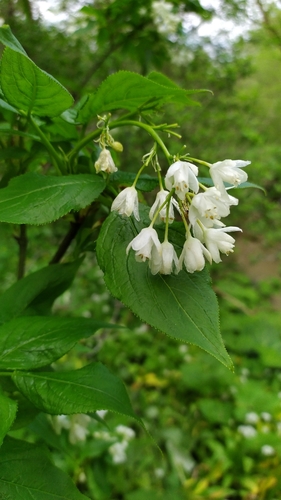
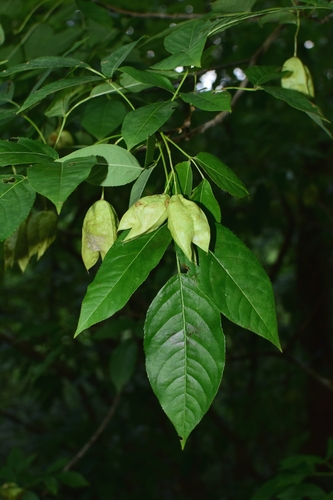
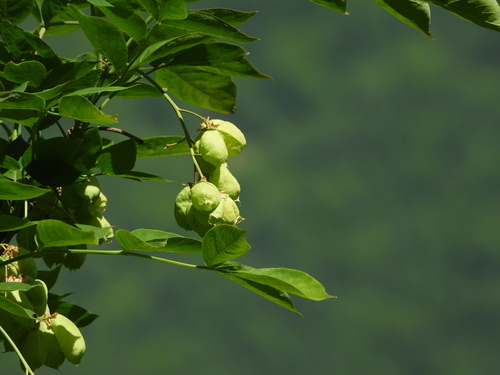
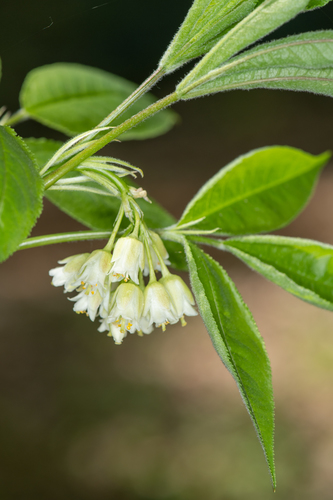
A fairly large tree. It grows 13 m high. The trunk is short and the crown is irregular. The bark is creamy brown and smooth but becomes cracked near the base with age. The leaves have an odd number of leaflets. They are opposite and in 2 rows. They are 9-20 cm long by 4-7 cm wide. They have irregular sharp teeth. The flowers are 6-8 mm across and greenish-white. They are in branched clusters in the upper axils of the leaves. The fruit is 2-5 cm across and pale yellowish green. They are round or with irregular lumps.
Edible Uses
The fruit are eaten.
Distribution
It is a tropical plant. It is a common under-storey tree in both evergreen and deciduous forest. In north Thailand it grows between 350-1,700 m above sea level. In Yunnan.
Where It Grows
Asia, Bhutan, China, Himalayas, India, Indochina, Indonesia, Laos, Malaysia, Nepal, Northeastern India, SE Asia, Sikkim, Thailand, Vietnam,
Synonyms
Also Known As
Banchet, Bangkong, Bangkongan, Boldekim, Bonkeseru, Dieng-soh-kei, Dieng-soh-long-anthri, Gerenyong, Geretak, Gobarkhutla, Gong majaching, Janoki-jamun, Jonaki jam, Kabau bukit, Kathamari, Makok phraan, Margut, Mota-amari, Nagpat, Pani-leteku, Singnok, Takre shein, Thaisramphang, Thali
References (12)
- Ambasta, S.P. (Ed.), 2000, The Useful Plants of India. CSIR India. p 657
- Anderson, E. F., 1993, Plants and people of the Golden Triangle. Dioscorides Press. p 223
- Burkill, I.H., 1966, A Dictionary of the Economic Products of the Malay Peninsula. Ministry of Agriculture and Cooperatives, Kuala Lumpur, Malaysia. Vol 2 (I-Z) p 2234
- Gardner, S., et al, 2000, A Field Guide to Forest Trees of Northern Thailand, Kobfai Publishing Project. p 140
- Majumdar, K and Datta, N., 2009, Traditional wild edible fruits for the forest dwellers of Tripura, India. Pleione 3(2) 167-178
Show all 12 references Hide references
- Murtem, G. & Chaudhrey, P., 2016, An ethnobotanical note on wild edible plants of Upper Eastern Himalaya, India. Brazilian Journal of Biological Sciences, 2016, v. 3, no. 5, p. 63-81.
- NYBG herbarium "edible"
- Savita, et al, 2006, Studies on wild edible plants of ethnic people in east Sikkim. Asian J. of Bio Sci. (2006) Vol. 1 No. 2 : 117-125
- Singh, H.B., Arora R.K.,1978, Wild edible Plants of India. Indian Council of Agricultural Research, New Delhi. p 73
- Singh, V. B., et al, (Ed.) Horticulture for Sustainable Income and Environmental Protection. Vol. 1 p 220
- Sundriyal, M., et al, 1998, Wild edibles and other useful plants from the Sikkim Himalaya, India. Oecologia Montana 7:43-54
- Wild edible plants of Himachal Pradesh