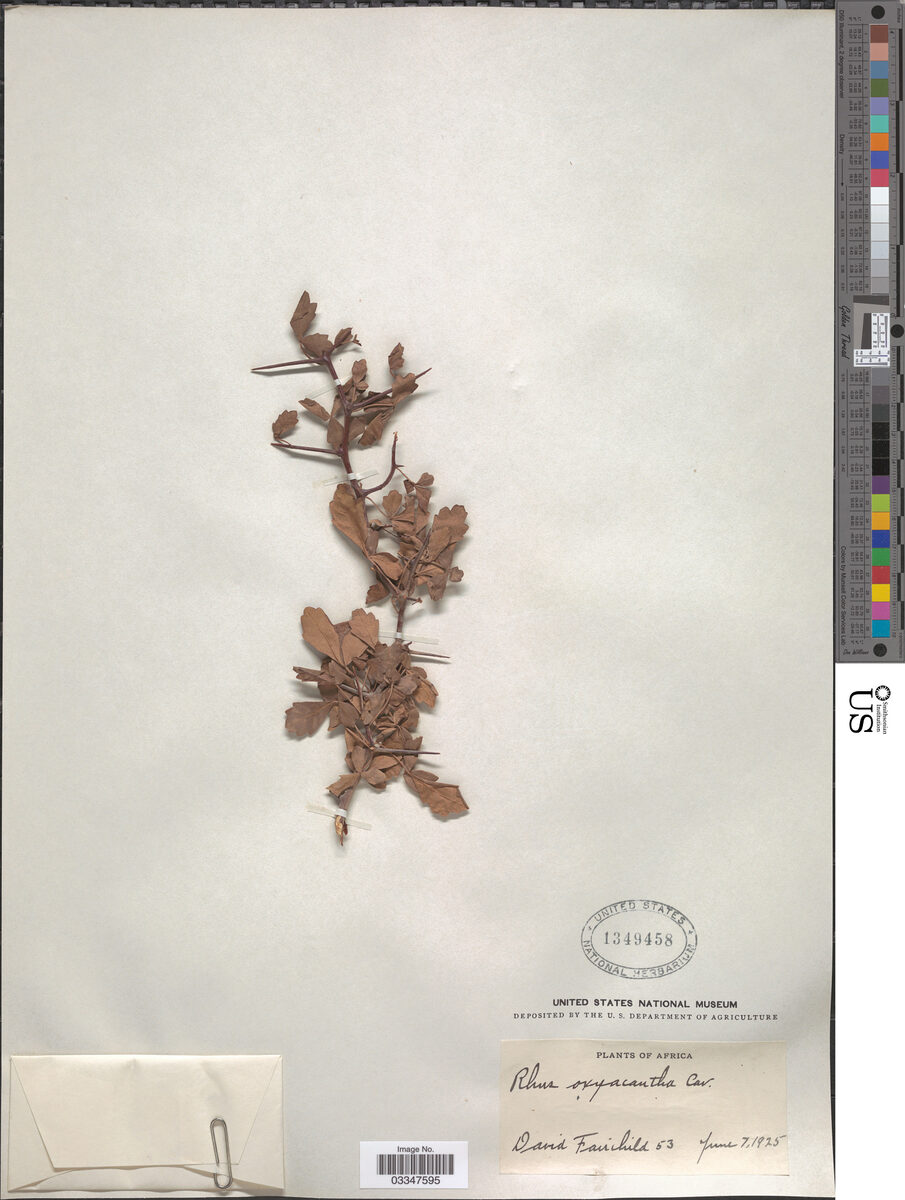
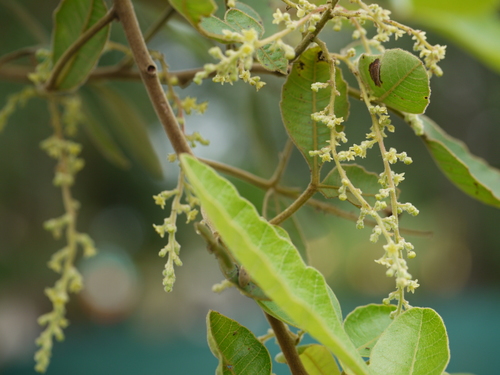
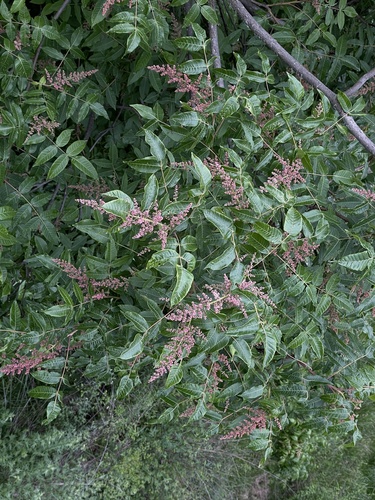
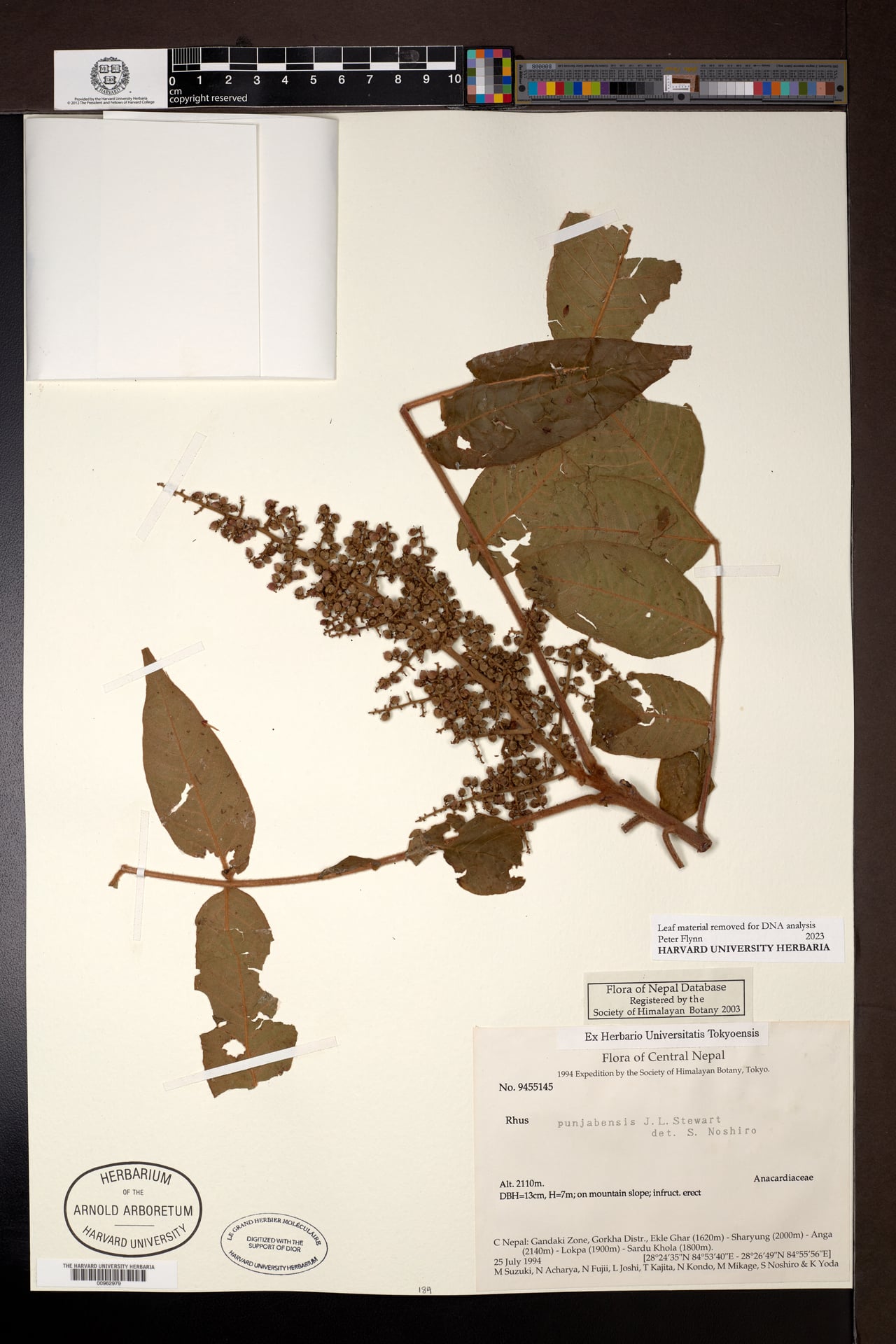
Mangifera sylvatica
Roxburgh
Winter mango
iNaturalist· cc-by-nc
(c) Aparajita Datta, some rights reserved (CC BY-NC), uploaded by Aparajita Datta
iNaturalist· cc-by-nc-sa
(c) Phuentsho, some rights reserved (CC BY-NC-SA), uploaded by Phuentsho
Summary
Source: WikipediaMangifera sylvatica, also known as the Himalayan mango, pickling mango, or Nepal mango, is a species of plant in the family Anacardiaceae. It is found in Bangladesh, Cambodia, China (Yunnan), India (Assam, Darjeeling, Sikkim), Myanmar, Nepal, Bhutan and Thailand. It is a tree 6–20 m (20–66 ft) tall. The fruit measures 6 cm–8 cm × 4 cm–5 cm (2.4 in–3.1 in × 1.6 in–2.0 in).
Description
A large tree. It grows 20-45 m tall. The leaves are stiff. They are 15-20 cm long and 3-6 cm wide. The flowers are yellow, pink or red. They do not have an odour. They are in groups at the ends of branches. The fruit are yellow. They are 8-16 cm long. There are both sweet and tart kinds. The fruit hang on the tree in winter.
Edible Uses
Unripe fruit are sliced and used for tarts, pickles, jellies, and curries—they are acidic. Ripe fruit are eaten raw like mangoes.
Traditional Uses
The unripe fruit are used for tarts, pickles and jellies. They are used in curries. They are sliced. They are acidic. The ripe fruit are eaten raw like mangoes.
Medicinal Uses
The dried fruit is used medicinally.
Distribution
A tropical plant. They grow in the humid tropics. It is native to the eastern Himalayas. It grows in forests along streams in southern China. In Sikkim it grows between 500-1,000 m above sea level. In Yunnan.
Where It Grows
Andamans, Asia, Bangladesh, Bhutan, Cambodia, China, Himalayas, India, Indochina, Laos, Myanmar, Nepal, Northeastern India, SE Asia, Sikkim, Thailand,
Other Uses
The wood is a source of 'machang' timber. We do not have a specific description for the wood of this speices, but a general description of machang timber is as follows:- The heartwood is light brown or light grey brown, occasionally with chocolate or black streaky coreword; it is not clearly differentiated from the wide band of sapwood. The texture is moderately coarse to coarse and even; the grain interlocked and wavy. The wood is moderately heavy to heavy; moderately hard; not durable under exposed conditions, being susceptible to fungi, dry wood borers and termites. The wood seasons somewhat rapidly with only a slight risk of checking or distortion; once dry it is moderately stable in service. It can be worked with ordinary tools, there is a slight difficulty resawing when green, but is easy when dry; planing is easy but the surface produced is moderately smooth with grain pick-up on the radial side; nailing and screwing is excellent; gluing is correct. The wood is suitable for light construction, turnery, flooring, interior panelling, boxes, crates, pallets and plywood manufacture. Corewood can be used for decorative veneer production.
Production
In SE Asia plants flower January to March and September to October and fruit May to June and December to January. A tree can produce 50 kg of fruit a year.
Notes
There are about 40 Mangifera species.
Also Known As
Aanp, Amtsukuli, Arem titi, Ban-am, Bon am, Chetchetsu, Chuchche aarp, Chuche anp, Chuckey amp, Chuchiam, Dong lao miu, Gam thaihai, Haibamin, Hnamba chi, Jangali aamp, Jangli, Jat aam, Jharbuo aam, Jungali amp, Kathorkung, Kho-maeng-saa, Lagulamjio, Lakshi am, Lakshmi am, Mak-mong-sang-yip, Mamen, Mamnang ki tai, Mamuang paep, Mong wo, Motum toggu, Siminthayet, Sinna-thayet, Som muang kluai, Tagol, Tagung, Taw-thayet, Thaichual, Thaiju mairong, Uriaam, Uri am, Vekek, Yumrang kedi
References (45)
- Ambasta, S.P. (Ed.), 2000, The Useful Plants of India. CSIR India. p 354
- Angami, A., et al, 2006, Status and potential of wild edible plants of Arunachal Pradesh. Indian Journal of Traditional Knowledge 5(4) October 2006, pp 541-550
- BARC, 2016, State of Biodiversity for Food and Agriculture in Bangladesh. Bangladesh Agricultural Research Council.
- Chayamarit, K., 1994, Preliminary Checklist of the Family Anacardiaceae in Thailand. Thai For. Bull. 22:1-25
- Cao, Y., et al, 2020, Ethnobotanical study on wild edible plants used by three trans-boundary ethnic groups in Jiangcheng County, Pu’er, Southwest China. Journal of Ethnobiology and Ethnomedicine (2020) 16:66
Show all 45 references Hide references
- Das, S. and Mohiuddin, M., 2012, Gender role in Home Garden Management in the Indigenous Community: A case study in Bandarban Hill District, Bangladesh. International Journal of Social Forestry. 5(1):22-37
- Dobriyal, M. J. R. & Dobriyal, R., 2014, Non Wood Forest Produce an Option for Ethnic Food and Nutritional Security in India. Int. J. of Usuf. Mngt. 15(1):17-37
- Fl. ind. 2:438. 1824
- Gardner, S., et al, 2000, A Field Guide to Forest Trees of Northern Thailand, Kobfai Publishing Project. p 143
- Gautam, R. S., et al, 2020, Wild Edible Fruits of Nepal. Int. J. Appl. Sci. Biotechnol. Vol 8(3): 289-304
- Gautam, R. S., et al, 2022, Ethnobotanical Review of Wild Edible Plants of Nepal. Journal of Natural History Museum Volume 32, 2021-22 p 102
- Ghimeray, A. K., Lamsal, K., et al, 2010, Wild edible angiospermic plants of the Illam Hills (Eastern Nepal) and their mode of use by local community. Korean J. Pl. Taxon. 40(1)
- Ghorbani, A., et al, 2012, A comparison of the wild food plant use knowledge of ethnic minorities in Naban River Watershed Nature Reserve, Yunnan, SW China. Journal of Ethnobiology and Ethnomedicine; 8:17
- Hazarika, B. et al. (2020). An overview of the unexplored underutilized fruit crops of Assam, India. Journal of Applied and Natural Science, 12(3): 442 - 453
- Hedrick, U.P., 1919, (Ed.), Sturtevant's edible plants of the world. p 401
- Hu, Shiu-ying, 2005, Food Plants of China. The Chinese University Press. p 518
- Jin, Chen et al, 1999, Ethnobotanical studies on Wild Edible Fruits in Southern Yunnan: Folk Names: Nutritional Value and Uses. Economic Botany 53(1) pp 2-14
- Karki, S., et al, 2017, Minor Fruits in Nepal: Utilization and Conservation Efforts. Proceedings of 2nd National Workshop on CUAPGR, 2017.
- Lungphi, P., Wangpan, T. & Tangjang, S., 2018, Wild edible plants and their additional uses by the Tangsa community living in the Changlang district of Arunachal Pradesh, India. Pleione 12(2): 151 - 164. 2018.
- Luo, B., et al, 2019, Wild edible plants collected by Hani from terraced rice paddy agroecosystem in Honghe Prefecture, Yunnan, China. Journal of Ethnobiology and Ethnomedicine 15:56
- Majumdar, K and Datta, N., 2009, Traditional wild edible fruits for the forest dwellers of Tripura, India. Pleione 3(2) 167-178
- Manju, S., and Sundriyal, R. C., 2001, Wild Edible Plants of the Sikkim Humalaya: Nutritive Values of Selected Species. Economic Botany 55(3): 377-390
- Medhi, P. & Borthakur, S. K., 2012, Phytoresources from North Cachur Hills of Assam -3: Edible plants sold at Hflong market. Indian Journal of Natural Products and Resources. 3(1) pp 84-109
- Medhi, P., Sarma, A and Borthakur, S. K., 2014, Wild edible plants from the Dima Hasao district of Assam, India. Pleione 8(1): 133-148
- Morton, J. F., 1987, Fruits of Warm Climates. Wipf & Stock Publishers p 237
- Mozhui, R., et al, 2011, Wild edible fruits used by the tribals of Dimapur district of Nagaland, India. Pleione 5(1): 56 - 64.
- Mukhia, P.K., et al, 2013, Wild plants as Non Wood Forest Products used by the rural community of Dagana, a southern foothill district of Bhutan, SAARC Journal, 27 pages
- Murtem, G. & Chaudhrey, P., 2016, An ethnobotanical note on wild edible plants of Upper Eastern Himalaya, India. Brazilian Journal of Biological Sciences, 2016, v. 3, no. 5, p. 63-81.
- Natuhara, Y., et al, 2011, Uses of trees in paddy fields in Champasak Province, Southern Lao PDR. Landscape and Ecological Engineering. p 6
- Pasha, M. K. & Uddin, S. B., 2019, Minor Edible Fruits of Bangladesh. Bangladesh J. Plant Taxon. 26(2): 299–313
- Patiri, B. & Borah, A., 2007, Wild Edible Plants of Assam. Geethaki Publishers. p 32
- Paul, A., 2013, Minor and uncultivated fruits of Eastern India, 2nd International Symposium on Minor Fruits and Medicinal Plants
- Pegu, R., et al, 2013, Ethnobotanical study of Wild Edible Plants in Poba Reserved Forest, Assam, India. Research Journal of Agriculture and Forestry Sciences 1(3):1-10
- Phangchopi, U., et al, 2015, Diversity of wild edible plants in Marat Longri Wildlife Sanctuary, Assam. Indian Journal of Natural Products and Resources Vol. 6(4), December 2015 pp. 305-313
- PROSEA No. 2
- Savita, et al, 2006, Studies on wild edible plants of ethnic people in east Sikkim. Asian J. of Bio Sci. (2006) Vol. 1 No. 2 : 117-125
- Shin, T., et al, 2018, Traditional knowledge of wild edible plants with special emphasis on medicinal uses in Southern Shan State, Myanmar. Journal of Ethnobiology and Ethnomedicine (2018) 14:48
- Singh, H.B., Arora R.K.,1978, Wild edible Plants of India. Indian Council of Agricultural Research, New Delhi. p 66, 76
- Singh, V. B., et al, (Ed.) Horticulture for Sustainable Income and Environmental Protection. Vol. 1 p 217
- Sundriyal, M., et al, 1998, Wild edibles and other useful plants from the Sikkim Himalaya, India. Oecologia Montana 7:43-54
- Sundriyal, M., et al, 2004, Dietary Use of Wild Plant Resources in the Sikkim Himalaya, India. Economic Botany 58(4) pp 626-638
- Sundriyal, M. & Sundriyal, R. C., 2004, Structure, Phenology, Fruit Yield, and Future Prospects of some Prominent Wild Edible Plant Species of the Sikkim Himalaya, India. Journal of Ethnobiology 24(1): 113-138
- Taram, M., et al, 2018, Wild Food Plant Resources of Komkar Adi Tribe of Upper Siang District in Arunachal Pradesh, India. Bulletin of Arunachal Forest Research, Vol. 33(2), 27-35
- Thitiprasert, W., et al, 2007, Country report on the State of Plant Genetic Resources for Food and Agriculture in Thailand (1997-2004). FAO p 95
- Uprety, Y., et al, 2016, Traditional use and management of NTFPs in Kangchenjunga Landscape: implications for conservation and livelihoods. Journal of Ethnobiology and Ethnomedicine (2016) 12:19