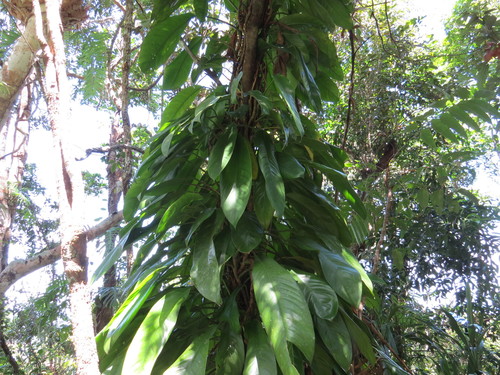
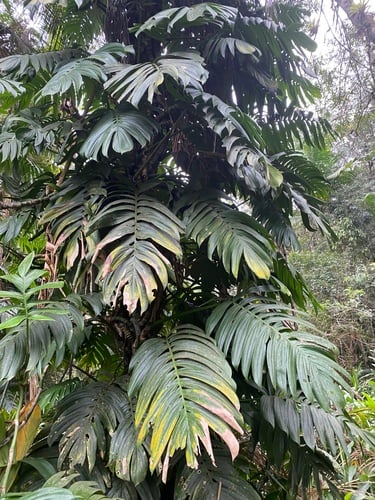
Remusatia vivipara
(Roxb.) Schott.
Hitchhiker elephant ear
iNaturalist· cc-by-nc
(c) shaunplumtree, some rights reserved (CC BY-NC), uploaded by shaunplumtree
iNaturalist· cc-by-sa
(c) Dinesh Valke, some rights reserved (CC BY-SA)
iNaturalist· cc-by-sa
(c) Dinesh Valke, some rights reserved (CC BY-SA)
Summary
Source: WikipediaRemusatia vivipara also called hitchhiker elephant ear is a perennial herb growing up to 50 cm tall in the genus Remusatia. It is widespread throughout the world, growing in temperate climates.
Description
A herb which forms tubers. These are 2-4 cm across. It grows to about 30-50 cm high. It keeps growing from year to year. The leaves have long stalks. These can be 30-50 cm long. The leaves are simple and 21-40 cm long by 15-18 cm wide. The leaves are almost round and taper to the tip. The leaves can be purple underneath. The bract around the flower is pinkish. The flower is a spike. This is about 17 cm long.
Edible Uses
Tubers are edible when cooked very thoroughly either by roasting or boiling to deactivate the oxalate crystals. They are eaten in Dhofar with clarified butter or buttermilk and eaten in India added to curries.
Traditional Uses
The young leaves are cooked as a vegetable. The tubers are also cooked as a vegetable. (They need to be boiled often in a change of water to get rid of irritating crystals otherwise they are poisonous. ) They are often cooked for a long time. They are also dried and stored.
Distribution
A tropical plant. It grows in humid tropical and subtropical places. In Nepal it grows between 1000-2600 m altitude. It grows in moist, shady places. It usually grows on trees. Coffs Harbour Botanical Gardens. In Yunnan.
Where It Grows
Africa, Asia, Australia, Bangladesh, Bhutan, China, Guinea, Guinée, Guinea-Bissau, Himalayas, India, Indochina, Indonesia, Laos, Madagascar, Middle East, Myanmar, Nepal, Oman, Pacific, SE Asia, Sri Lanka, Taiwan, Thailand, Tibet, Vietnam, West Africa,
Cultivation
Plants are grown from seed or by splitting the rhizome. It can be grown by bulbils of the shoots.
Notes
There are 4 Remusatia species.
Synonyms
Also Known As
Aloo, Fyaksa, Jaluka, Jaluko, Kalo pidalu, Marachembu, N'pablea, Ri-bo-srong, Rukhalu, Sereng saru, Umpablea
References (17)
- Ambasta S.P. (Ed.), 2000, The Useful Plants of India. CSIR India. p 518
- Aryal, K. P. et al, 2009, Uncultivated Plants and Livehood Support - A case study from the Chepang people of Nepal. Ethnobotany Research and Applications. 7:409-422
- Checklist of NT Vascular Plant Species. January 2003.
- Cooper, W. and Cooper, W., 2004, Fruits of the Australian Tropical Rainforest. Nokomis Editions, Victoria, Australia. p 61
- Dangol, D. R. et al, 2017, Wild Edible Plants in Nepal. Proceedings of 2nd National Workshop on CUAOGR, 2017.
Show all 17 references Hide references
- Gautam, R. S., et al, 2022, Ethnobotanical Review of Wild Edible Plants of Nepal. Journal of Natural History Museum Volume 32, 2021-22 p 104
- Hibbert, M., 2002, The Aussie Plant Finder 2002, Florilegium. p 245
- Li, S., et al, 2020, Monpa, memory, and change: an ethnobotanical study of plant use in Mêdog County, South-east Tibet, China. Journal of Ethnobiology and Ethnomedicine. (2020) 16:5 p 16
- Manandhar, N.P., 2002, Plants and People of Nepal. Timber Press. Portland, Oregon. p 392
- Marwah, R. G., et al, 2006, Antioxidant capacity of some edible and wound healing plants in Oman. Journal of Food Chemistry.
- Miller, A. G., Morris, M. & Stuart-Smith, S., 1988, Plants of Dhofar. The Southern Region of Oman, Traditional, Economic and Medicinal Uses. Sultanate of Oman. p 38
- Misra, R. C., et al, 2013, Genetic resources of wild tuberous food plants traditionally used in Similipal Biosphere Reserve, Odisha, India. Genetic Resources and Crop Evolution. Vol. 60 No. 2. Springer
- Narayanan Ratheesh, M. K. et al, 2011, Wild edible plants used by the Kattunaikka, Paniya and Kuruma tribes of Wayanad District, Kerala, India. Journal of Medicinal Plants Research Vol. 5(15), pp. 3520-3529
- Sharma, B.D., & Lakshminarasimhan, P., 1986, Ethnobotanical Studies on the Tribals of Nasik District (Maharashtra). J. Econ. Tax. Bot. Vol. 8 No. 2 pp 439-446
- Singh, H.B., Arora R.K.,1978, Wild edible Plants of India. Indian Council of Agricultural Research, New Delhi. p 34
- Uprety, Y., et al, 2012, Diversity of use and local knowledge of wild edible plant resources in Nepal. Journal of Ethnobotany and Ethnomedicine 8:16
- Vartak, V.D. and Kulkarni, D.K., 1987, Monsoon wild leafy vegetables from hilly regions of Pune and neighbouring districts, Maharashtra state. J. Econ. Tax. Bot. Vol. 11 No. 2 pp 331-335