Mollugo cerviana
(L.) Seringe
Voice plant
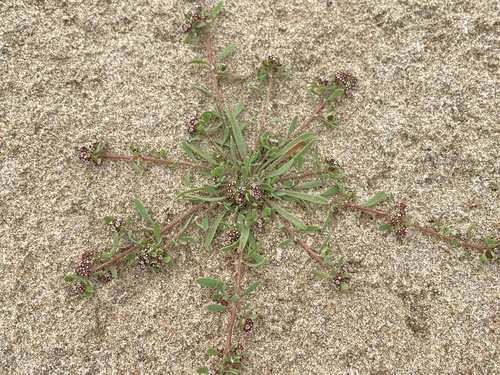
iNaturalist· cc-by
(c) Jim Morefield, some rights reserved (CC BY)
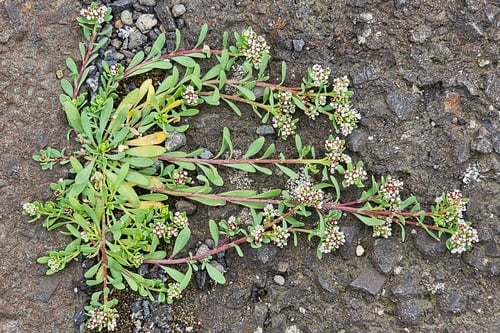
iNaturalist· cc-by
(c) Jim Morefield, some rights reserved (CC BY)
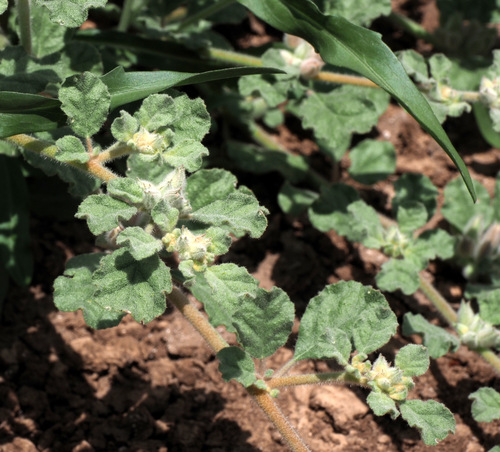
iNaturalist· cc-by-nc
(c) pavelbykau, some rights reserved (CC BY-NC)
Summary
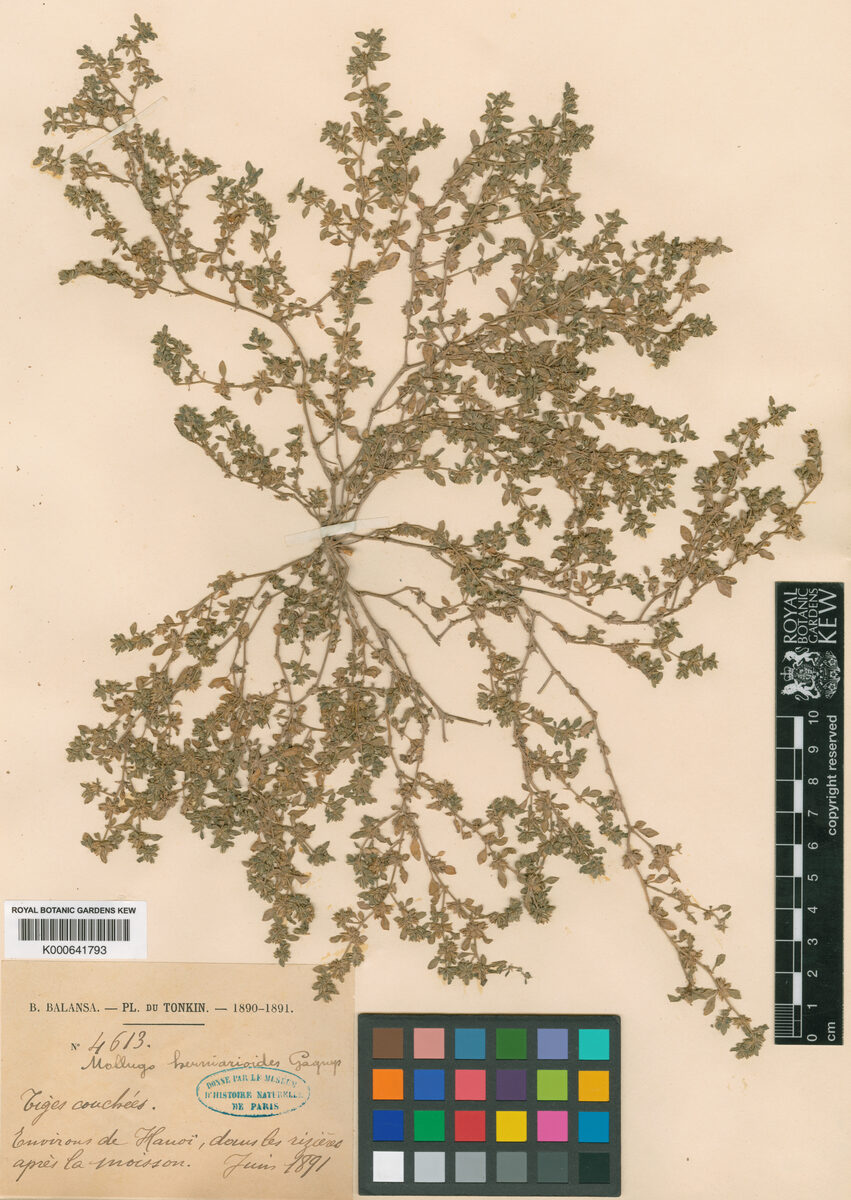
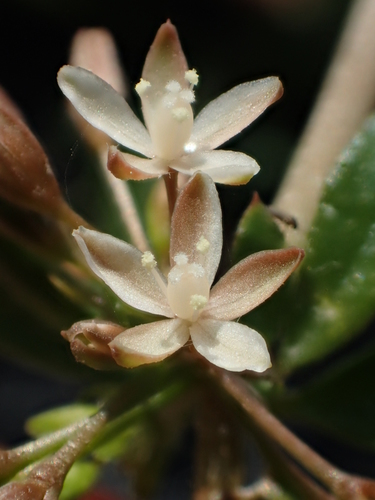
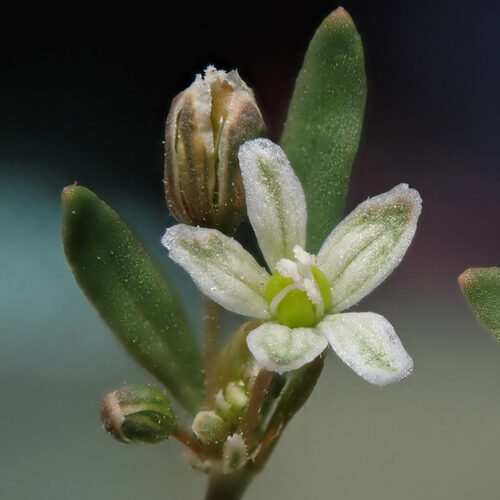
Source: WikipediaMollugo cerviana is a species of flowering plant known by the common name threadstem carpetweed. It can be found on most continents growing as a weed in many types of dry, sandy habitat types. It is an annual herb producing a thin, erect stem up to about 20 centimeters tall. The narrow, waxy leaves are up to 1.5 centimeters long, linear in shape, and arranged in whorls around the stem. The inflorescence is a loose umbel of tiny flowers each made up of whitish, petal-like sepals less than 2 millimeters long, and no true petals.
Description
A small herb. It grows 7-8 cm high. The root is thin. There are many stems which curve upwards. They are thin and stiff. The leaves do not have stalks. The leaves at the base are in a ring. There are 3-10 leaves up the stalk. They are narrow. They are 5-10 mm long by 0.3-0.5 mm wide. The flowering stalks are at the top or in the axils of leaves and in 3 stalked arrangements. These form flat topped clusters. The fruit is a capsule about 2-3 mm long. There are many brown seeds. They are D shaped and about 0.2 mm across.
Edible Uses
Leaves - cooked and used as a vegetable. The tender leaves are chopped and cooked; coconut milk or groundnut paste may be added and then the vegetable is served with a staple such as ugali or rice.
Traditional Uses
The stems and leaves are eaten as a vegetable and in savoury preparations. They are used as potherbs.
This uses section is brief — help expand it
Medicinal Uses
The plant is collected in large quantities, dried, powdered and burnt to put in incisions for the treatment of pleurisy. The plant is often used in the treatment of fevers, bilious fevers and syphilis. The leaf is chewed as a treatment for coughs and also to reduce the effect of a hang-over. The leaves are used as a treatment for stomach ache and constipation.
Distribution
It grows in dry sands and shady wet fields from sea level to 1200 m altitude in N China. It grows in sandy and gravelly places in the Mediterranean. It can grow near salty soils and sand. It grows between 30-2,400 m above sea level. In Zimbabwe it grows between 850-1,400 m above sea level. It grows in hot arid areas with a marked dry season. It can grow in arid places.
Where It Grows
Africa, Albania, Algeria, Angola, Asia, Australia, Balkans, Bangladesh, Benin, Botswana, Bulgaria, Burkina Faso, Central Africa, Central Asia, Chad, China, Congo DR, Djibouti, East Africa, Ecuador, Eritrea, Europe, Gambia, Germany, Ghana, Greece, Guinea, Guinée, India, Iran, Italy, Kazakhstan, Kenya, Lesotho, Madagascar, Malawi, Mali, Mauritania, Mauritius, Mediterranean, Mexico, Middle East, Mongolia, Morocco, Mozambique, Myanmar, Namibia, Niger, Nigeria, North Africa, North America, Oman, Pakistan, Peru, Portugal, Reunion, Romania, Russia, Sahara, Sahel, Saudi Arabia, SE Asia, Senegal, Siberia, Spain, Socotra, South Africa, Southern Africa, Spain, Sri Lanka, Sudan, Tanzania, Togo, Tunisia, Turkey, Türkiye, Uganda, Ukraine, Venezuela, West Africa, Yemen, Zambia, Zimbabwe,
Cultivation
Plants can be grown from seeds or cuttings.
Production
Leaves are collected during the rainy season.
Notes
There are about 35 Mollugo species. They are mostly in tropical and subtropical regions. There are 8 Mollugo in tropical America.
Synonyms
Also Known As
Ghimasak, Ilolompya, Kakotongo, Kibogaboga, Okaxungu, Pada, Parpadagam, Parpatakamu, Runkerenkere, Xiang ye su mi cao
References (20)
- Al-Sodany, Y. M., et al, 2013, Medicinal Plants in Saudi Arabia: I. Sarrwat Mountains at Taif, KSA. Academic Journal of Plant Sciences 6 (4): 134-145
- Ambasta, S.P. (Ed.), 2000, The Useful Plants of India. CSIR India. p 377
- Arora, R. K., 2014, Diversity in Underutilized Plant Species - An Asia-Pacific Perspective. Bioversity International. p 42
- Blamey, M and Grey-Wilson, C., 2005, Wild flowers of the Mediterranean. A & C Black London. p 43
- A. P. de Candolle, Prodr. 1:392. 1824
Show all 20 references Hide references
- Flora of Pakistan. www.eFloras.org
- Grubben, G. J. H. and Denton, O. A. (eds), 2004, Plant Resources of Tropical Africa 2. Vegetables. PROTA, Wageningen, Netherlands. p 563
- Jardin, C., 1970, List of Foods Used In Africa, FAO Nutrition Information Document Series No 2.p 90
- Lu De-quan, Hartmann,H.E.K., Molluginaceae. Flora of China.
- Morley, B.D., & Toelken, H.R., (Eds), 1983, Flowering Plants in Australia. Rigby. p 73
- Paczkowska, G . & Chapman, A.R., 2000, The Western Australian Flora. A Descriptive Calatogue. Western Australian Herbarium. p 331
- Peters, C. R., O'Brien, E. M., and Drummond, R.B., 1992, Edible Wild plants of Sub-saharan Africa. Kew. p 46
- Pullaiah, Y., Krishnamurthy, K. V. & Bahadur, B.(Eds.), 2016, Ethnobotany of India, Volume 1: Eastern Ghats and Deccan.
- Rodin, 1985,
- Royal Botanic Gardens, Kew (1999). Survey of Economic Plants for Arid and Semi-Arid Lands (SEPASAL) database. Published on the Internet; http://www.rbgkew.org.uk/ceb/sepasal/internet [Accessed 4th May 2011]
- Ruffo, C. K., Birnie, A. & Tengnas, B., 2002, Edible Wild Plants of Tanzania. RELMA p 472
- Ruiters-Welcome, A. K., 2019, Food plants of southern Africa. Ph.D. thesis. Univ. of Johannesburg p 79 (As Hypertelis)
- Singh, H.B., Arora R.K.,1978, Wild edible Plants of India. Indian Council of Agricultural Research, New Delhi. p 31
- Welcome, A. K. & Van Wyk, B.-E., 2019, An inventory and analysis of the food plants of southern Africa. South African Journal of Botany 122 (2019) 136–179
- World Checklist of Useful Plant Species 2020. Royal Botanic Gardens, Kew (As Hypertelis cerviana)