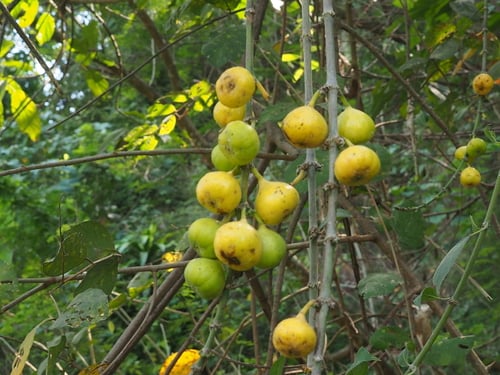
Ficus lutea
Vahl
Giant-leaved fig
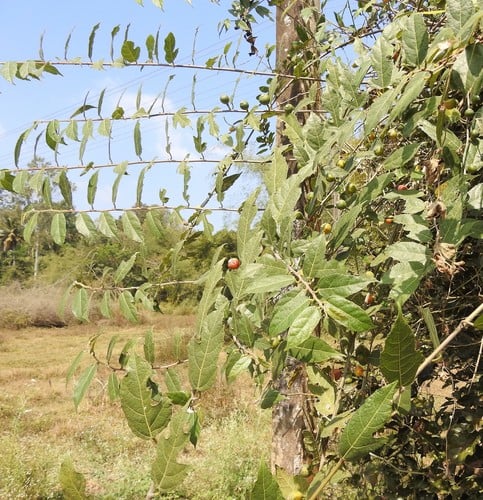
iNaturalist· cc-by-nc
(c) Peter Vos, some rights reserved (CC BY-NC), uploaded by Peter Vos
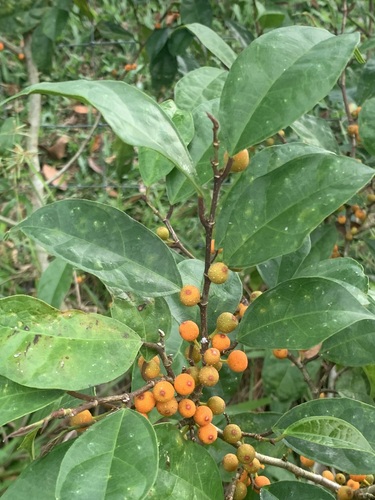
iNaturalist· cc-by
(c) Shaun Swanepoel, some rights reserved (CC BY), uploaded by Shaun Swanepoel
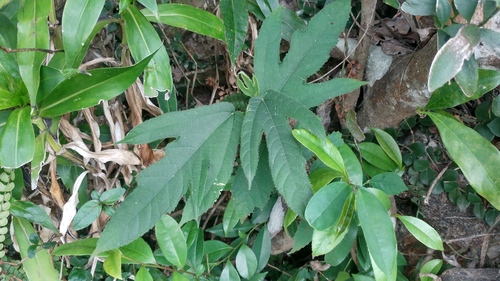
iNaturalist· cc-by-nc
(c) sixgables, some rights reserved (CC BY-NC)
Summary
Source: WikipediaFicus lutea is a medium to large sized deciduous tree in the family Moraceae. It is commonly known as the giant-leaved fig or Lagos rubbertree. These trees occur from the Eastern Cape of South Africa to Tropical Africa.
Description
A strangler fig. It often grows attached to other plants. It can grow to a large tree. It grows 18 m high. It can spread 12 m wide. The trunk can be 3 m around. The crown is very wide and round. It can have aerial roots. The bark is grey brown. The leaves are large and evergreen. The leaves are dark green and slender. They are 38 cm long by 20.5 cm wide. They are crowded near the ends of branches. The leaf stalks are 2-8 cm long. The tip is pointed and the base is rounded. The leaf stalk is 12 cm long. The leaves are in spirals on stout small branches. The figs are small and orange-red when ripe. They are crowded closely together along the ends of the branches. They are 1-1.7 cm across.
Edible Uses
The fruit are eaten as a snack. The leaves are commonly eaten as a vegetable, particularly in Senegal.
Traditional Uses
The fig fruit are eaten as a snack.
This uses section is brief — help expand it
Medicinal Uses
Traditional medicinal uses recorded.
Distribution
A tropical plant. It grows in river forests and woodland. In East Africa it grows from sea level to 2,000 m altitude. It can be in palm groves, on the edges of mangroves and in coastal sands. It grows in areas with a rainfall of 600-1000 mm per year. It grows in the Sahel. It can grow in arid places. It suits hardiness zones 11-12.
Where It Grows
Africa*, Angola, Asia, Australia, Botswana, Burkina Faso, Cameroon, Central Africa, Central African Republic, CAR, East Africa, Eswatini, Ethiopia, Gabon, Ghana, Guinea, Guinée, Guinea-Bissau, Indonesia, Kenya, Madagascar, Malawi, Mozambique, Nigeria, Sahel, Sao Tome and Principe, SE Asia, Senegal, Sierra Leone, South Africa, Southern Africa, Swaziland, Tanzania, West Africa, Zimbabwe,
Cultivation
Plants can be grown by seeds. It can be grown from branch cuttings. Cuttings grow easily.
Propagation
Seed - germinates best at a temperature around 20°c. Sow the seed in containers, only covering them very lightly with compost and firming them down gently. Place in a lightly shaded position, water well, but do not wash the seed away!. Germination times may vary from 10 - 30 days, and after around one week of growth the seedlings are best moved into a sunny position. Pot up into individual containers when large enough to handle. Air layering. Tip cuttings around 4 - 12cm long, taken from lateral branches.
Other Uses
A fibre is obtained from the bark. It is used to make twine. The bark has been used for making bark cloth. A latex is obtained from the tree. It is valued in the pharmaceutical industry, and is used for caulking canoes. The latex can be used to make a good quality rubber, known as Dahomey rubber. The bark is used to obtain red-ochre dyes for raffia and silk textiles. The wood is said to be used as soap. The wood ashes are a source of potash, used when making soap. The wood is used for making bowls.
Production
Plants grow quickly under warm, moist conditions. A fruit can weigh 3 g.
Other Information
The leaves are commonly eaten in Senegal.
Notes
There are about 800-1000 Ficus species. They are mostly in the tropics. There are 120 Ficus species in tropical America.
Nutrition
| Part | Moisture | kJ | kcal | Protein | Vit A | Vit C | Iron | Zinc |
|---|---|---|---|---|---|---|---|---|
| Fruit | 81.2 | 234 | 56 | 0.9 | — | — | — | — |
Synonyms
Also Known As
Amontana, Be lak, Belaque, Bi toge, Bupoco, Cobo, Fugera, Laha, Metololo, Mkuyu, Mumbu, Nekbudu, Ofonto, Ordenae, Ordenal, Pama, Pohon ara daun lebar, Sufa-soto, Tcheguedje, Tcheque-sumo, Tcheque, Vogel's fig, Zulu fig
References (32)
- Abbiw, D.K., 1990, Useful Plants of Ghana. West African uses of wild and cultivated plants. Intermediate Technology Publications and the Royal Botanic Gardens, Kew. p 47 and (Also as Ficus vogelii)
- Ann. Mus. Bot. Lugduno-Batavum 3:288. 1867-1868 ("1867") (As Ficus vogelii)
- Burkill, H. M., 1985, The useful plants of west tropical Africa, Vol. 4. Kew.
- Cundall, P., (ed.), 2004, Gardening Australia: flora: the gardener's bible. ABC Books. p 603
- Dalziel, J. M., 1937, The Useful plants of west tropical Africa. Crown Agents for the Colonies London.
Show all 32 references Hide references
- Dharani, N., 2002, Field Guide to common Trees & Shrubs of East Africa. Struik. p 109
- Djihounouck, Y., et al, 2018, Diversité Et Importance Socio-Economique Des Espèces Fruitières Sauvages Comestibles En Zone Kasa (Sud-Ouest Du Sénégal). European Scientific Journal December 2018 edition Vol.14, No.36 ISSN: 1857 – 7881
- Enum. pl. 2:185. 1805
- Etherington, K., & Imwold, D., (Eds), 2001, Botanica's Trees & Shrubs. The illustrated A-Z of over 8500 trees and shrubs. Random House, Australia. p 327
- FAO, 1988, Traditional Food Plants, FAO Food and Nutrition Paper 42. FAO Rome p 284 (As Ficus vogelii)
- Fioccardi, A., et al, 2022, First phytochemical study of six tree and shrub species with high health-promoting potential from Madagascar: Innovative uses for food and medicinal applications. Scientia Horticulturae 299 (2022) 111010
- Hearne, D.A., & Rance, S.J., 1975, Trees for Darwin and Northern Australia. AGPS, Canberra p Pl 18 ? (As Ficus vogelii)
- INFOODS:FAO/INFOODS Databases
- Jardin, C., 1970, List of Foods Used In Africa, FAO Nutrition Information Document Series No 2.p 136 (As Ficus baronii and p 138 as Ficus vogelii))
- J. Linn. Soc., Bot. 20:262. 1883 (As Ficus baronii)
- Long, C., 2005, Swaziland's Flora - siSwati names and Uses http://www.sntc.org.sz/flora/
- Maydell, H. von, 1990, Trees and shrubs of the Sahel: their characteristics and uses. Margraf. p 283 (As Ficus vogelii)
- Mutie, F. M., et al, 2023, Important Medicinal and Food Taxa (Orders and Families) in Kenya, Based on Three Quantitative Approaches. Plants 2023, 12, 1145
- Palgrave, K.C., 1996, Trees of Southern Africa. Struik Publishers. p 118 (As Ficus vogelii)
- Peters, C. R., O'Brien, E. M., and Drummond, R.B., 1992, Edible Wild plants of Sub-saharan Africa. Kew. p 150
- Ruiters-Welcome, A. K., 2019, Food plants of southern Africa. Ph.D. thesis. Univ. of Johannesburg p 79
- Styger, E., et al, 1999, Indigenous fruit trees of Madagascar: potential components of agroforestry systems to improve human nutrition and restore biological diversity. Agroforestry Systems 46: 289-310
- Sukarya, D. G., (Ed.) 2013, 3,500 Plant Species of the Botanic Gardens of Indonesia. LIPI p 285
- Swaziland's Flora Database http://www.sntc.org.sz/flora
- van Wyk, B, van Wyk, P, and van Wyk B., 2000, Photographic guide to Trees of Southern Africa. Briza. p 153
- Vivien, J., & Faure, J.J., 1996, Fruitiers Sauvages d'Afrique. Especes du Cameroun. CTA p 222
- Wehmeyer, A. S, 1986, Edible Wild Plants of Southern Africa. Data on the Nutrient Contents of over 300 species
- Welcome, A. K. & Van Wyk, B.-E., 2019, An inventory and analysis of the food plants of southern Africa. South African Journal of Botany 122 (2019) 136–179
- White, F., Dowsett-Lemaire, F. and Chapman, J. D., 2001, Evergreen Forest Flora of Malawi. Kew. p 386
- Wilson, A. L. & Downs, C. T., 2012, Fruit nutritional composition and non-nutritive traits of indigenous South African tree species. South African Journal of Botany. 78:30-36
- World Checklist of Useful Plant Species 2020. Royal Botanic Gardens, Kew
- www.figweb.org