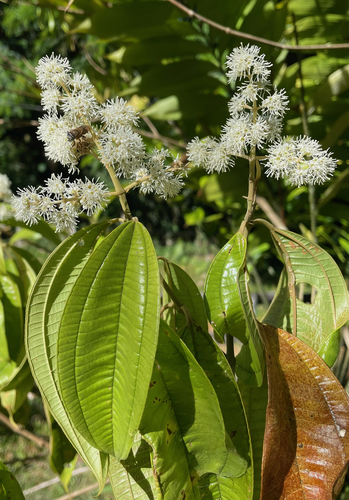
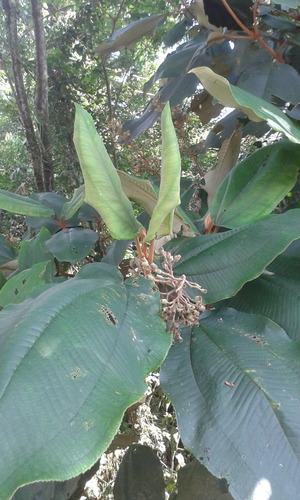
Bellucia grossularioides
(L.) Triana
Mess apple, Big jiggernet
iNaturalist· cc-by-nc-sa
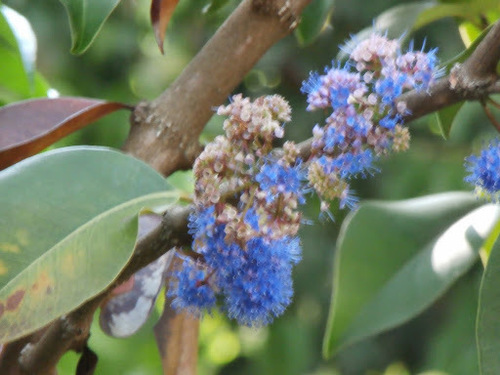
(c) Rich Hoyer, some rights reserved (CC BY-NC-SA), uploaded by Rich Hoyer
iNaturalist· cc-by
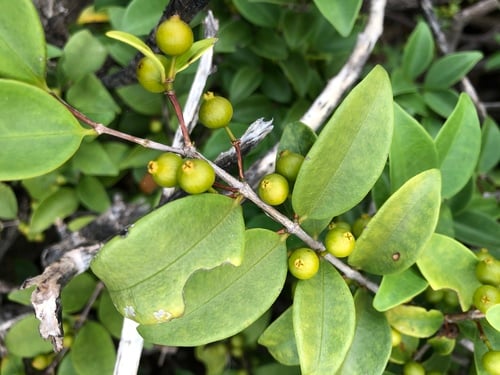
(c) Guillaume Delaitre, some rights reserved (CC BY), uploaded by Guillaume Delaitre
iNaturalist· cc-by-nc
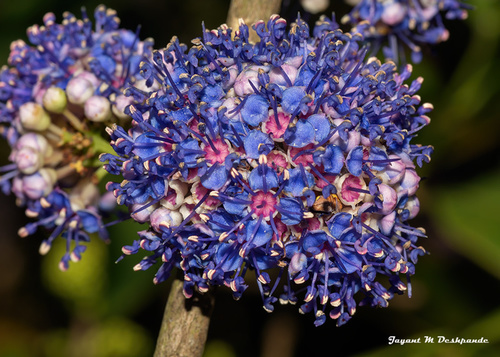
(c) Anderson Mesa C, some rights reserved (CC BY-NC), uploaded by Anderson Mesa C
Description
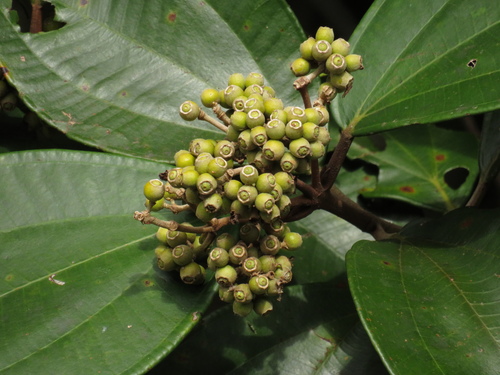
A tree. It grows 6-9 m high. It can grow 30 m tall. The crown is round and dense. The branches are lumpy. The trunk is twisted. It is 30-40 cm across. The leaves are simple and opposite. They are 15-35 cm long by 10-20 cm wide. The leaf stalks are 3-7 cm long. The flowers are on stalks on the stem and are white or pink. They are 3.5 cm across. The fruit is a half round berry. It is 2-3 cm across. The pulp is sweet. There are several seeds.
Edible Uses
Fruit - raw. A thin-skinned fruit with a dense, succulent pulp that has a slightly acidic, pleasant flavour. The pulp contains many small seeds, but these can be swallowed with ease. The fruit might be edible. The fruit is up to 4cm in diameter.
Traditional Uses
The fruit are eaten fresh. They are also used for juice.
This uses section is brief — help expand it
Medicinal Uses
The leaves are used in the treatment of leucorrhoea. The leaves are used in an emollient decoction, combined with the leaves of Capsicum frutescens and Omphalea diandra, to soothe furuncles and to prevent their return. The fruits are anthelmintic. They are used to expel intestinal worms.
Distribution
A tropical plant. It grows in the whole Amazon region. It is most common in dryland secondary forest. It grows from sea level to 400 m altitude.
Where It Grows
Amazon, Belize, Bolivia, Brazil*, Central America, Colombia, Costa Rica, Guatemala, Guiana, Guianas, Guyana, Honduras, Mexico, North America, Panama, Peru, South America, Suriname, Venezuela,
Cultivation
Plants are grown from seed. The ripe fruit are harvested and the fruit allowed to soften in a plastic bag. Because the seeds are small the fruit are crushed in water and this mixture is then used for sowing. The fresh seeds are planted on the surface of the soil. They will germinate in a few days. The seedlings are then planted out separately into containers and then transplanted into the field when 20-30 cm tall.
Propagation
Seed - due to its small size, it is best to place the fruits in plastic bags until the pulp has partially decomposed then mix them with water to make a suspension. Water the soil in a nursery seedbed with this suspension and do not cover the seed, but make sure the soil does not dry out. A moderate rate of germination can be expected, with the seeds sprouting within a few days. Pot up the seedlings into individual containers when they are 4 - 5cm tall and plant out into their permanent positions when they are 20 - 30cm tall.
Other Uses
The bark is a source of tannins. The wood is medium-textured, straight-grained, moderately heavy but not durable. It can be used for making low value items such as pencils, boxes, toys and toothpicks. The wood is used for fuel and making charcoal. A natural pioneer species within its native range, where it can supply large quantities of fruit for the native fauna.
Other Information
The fruit are not much appreciated in some areas and enjoyed in others. Fruit are sold in local markets.
Synonyms
Also Known As
Araca-de-anta, Arbol de manzana, Asakali, Asakari, Bois messe, Camburito, Cara-re-yek, Chiconit, Chiganet, Cimarnon, Coronilla, Coronillo, Goiaba-de-anta, Guayaba, Guayabochi, Guayabo de monte, Huicama, Itara, Kadade, Kobhe, Lebi-mesoepoe, Makasihi, Maya, Mespelboom, Mesproe, Mispel, Mu'y, Nispa, Paja-oedoe, Nispere del monte, Nispero, Pomarosa, Paja-oe-doe, Pumalaca, Pumarosa, Sakwa sepere, Sikararia, Sir-in, Tacarique
References (27)
- Altschul, S.V.R., 1973, Drugs and Foods from Little-known Plants. Notes in Harvard University Herbaria. Harvard Univ. Press. Massachusetts. no. 3093
- Asprilla-Perea, J., & Diaz-Puente, J.M., 2018, Traditional use of wild edible food in rural territories within tropical forest zones: A case study from the northwestern Colombia. New Trends and Issues Proceedings on Humanities and Social Sciences [Online]. 5(1), 162–181.
- Bendezu, Y. F., 2018, Arboles nativos de lad Region Ucayali. Instituto Nacional de Innovacion Agraria. p 199
- Bircher, A. G. & Bircher, W. H., 2000, Encyclopedia of Fruit Trees and Edible Flowering Plants in Egypt and the Subtropics. AUC Press. p 56 (As Bellucia brasiliensis)
- Chizmar Fernandez, C., et al, 2009, Plantas comestibles de Centroamerica. Instituto de Biodiversidad, Costa Rica. p 235
Show all 27 references Hide references
- Grandtner, M. M., 2008, World Dictionary of Trees. Wood and Forest Science Department. Laval University, Quebec, Qc Canada. (Internet database http://www.WDT.QC.ca)
- Grandtner, M. M. & Chevrette, J., 2013, Dictionary of Trees, Volume 2: South America: Nomenclature, Taxonomy and Ecology. Academic Press p 63
- Hedrick, U.P., 1919, (Ed.), Sturtevant's edible plants of the world. p 96 (As Bellucia aubletii, Bellucia brasiliensis)
- Hellmuth, N. M., 2011, Maya Ethnobotany. Complete Inventory of plants. Associacion FLAAR Mesoamerica. Tenth edition.
- Johnson, M. and Colquhoun, A., 1996, Preliminary Ethnobotanical Survey of Kurupukari: An Amerindian Settlement of Central Guyana. Economic Botany, Vol. 50, No. 2, pp. 182-194
- Kermath, B. M., et al, 2014, Food Plants in the Americas: A survey of the domesticated, cultivated and wild plants used for Human food in North, Central and South America and the Caribbean. On line draft. p 126
- Lopez-Diago, D. & Garcia, N., 2021, Wild edible fruits of Colombia. Biota ColomBiana 22 (2) p 42
- Lorenzi, H., 2002, Brazilian Trees. A Guide to the Identification and Cultivation of Brazilian Native Trees. Vol. 02 Nova Odessa, SP, Instituto Plantarum p 245
- Lorenzi, H., Bacher, L., Lacerda, M. & Sartori, S., 2006, Brazilian Fruits & Cultivated Exotics. Sao Paulo, Instituto Plantarum de Estuados da Flora Ltda. p 170
- Maas, P.J. M., Non-timber forest products of the North-West District of Guyana. Part 1. Nationaal Herbarium Nederland, Universiteit Utrecht. p 100
- Maas, P.J. M., Non-Timber Forest Products of the North-West District of Guyana Part 2. The 85 most important NTFP species. p 36
- NYBG herbarium "edible"
- Omawale, 1973, Guyana's edible plants. Guyana University, Georgetown p 14
- Paz, F. S., et al, 2021, Edible Fruit Plant Species in the Amazon Forest Rely Mostly on Bees and Beetles as Pollinators. Journal of Economic Entomology, XX(XX), 2021, 1–13
- Reis, S. V. and Lipp, F. L., 1982, New Plant Sources for Drugs and Foods from the New York Botanical Garden herbarium. Harvard. p 212
- Roa, J. A. G. & Boada, D. S. G., 2018, Fundación para el Fortalecimiento de la Fruticultura y Plantas Alimenticias no Convencionales en Colombia.
- Segura, S., et al, 2018, The edible fruit species in Mexico. Genet Resour Crop Evol (2018) 65:1767–1793
- Trans. Linn. Soc. London 28:141. 1871
- van Roosmalen, M.G.M., 1985, Fruits of the Guianan Flora. Utrecht Univ. & Wageningen Univ. p 275
- Vasquez, R. and Gentry, A. H., 1989, Use and Misuse of Forest-harvested Fruits in the Iquitos Area. Conservation Biology 3(4): 350f
- World Checklist of Useful Plant Species 2020. Royal Botanic Gardens, Kew
- www.proyanomami.org