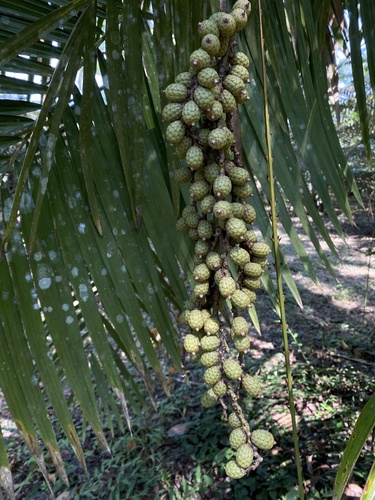
Dypsis baronii
(Becc.) Beentje & J. Dransf.
Sugarcane tree
iNaturalist· cc0
no rights reserved, uploaded by Romer N. Rabarijaona
iNaturalist· cc-by-nc
(c) Norbert Hahn, some rights reserved (CC BY-NC)
iNaturalist· cc-by
(c) Michael A. Alcorn, some rights reserved (CC BY)
Summary
Source: WikipediaDypsis baronii is a species of palm tree in the family Arecaceae. It is often known as sugarcane palm because of the scars on its trunks that resemble sugarcane.
Description
A clustering palm. Usually there are 3-5 clustered together. It grows 2-8 m tall. The trunks are 2.5-12 cm across. They are deep green. There are white or grey widely spaced rings that are from the leaf base scars. The crown-shaft is 25 cm long. It is light grey or yellowish-green and bulges at the base. It is waxy and smooth. There are usually only about 6 leaves in the leaf crown. These are 2 m long. The new leaf stalk is red. The leaves are erect but arching. The leaflets are 25 cm long and stiff. They are deep green. They grow at right angles forming a V shape. The flowering stalk is much branched. The flowers are single sex and brown or white. The fruit are round and 1.3 cm across. They are bright yellow.
Edible Uses
Wild Dypsis baronii is harvested for its edible apical bud and for medicinal purposes. it is grown in Antananarivo and elsewhere as an ornamental.
Traditional Uses
Africa, Australia, East Africa, Madagascar,
This uses section is brief — help expand it
Medicinal Uses
The plant (parts not specified but probably the bark and/or the fruits) is used in the treatment of headaches, jaundice and hepatitis; and also as an aid to lactation.
Distribution
A tropical plant. It grows between 850-1470 m altitude in Madagascar. It can grow in part shade or full sun. It suits Mediterranean climates with little frost. It suits a humus rich well drained soil. In Brisbane Botanical Gardens.
Where It Grows
Moist montane forest and bamboo-dominated forest at elevations from 850 - 1,500 metres, usually on steep slopes, less often on ridge-crests.
Cultivation
It is of local importance.
Propagation
Seeds germinate in 1 - 3 months.
Production
There are 140 Dypsis species. They are all endemic to Madagascar.
Synonyms
Also Known As
Farihazo, Tongalo
References (9)
- Dransfield, J. & Beentje, H., 1995, The Palms of Madagascar. Royal Botanical Gardens, Kew and The International Palm Society. p 198
- Grubben, G. J. H. and Denton, O. A. (eds), 2004, Plant Resources of Tropical Africa 2. Vegetables. PROTA, Wageningen, Netherlands. p 290
- Haynes, J., & McLaughlin, J., 2000, Edible palms and Their Uses. University of Florida Fact sheet MCDE-00-50-1 p 6
- Hibbert, M., 2002, The Aussie Plant Finder 2002, Florilegium. p 90
- Johnson, D.V., 1998, Tropical palms. Non-wood Forest products 10. FAO Rome. p 116
Show all 9 references Hide references
- Palms of Madagascar 198. 1995
- Riffle, R.L. & Craft, P., 2003, An Encyclopedia of Cultivated Palms. Timber Press. p 325
- van der Burg, W.J., 2004. Dypsis baronii (Becc.) Beentje & J.Dransf. [Internet] Record from Protabase. Grubben, G.J.H. & Denton, O.A. (Editors). PROTA (Plant Resources of Tropical Africa), Wageningen, Netherlands. < http://database.prota.org/search.htm>. Accessed 15 October 2009.
- World Checklist of Useful Plant Species 2020. Royal Botanic Gardens, Kew