Syagrus schizophylla
(Mart.) Glassman
Arikury palm
iNaturalist· cc-by-nc
(c) ernesto_sakai, some rights reserved (CC BY-NC)
iNaturalist· cc-by-nc
(c) ernesto_sakai, some rights reserved (CC BY-NC)
iNaturalist· cc-by-nc
(c) ernesto_sakai, some rights reserved (CC BY-NC)
Description
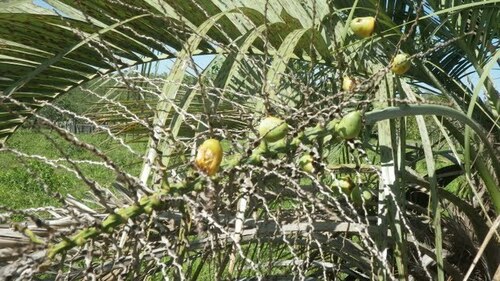
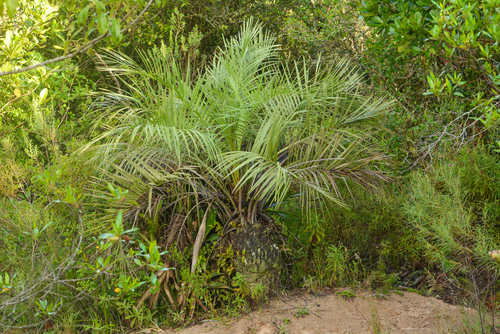
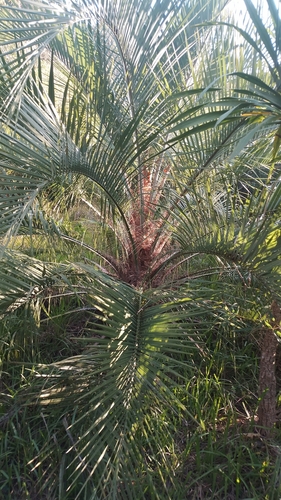
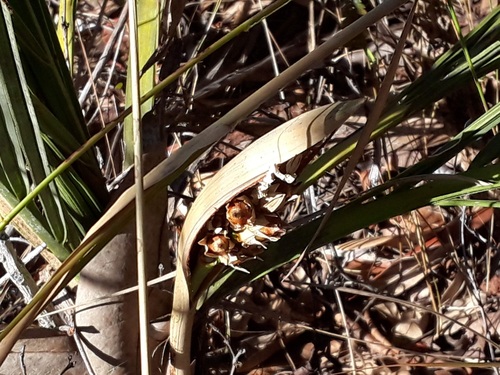
A solitary palm. It sometimes forms clusters. It grows 5 m high. The trunks have leaf bases and fibres. The trunk itself is 15 cm across. The crown is made up of dark green leaves with slender stalks. They arch over and sometimes have a twist. The leaves are 2 m long. The leaves have leaflets along the stalk. The leaves have long black leaf bases which cover the trunk. These are spiny near the base. The flowering stalk produces 2.5 cm long egg shaped fruit. These are reddish-orange. The fruit is edible.
Edible Uses
Fruit - raw. A fibrous, succulent pulp with a pleasant, sweet flavour. The fruit is about 35mm long and 20mm wide.
Traditional Uses
The pulp of the fruit is eaten fresh.
This uses section is brief — help expand it
Medicinal Uses
The juice of the unripe nuts is used in the treatment of ophthalmia.
Known Hazards
The plant cannot tolerate frost or drought.
Distribution
A tropical plant. It will grow in tropical and subtropical places. It is somewhat cold tolerant. It needs protection from direct sun when young. It cannot tolerate frost or drought. It can grow on a range of soils providing they are well drained. In Brisbane Botanical gardens.
Where It Grows
Asia, Australia, Brazil*, Indonesia, SE Asia, South America,
Cultivation
Plants are grown from seed. Seed germinate in about 2 months.
Propagation
Seed - germinates in 2 - 4 months.
Notes
There are about 30 Syagrus species.
Synonyms
Also Known As
Aricuri, Aricuriroba, Licuriroba, Palem ratu arikuri
References (12)
- Balick, M.J. and Beck, H.T., (Ed.), 1990, Useful palms of the World. A Synoptic Bibliography. Colombia p 361 (As Arikuryroba schizophylla),
- Bircher, A. G. & Bircher, W. H., 2000, Encyclopedia of Fruit Trees and Edible Flowering Plants in Egypt and the Subtropics. AUC Press. p 41 (As Arikuryroba capanemae)
- Fieldiana, Bot. 31:386, t. 11. 1968
- Haynes, J., & McLaughlin, J., 2000, Edible palms and Their Uses. University of Florida Fact sheet MCDE-00-50-1 p 13
- Henderson, A., Galeano, G and Bernal, R., 1995, Field Guide to the Palms of the Americas. Princeton. p 148
Show all 12 references Hide references
- Johnson, D.V., 1998, Tropical palms. Non-wood Forest products 10. FAO Rome. p 95
- Jones, D.L., 1994, Palms throughout the World. Smithtonian Institution, Washington. p 362
- Kermath, B. M., et al, 2014, Food Plants in the Americas: A survey of the domesticated, cultivated and wild plants used for Human food in North, Central and South America and the Caribbean. On line draft. p 844
- Lorenzi, H., Bacher, L., Lacerda, M. & Sartori, S., 2006, Brazilian Fruits & Cultivated Exotics. Sao Paulo, Instituto Plantarum de Estuados da Flora Ltda. p 96
- Oliviera V. B., et al, 2012, Native foods from Brazilian biodiversity as a source of bioactive compounds. Food Research International 48 (2012) 170-179
- Riffle, R.L. & Craft, P., 2003, An Encyclopedia of Cultivated Palms. Timber Press. p 461
- Sukarya, D. G., (Ed.) 2013, 3,500 Plant Species of the Botanic Gardens of Indonesia. LIPI p 820