Borassodendron borneense
J. Dransf.
Bindang palm
iNaturalist· cc-by-nc
(c) Luis Mata, some rights reserved (CC BY-NC), uploaded by Luis Mata
iNaturalist· cc-by-nc
(c) Akhsan Baihaqi, some rights reserved (CC BY-NC)
iNaturalist· cc-by-nc
(c) Akhsan Baihaqi, some rights reserved (CC BY-NC)
Description
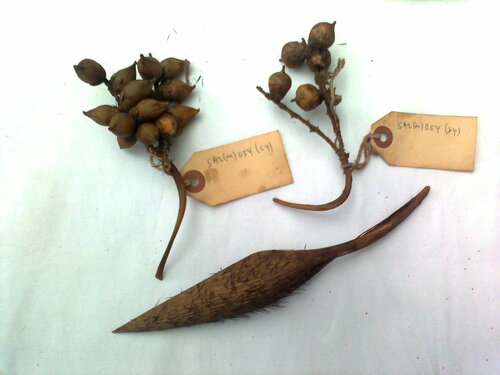
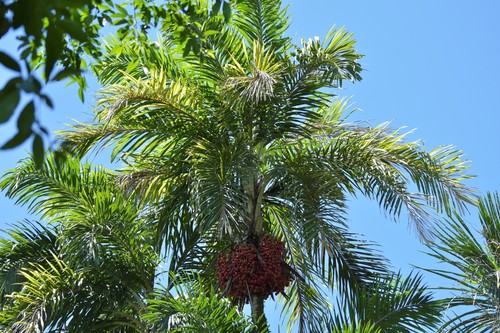
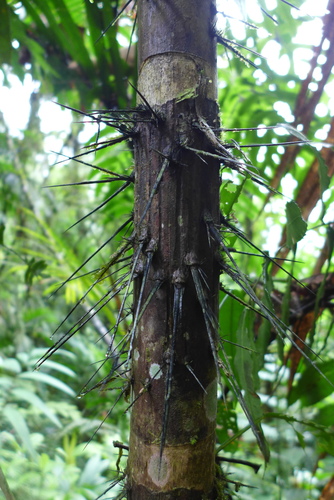
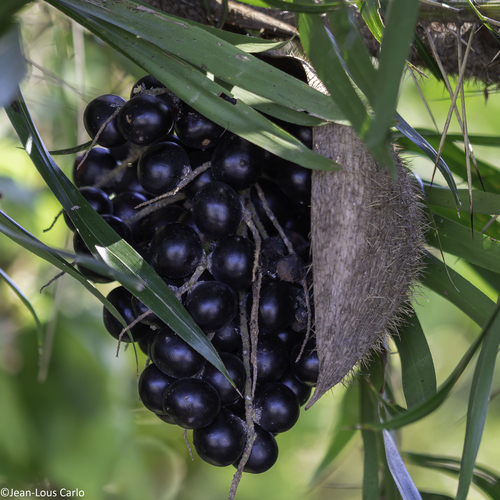
A solitary fan palm. It grows 20 m tall. The trunk is 30 cm across. The leaves spread out like fingers on a hand. The flowering stalks come from among the leaf bases. The male flower is a long thick branch which hangs down. It is branched. The female flower is unbranched. The fruit are round and glossy. They are 8 cm across. They are green to purple.
Edible Uses
The immature fruit is edible, as is the palm heart, which has a crisp, sweet, and fragrant taste. The cabbage (inner core) is also edible.
Traditional Uses
The immature fruit is edible. The palm heart is edible. It has a crisp, sweet and fragrant taste.
This uses section is brief — help expand it
Distribution
A tropical plant. It grows in lowland rainforest.
Where It Grows
Asia, Indonesia, Malaysia, Sarawak, SE Asia,
Cultivation
Plants can be grown from seeds.
Other Uses
The stems are sawn into boards and used for house construction.
Production
It is a slow growing palm.
Notes
There are 2 Borassodendron species.
Also Known As
Mudor, Palem bindang
References (7)
- Balick, M.J. and Beck, H.T., (Ed.), 1990, Useful palms of the World. A Synoptic Bibliography. Colombia p 214
- Davis, S.D., Heywood, V.H., & Hamilton, A.C. (eds), 1994, Centres of plant Diversity. WWF. Vol 1 or 2. p 363
- Dransfield, J., 1972, The genus Borassodendron (Palmae) in Malesia. Reinwardtia 8(2):351-363
- Haynes, J., & McLaughlin, J., 2000, Edible palms and Their Uses. University of Florida Fact sheet MCDE-00-50-1 p 3
- Johnson, D.V., 1998, Tropical palms. Non-wood Forest products 10. FAO Rome. p 44
Show all 7 references Hide references
- Riffle, R.L. & Craft, P., 2003, An Encyclopedia of Cultivated Palms. Timber Press. p 274
- Sukarya, D. G., (Ed.) 2013, 3,500 Plant Species of the Botanic Gardens of Indonesia. LIPI p 759