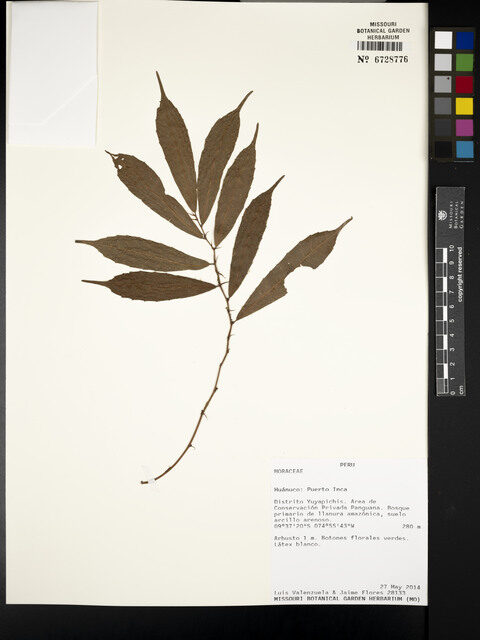
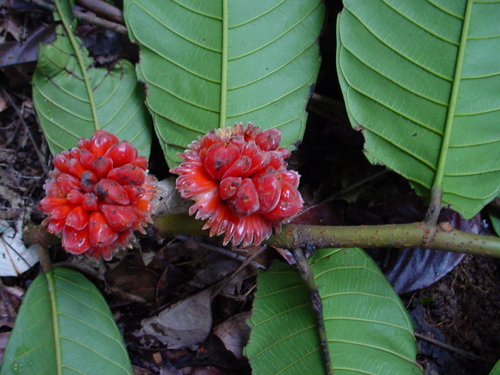
Maclura pomifera
(Rafinesque) Schneider
Osage orange, Bow-wood, Hedge apple, Bodark, Bois d'arc
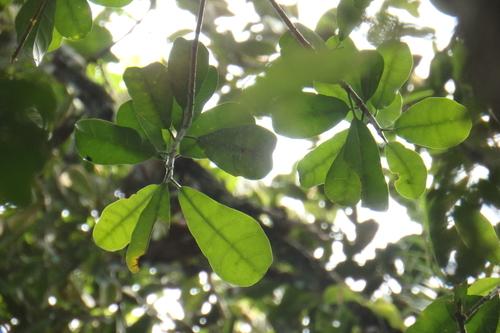
iNaturalist· cc-by-nc
(c) hilliri, some rights reserved (CC BY-NC)
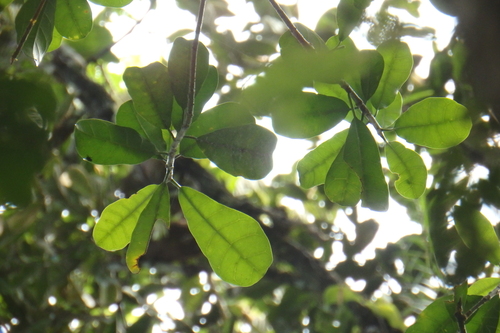
iNaturalist· cc-by-nc-sa
(c) Amadej Trnkoczy, some rights reserved (CC BY-NC-SA)
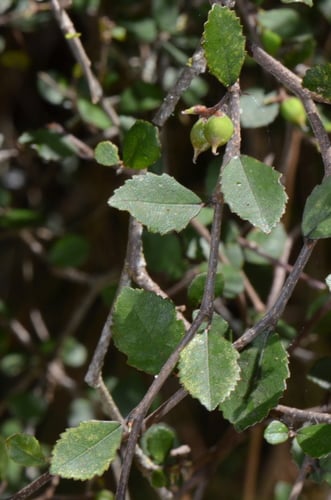
iNaturalist· cc-by
(c) Patrick Hanly, some rights reserved (CC BY), uploaded by Patrick Hanly
Summary
Source: WikipediaMaclura pomifera, commonly known as the Osage orange ( OH-sayj), is a small deciduous tree or large shrub, native to the south-central United States. It is a member of the mulberry family, Moraceae. It typically grows about 8 to 15 m (30–50 ft) tall. The distinctive multiple fruit resembles an immature orange, is roughly spherical, bumpy, 8 to 15 cm (3–6 in) in diameter, and turns bright yellow-green in the fall. The fruit excretes a sticky white latex when cut or damaged. Despite the name "Osage orange", it is not related to the orange. Due to its latex secretions and woody pulp, the fruit is not usually eaten by humans and rarely by foraging animals. Ecologists Daniel H. Janzen and Paul S. Martin proposed in 1982 that the fruit of this species might be an example of what has come to be called an evolutionary anachronism—that is, a fruit coevolved with a large animal seed dispersal partner that is now extinct. This hypothesis is controversial. Maclura pomifera has many common names, including mock orange, horse apple, hedge apple, hedge ball, monkey ball, pap, monkey brains, and yellow-wood. The name bois d'arc (French, meaning "bow-wood") has also been corrupted into bodark and bodock.
Description
A small tree which loses its leaves. The crown is round. It can grow 10-15 m high. The plant has a thick white sap. The bark is orange-brown and cracked. The leaves are small and alternate. They are oval and 7-12 cm long by 5 cm across. They narrow into a long tip. The twigs are orange brown. They can become a thorn at each leaf base. The flowers are wind pollinated. The male and female flowers are on separate trees. They are small and yellow in clusters 1 cm long. The fruit are 10-14 cm across. They resemble a green orange made up of small fruit fused together.
Edible Uses
One report suggests the fruit is edible, but this is almost certainly a mistake — the fruit is harsh, hard, dry, and astringent despite its large size. The fruit does contain an antioxidant useful as a food preservative, particularly for oils. The heartwood and root yield a non-toxic antibiotic that also functions as a food preservative.
Traditional Uses
The dried fruit pulp contains a fatty oil which is edible after purification. CAUTION: It could only be used with great care and correct processing.
Medicinal Uses
A tea made from the roots has been used as a wash for sore eyes. The inedible fruits contain antioxidant and fungicidal compounds. A 10% aqueous infusion and an extract diluted 1:1 have demonstrated cardiovascular potentialities.
Distribution
It is a temperate plant. It is native to C. & S. United States. It will grows under a variety of difficult conditions. It is intolerant of shade. It can withstand bitter cold and drought. It will grow in very alkaline soils. It suits hardiness zones 6-10. Mt Cootha Botanical Gardens. National Arboretum Canberra.
Where It Grows
Asia, Australia, China, Europe, India, Iran, Iraq, Italy, Mediterranean, Middle East, North America*, Pakistan, Romania, Slovenia, Tasmania, USA,
Cultivation
Plants can be grown from seed. The seed need to be planted fresh. It can reproduce by root sprouts and root cuttings.
Propagation
Sow seed as soon as it is ripe in pots in a cold frame. Stored seed should be pre-soaked for 48 hours in warm water, stratified for 2 months at 4°C, then sown in a cold frame. Germination is normally good. Prick seedlings into individual pots when large enough to handle and grow on in a greenhouse through their first winter. Plant out in late spring or early summer after the last expected frosts. Seed remains viable for 3 years. For larger quantities, sow in an open seed bed and grow on for a couple of years before planting out. Cuttings of half-ripe wood can be taken in July or August in a frame; cuttings of mature wood from November to January in a frame. Layering can be done in summer. Root cuttings 4cm long taken in December should be planted horizontally in pots in a greenhouse and planted out as soon as possible — success rate is good.
Other Uses
A yellow dye is obtained from the bark of the root and the wood; green and orange can also be extracted from the same sources. The sap of the fruit acts as an insect repellent and is said to be effective against cockroaches. The bark is a source of tannin. The plant is widely grown as a hedge in North America and Europe, tolerating severe pruning and forming an effective stock-proof barrier that also withstands maritime exposure. A hedge in a very exposed position at Rosewarne in North Cornwall was growing well as of 1989, though it is very bare in winter. The species is also planted in shelterbelts. The wood is coarse-grained, exceedingly hard, heavy, flexible, very strong, very durable, silky, and lustrous, weighing 48lb per cubic foot. One of the most durable woods in North America, it sees limited commercial use but is valued locally for fence posts, piers, and bows, and makes an excellent fuel.
Notes
There is only one Maclura species.
Synonyms
References (16)
- Ambasta S.P. (Ed.), 2000, The Useful Plants of India. CSIR India. p 61
- Clopton, J. R. et al, 1949, Osage Orange - A Potential Source of Edible Oil and other Industrial Raw materials. The Journal of the American Oil Chemists' Society. p 470-472
- Coombes, A.J., 2000, Trees. Dorling Kindersley Handbooks. p 220
- Cundall, P., (ed.), 2004, Gardening Australia: flora: the gardener's bible. ABC Books. p 849
- Etherington, K., & Imwold, D., (Eds), 2001, Botanica's Trees & Shrubs. The illustrated A-Z of over 8500 trees and shrubs. Random House, Australia. p 453 (Said to be like inedible oranges)
Show all 16 references Hide references
- Farrar, J.L., 1995, Trees of the Northern United States and Canada. Iowa State University press/Ames p 408 (Fruit listed as not edible)
- Flora of Pakistan. www.eFloras.org
- Grandtner, M. M., 2008, World Dictionary of Trees. Wood and Forest Science Department. Laval University, Quebec, Qc Canada. (Internet database http://www.wdt.qc.ca)
- Hibbert, M., 2002, The Aussie Plant Finder 2002, Florilegium. p 188
- http://www.botanic-gardens-ljubljana.com/en/plants
- Ill. Handb. Laubholzk. 1:806. 1906
- Kermath, B. M., et al, 2014, Food Plants in the Americas: A survey of the domesticated, cultivated and wild plants used for Human food in North, Central and South America and the Caribbean. On line draft. p 506
- Little, E.L., 1980, National Audubon Society Field Guide to North American Trees. Alfred A. Knopf. p 429
- Lord, E.E., & Willis, J.H., 1999, Shrubs and Trees for Australian gardens. Lothian. p 59
- Ryan, S., 2008, Dicksonia. Rare Plants Manual. Hyland House. p 38
- Schuler, S., (Ed.), 1977, Simon & Schuster's Guide to Trees. Simon & Schuster. No. 134 (As Maclura ponifera) (Fruit listed as not edible)