Ziziphus rugosa
Lam.
iNaturalist· cc-by-sa
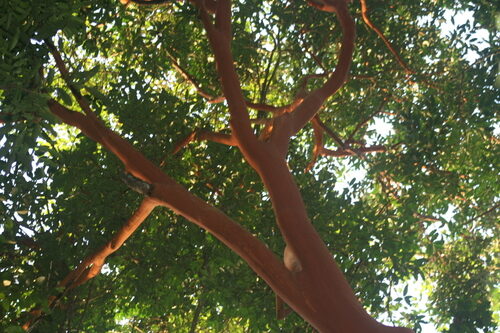
(c) Dinesh Valke, some rights reserved (CC BY-SA)
iNaturalist· cc-by-sa
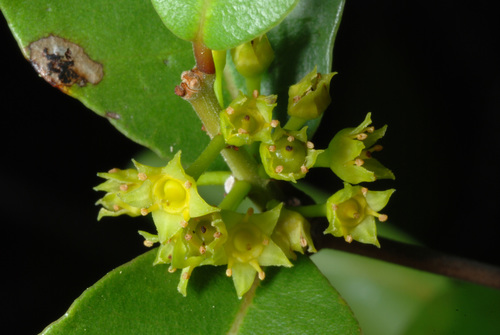
(c) Dinesh Valke, some rights reserved (CC BY-SA)
Summary
Source: WikipediaZiziphus rugosa is a species of tree in the family Rhamnaceae. It is a wild fruit. The tree is native to hills and mountains below 1,400 metres (4,600 ft) altitude, in China (Hainan, Yunnan), India, Laos, Burma, Sri Lanka, Thailand, and Vietnam. The berry-sized fruit is known in India as zunna berry, chunna fruit or churna fruit. Its bark and wood are used medicinally for dysentery in Laos. The population of Western Ghats in India collect the fruits (berries) for self consumption and sale. The berries are popularly known as 'Toran'तोरण in Marathi language.
Description
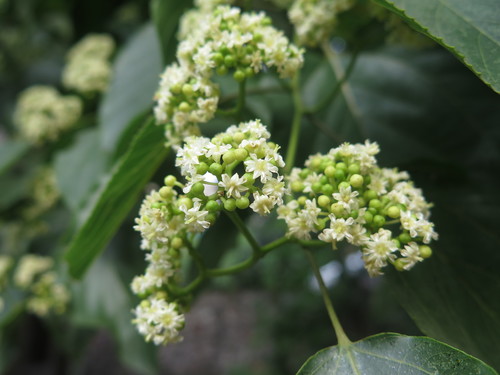
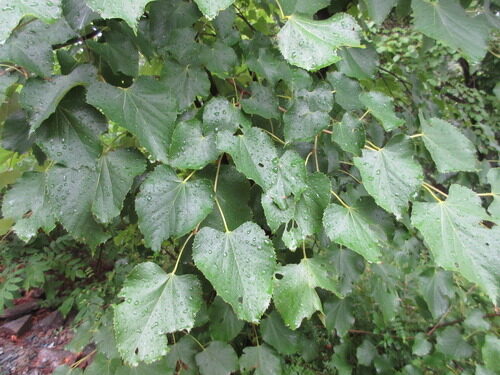
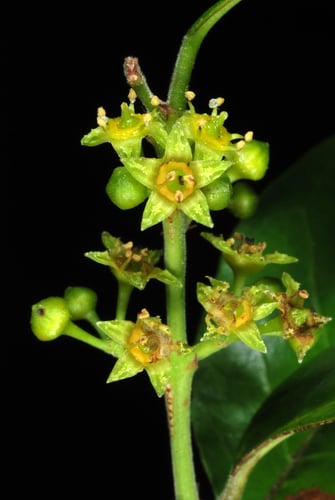
A shrub or small tree. It grows to about 5 m high. It can be a straggler and loses it leaves during the year. The bark is dark grey. It is deeply cracked into thick rectangular scales. The leaves have stalks. They are 5.5-13 cm long by 3-11 cm wide. They are almost round or oval with teeth. They are dark green above. They are thick grey or rusty colour and like felt underneath. They are obliquely rounded at the base. The flowers are yellowish. The occur in long panicles at the ends of branches or in the axils or leaves. The fruit is fleshy with a hard covering over the seed. The fruit is round or pear shaped. It is 5-8 mm across and white when ripe.
Edible Uses
Fruit - raw or cooked. Both ripe and unripe fruits are eaten. The orange to black, obovoid-globose or subglobose fruit is 9 - 12mm long and 8 - 10mm wide.
Traditional Uses
The mealy pulp of the ripe fruit is eaten raw. They are also used for curries.
This uses section is brief — help expand it
Medicinal Uses
The bark is astringent. A paste made from the bark is applied as a poultice on swollen gums and to toothaches. The flowers, combined with an equal quantity of the petioles of betel leaves and half as much lime is used to make a pill that is used in the treatment of menorrhagia. The stems and the fruit are hypotensive. The triterpene saponins isolated from the bark showed CNS depressant, tranquilizing and analgesic without producing hepatotoxicity. The cyclopeptide alkaloids of the plant show antibacterial as well as antifungal activity
Distribution
A tropical plant. In Nepal plants grow to 1200 m altitude. It grows on the Deccan in India. In Yunnan.
Where It Grows
Asia, Bangladesh, China, Himalayas, India, Indochina, Laos, Myanmar, Nepal, Northeastern India, Pakistan, SE Asia, Sikkim, Sri Lanka, Thailand, Vietnam,
Cultivation
Plants are grown from seed or root suckers.
Propagation
Seed - remove the flesh from around the seed then soak the seed in cold water for 6 hours. Cover the seed in seedling trays with a thin layer of river sand and keep moist. Seeds usually germinate in 2 - 3 weeks with a minimum of 75% germination. Seedlings transplant easily into black nursery soil but they have long taproots and care should be taken not to damage them. Division of root suckers.
Other Uses
The branches are used for making fences. The wood is used for fuel.
Production
In southern India plants fruit is April to May.
Nutrition
| Part | Moisture | kJ | kcal | Protein | Vit A | Vit C | Iron | Zinc |
|---|---|---|---|---|---|---|---|---|
| Fruit | — | — | — | — | 35 | 23.9 | 3.7 | — |
| Fruit | 60.1 | — | — | 0.6 | — | 21.3 | — | — |
Synonyms
Also Known As
Anneri, Bata bakuri, Bayer, Bili soori hannu, Bon bogori, Bonbokuri, Bon-boroi, Churan, Churna, Dawanra, Dhaura, Dumakpul, Dung-soh-lang-khrithad, Elachi, Gamarai, Ghatbor, Jangli boroi, Kattilandai, Kattilanthai, Kottai, Kottaipazham, Kottamaram, Mak-kok, Myauk-zi, Malantutali, Ora bukuri, Pinduparighamu, Poran, Rug boroi, Sammankaw, Sekra, Simu koli, Taw-zi, Thodali, Tinkoli, Todali, Toran, Yumrang bogori, Zi-ganauk, Zi-talaing
References (47)
- Ajesh, T. P., et al, 2012, Ethnobotanical Documentation of Wild Edible Fruits used by Muthuvan Tribes of Idukki, Kerala-India. International Journal of Pharma and Bio Sciences 3(3): 479-487
- Altschul, S.V.R., 1973, Drugs and Foods from Little-known Plants. Notes in Harvard University Herbaria. Harvard Univ. Press. Massachusetts. no. 2620
- Ambasta, S.P. (Ed.), 2000, The Useful Plants of India. CSIR India. p 704
- Bajpai, O., et al, 2015, Tree species of the Himalayan Terai region of Uttar Pradesh, India: a checklist. Check List 11(4): 1718
- BARC, 2016, State of Biodiversity for Food and Agriculture in Bangladesh. Bangladesh Agricultural Research Council.
Show all 47 references Hide references
- Burkill, I.H., 1966, A Dictionary of the Economic Products of the Malay Peninsula. Ministry of Agriculture and Cooperatives, Kuala Lumpur, Malaysia. Vol 2 (I-Z) p 2347 (As Zizyphus xylopyrus)
- Chandrashekara, U. M., 2009, Tree species yielding edible fruit in the coffee-based homegardens of Kerala, India: their diversity, uses and management. Food Sec. 1:361-370
- Dangol, D. R. et al, 2017, Wild Edible Plants in Nepal. Proceedings of 2nd National Workshop on CUAOGR, 2017.
- Datar, M. N. & Upadhye, A. S., 2016, Forest foods of northern region of Western Ghats. MACS - Agharkar Research Institute, Pune. Pp 1-160. ISBN: 978-93-85735-10-3 p 103
- Dobriyal, M. J. R. & Dobriyal, R., 2014, Non Wood Forest Produce an Option for Ethnic Food and Nutritional Security in India. Int. J. of Usuf. Mngt. 15(1):17-37
- J. B. A. P. M. de Lamarck & L. A. J. Desrousseaux, Encycl. 3:319. 1789
- Ethnobotany of Karbis. Chapter 4 in p 106
- Flora of Pakistan. www.eFloras.org
- Gardner, S., et al, 2000, A Field Guide to Forest Trees of Northern Thailand, Kobfai Publishing Project. p 130
- Harisha, R. P. & Padmavathy, S., 2013, Knowledge and Use of Wild Edible Plants in Two Communities in Malai Madeshwara Hills, Southern India. International Journal of Botany 9(2): 64-72.
- Hedrick, U.P., 1919, (Ed.), Sturtevant's edible plants of the world. p 707
- Jadhav, R., et al, 2015, Forest Foods of Northern Western Ghats: Mode of Consumption, Nutrition and Availability. Asian Agri-History Vol. 19, No. 4: 293-317
- Jose, D. T. & Sasidharan, N., 2016, Checklist of wild edible plants of Aralam Wildlife sanctuary, Kerala, India. South Indian Journal Of Biological Sciences 2016; 2(1); 141‐144
- Karuppusamy, S., et al, 2011, Antioxidant activity of selected lesser known edible fruits from Western Ghats, of India. Indian Journal of Natural Products and resources. 2(2): 174-178
- Majumdar, K and Datta, N., 2009, Traditional wild edible fruits for the forest dwellers of Tripura, India. Pleione 3(2) 167-178
- Manandhar, N.P., 2002, Plants and People of Nepal. Timber Press. Portland, Oregon. p 487
- Misra S. & Misra M., 2016, Ethnobotanical and Nutritional Evaluation of Some Edible Fruit Plants of Southern Odisha, India. International Journal of Advances in Agricultural Science and Technology, Vol.3 Issue.1, March- 2016, pg. 1-30
- Misra, S., 2020, Survey of edible plants for human consumption in south Odisha, India. Journal of Emerging Technologies and Innovative Research (JETIR) Vol. 7, Issue 12 p 292
- Mozhui, R., et al, 2011, Wild edible fruits used by the tribals of Dimapur district of Nagaland, India. Pleione 5(1): 56 - 64
- Murtem, G. & Chaudhrey, P., 2016, An ethnobotanical note on wild edible plants of Upper Eastern Himalaya, India. Brazilian Journal of Biological Sciences, 2016, v. 3, no. 5, p. 63-81.
- Nayaham, M. C., et al, 1993, Less Known Edible Fruit - Yielding plants of Nilgiris. Ancient Science of Life. Vol. X11 Nos. 3 & 4, pp 363-376
- Pasha, M. K. & Uddin, S. B., 2019, Minor Edible Fruits of Bangladesh. Bangladesh J. Plant Taxon. 26(2): 299–313
- Patiri, B. & Borah, A., 2007, Wild Edible Plants of Assam. Geethaki Publishers. p 27
- Pegu, R., et al, 2013, Ethnobotanical study of Wild Edible Plants in Poba Reserved Forest, Assam, India. Research Journal of Agriculture and Forestry Sciences 1(3):1-10
- Prachi, K., et al, 2012, Underutilized wild fruits of North Maharashtra. Journal of Research in Plant Sciences. (2012) 1:071-076
- Pradhan, R., et al, 2020, Potential Wild Edible Plants and its Significance in Livelihood of Indigenous People of Male Mahadeshwara Hills, Karnataka. Economic Affairs Vol. 64, No. 4 pp. 01-14
- Ramachandran, V.S. and Nair, V.J., 1981, Ethnobotanical studies in Cannanore District, Kerala State (India). J Econ. Tax. Bot. Vol 2 pp 65-72
- Ramachandran, V. S., 2007, Wild edible plants of the Anamalais, Coimbatore district, western Ghats, Tamil Nadu. Indian Journal or Traditional Knowledge. 6(1) pp 173-176
- Ravikrishna, S., 2011, Ethno-medico-botanical survey on Wild Edible fruits of Udupi Taluq, Udupi p 105
- Reis, S. V. and Lipp, F. L., 1982, New Plant Sources for Drugs and Foods from the New York Botanical Garden herbarium. Harvard. p 173
- Sadhale, A., et al, 1991, Ethnobotanical studies of sacred grove at Ajiwali, Pune district. J. Econ. Tax. Bot. Vol. 15 No. 1 pp 167-172
- Sarma, H., et al, 2010, Updated Estimates of Wild Edible and Threatened Plants of Assam: A Meta-analysis. International Journal of Botany 6(4): 414-423
- Sasi, R. & Rajendran, A., 2012, Diversity of Wild Fruits in Nilgiri Hills of the Southern Western Ghats - Ethnobotanical Aspects. IJABPT, 3(1) p 82-87
- Sawian, J. T., et al, 2007, Wild edible plants of Meghalaya, North-east India. Natural Product Radiance Vol. 6(5): p 423
- Shah, G.L. et al, 1981, An account of the Ethnobotany of Saurashtra in Gujarat State (India). J. Econ. Tax. Bot. Vol 2 pp 173-182
- Shah, G.L., 1984, Some economically important plant of Salsette Island near Bombay. J. Econ. Tax. Bot. Vol. 5 No. 4 pp 753-765
- Teron, R. & Borthakur, S. K., 2016, Edible Medicines: An Exploration of Medicinal Plants in Dietary Practices of Karbi Tribal Population of Assam, Northeast India. In Mondal, N. & Sen, J.(Ed.) Nutrition and Health among tribal populations of India. p 155
- Uprety, Y., et al, 2011, Plant biodiversity and ethnobotany inside the projected impact area of the Upper Seti Hydropower Project, Western Nepal. Environ. Dev. Sustain. (2011) 13:463-492
- Uprety, Y., et al, 2012, Diversity of use and local knowledge of wild edible plant resources in Nepal. Journal of Ethnobotany and Ethnomedicine 8:16
- Valvi, S. R. & Rathod, 2011, Mineral composition of some wild edible fruits from Kolhapur District. International Journal or Applied Biology and Pharmaceutical Tehcnology. 2(1): 392
- WATT
- Yesodharan, K. & Sujana, K. A., 2007, Wild edible plants traditionally used by the tribes in the Parambokulam Wildlife Sanctuary, Kerala, India. Natural Product Radiance 6(1) pp 74-80