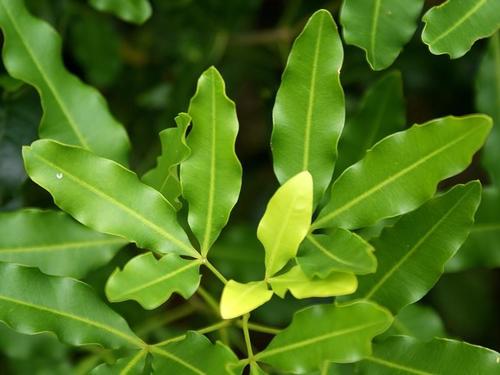
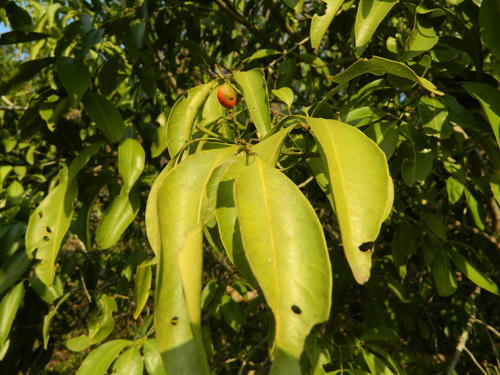
Zanthoxylum schinifolium
Siebold & Zucc.
Green zanthoxylum, Aromatic zanthoxylum
iNaturalist· cc-by-sa
(c) harum.koh, some rights reserved (CC BY-SA)
iNaturalist· cc-by-nc
(c) era7568, some rights reserved (CC BY-NC)
iNaturalist· cc-by-nc
(c) era7568, some rights reserved (CC BY-NC)
Summary
Source: WikipediaZanthoxylum schinifolium, also called mastic-leaf prickly ash, is a species of flowering plant in the Rutaceae, the citrus family. It was first described and published in Abh. Math.-Phys. Cl. Königl. Bayer. Akad. Wiss. vol.4 (Issue 2) on page 137 in 1845 by botanists Philipp Franz von Siebold and Joseph Gerhard Zuccarini. It is native to central and eastern China, as well as temperate eastern Asia, which includes Japan, Korea, Manchuria, Ryukyu Islands and Taiwan. It is a shrub that grows primarily in the temperate biome regions. There are two accepted and known varieties: Zanthoxylum schinifolium var. okinawense (Nakai) Hatus. ex Simabuku Zanthoxylum schinifolium var. schinifolium Its peppercorns are the source of the spice Sancho (spice) which is used in Korean cuisine. It is called 青花椒 "green flower-pepper / green Sichuan pepper" in China. It is used in traditional medicine and cooking. It is an economically-important crop in Sichuan. Fungal pathogen species Pestalotiopsis kenyana is known to cause leaf spot disease on Zanthoxylum schinifolium in Sichuan Province, China.
Description
A shrub that loses its leaves. It grows 1-3 m high. It has prickles. The young branches are purple. The leaves have leaflets along the stalk. There are 11-21 leaflets and they are narrowly sword shaped and 2-5 cm long by 1-1.5 cm wide. There are teeth along the edge. Flowers are small and yellowish-green and of one sex. Male and female flowers are on separate trees. They are in groups in the axils of leaves or at the ends of branches. The fruit follicles are purple-red. The seeds are bluish-black and shiny.
Edible Uses
The seed is cooked and used as a condiment and pepper substitute. Young leaves are also eaten, though no further details are given.
Traditional Uses
The fruit are used fresh and dried as a spice.
This uses section is brief — help expand it
Medicinal Uses
The pericarp is anaesthetic, diuretic, parasiticide, and vasodilator. It is used to treat gastralgia and dyspepsia caused by cold, as well as vomiting, diarrhoea, abdominal pain, ascariasis, and dermal diseases. It has a local anaesthetic action and is parasiticide against the pork tapeworm (Taenia solium). The pericarp contains geraniol, which in small doses has a mild diuretic effect, while large doses inhibit the excretion of urine. At low concentrations there is a persistent increase in peristalsis; at high concentrations, inhibition occurs. The resin in the bark — especially that of the roots — is powerfully stimulant and tonic.
Distribution
It is a temperate plant. It is widespread in eastern Asia growing in forests. In China it grows in upland open forests below 800 m above sea level.
Where It Grows
Asia, China, Japan, Korea, Ryukyu, Taiwan,
Cultivation
Uses: Clearstem tree, multi-stem tree, specimen tree, specimen shrub; Parks, tree containers, cemeteries, roof gardens, large gardens. Prefers a good deep well-drained moisture retentive soil in full sun or semi-shade. Flowers are formed on the old wood. Dioecious. Male and female plants must be grown if seed is required. Self-sown seedlings have occasionally been observed growing in bare soil in the shade of the parent plant.
Propagation
Seed is best sown in a greenhouse as soon as it ripens in autumn. Stored seed may need up to 3 months of cold stratification, though scarification can also help. Sow stored seed in a cold frame as early in the year as possible; germination should occur in late spring, though it may take a further 12 months. Prick seedlings into individual pots when large enough to handle, grow on in a cold frame through their first winter, then plant out in early summer. Cuttings of half-ripe wood can be taken in July or August and rooted in a frame. Root cuttings 3cm long, planted horizontally in pots in a greenhouse, give a good success rate. Suckers can be removed in late winter and planted directly into their permanent positions.
Other Uses
The plant has parasiticide properties.
Notes
There are about 200 Zanthoxylum species.
Synonyms
Also Known As
Inu-Zansho, Sanchonamu, Yai Chiao, Yeh Chiao
References (10)
- Abh. Math.-Phys. Cl. Koenigl. Bayer. Akad. Wiss. 4(2):137. 1846
- Chon, S. et al., 2009, Total Phenolics Level, Antioxidants Activity and Cytotoxicity of Young Sprouts of Some Traditional Korean Salad Plants. Plant Foods for Human Nutrition. 64:25-31
- Hu, Shiu-ying, 2005, Food Plants of China. The Chinese University Press. p 504
- Hwang, H., et al, 2013, A Study on the Flora of 15 Islands in the Western Sea of Jeollanamdo Province, Korea. Journal of Asia-Pacific Biodiversity Vol. 6, No. 2 281-310
- Hwang, HS, et al, 2014, Distribution characteristics of plant in the Ungseokbong Mountain, Gyeongsangnam-do, Korea. Journal of Asia-Pacific Biodiversity. 7(2014) e164-e178
Show all 10 references Hide references
- Kim, H. & Song, M., 2013, Ethnobotanical analysis for traditional knowledge of wild edible plants in North Jeolla Province (Korea). Genetic. Resour. Crop Evol. (2013) 60:1571-1585
- Martin, F. W., et al, 1987, Perennial Edible Fruits of the Tropics. USDA Handbook 642 p 78
- Pemberton, R. W. & Lee, N. S., 1996, Wild Food Plants in South Korea: Market Presence, New Crops, and Exports to the United States. Economic Botany, Vol. 50, No. 1, pp. 57-70
- Peter, K. V. (Ed.), 2004, Handbook of Herbs and Spices Vol. 2 Woodhead Publishing and CRC Press.
- Plants for a Future database, The Field, Penpol, Lostwithiel, Cornwall, PL22 0NG, UK. http://www.scs.leeds.ac.uk/pfaf/