Yucca harrimaniae
Trelease
Spanish bayonet
iNaturalist· cc-by-nc
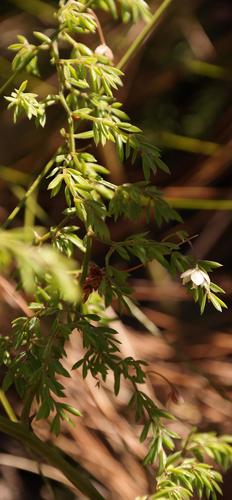
(c) Meg K, some rights reserved (CC BY-NC), uploaded by Meg K
iNaturalist· cc-by-nc
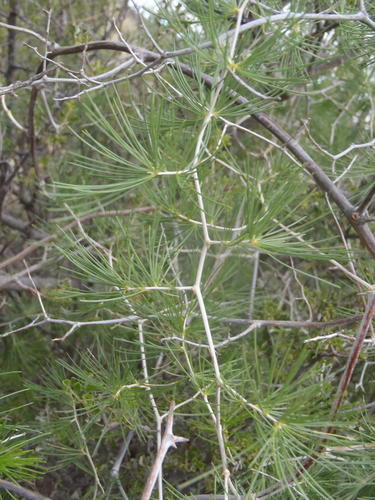
(c) faerthen, some rights reserved (CC BY-NC)
iNaturalist· cc-by-nc
(c) faerthen, some rights reserved (CC BY-NC)
Summary
Source: WikipediaYucca harrimaniae Trel., the Spanish bayonet, is a species in the family Asparagaceae, native to Utah, Nevada, Colorado, northeastern Arizona and northern New Mexico, at elevations from 1000 m to 2700 m. Yucca harrimaniae is a small, acaulescent (stemless) species forming clumps of rosettes. Flowers are nodding (hanging downward), partly greenish-white, partly purplish. The species is closely related to Y. sterilis (Neese & S.L.Welsh) S.L.Welsh & L.C.Higgins.. The overall species is relatively common and widespread. Two varieties, var. nana and var. sterilis, have very small and restricted ranges.
Description
Compact evergreen shrub reaching 0.4 m tall with slow growth rate. Hardy to UK zone 7. Tolerates light sandy, medium loamy, and heavy clay soils preferring well-drained conditions and poor soils. Grows in mildly acid to mildly alkaline pH. Adapts to semi-shade or full sun, handles drought well, and tolerates strong winds but not coastal exposure.
Edible Uses
The immature fruit is cooked; it has a bitter taste, though most of the bitterness is concentrated in the skin. Flowers are delicious eaten raw and can also be dried, crushed and used as a flavouring. The flowering stem is peeled, cooked and eaten like asparagus — the whitish inner portion is the part consumed.
Traditional Uses
The flowers are edible raw or cooked. They can also be dried and crished and used as flavouring.
This uses section is brief — help expand it
Medicinal Uses
None known.
Known Hazards
The roots contain saponins. Whilst saponins are quite toxic to people, they are poorly absorbed by the body and so tend to pass straight through. They are also destroyed by prolonged heat, such as slow baking in an oven. Saponins are found in many common foods such as beans. Saponins are much more toxic to some creatures, such as fish, and hunting tribes have traditionally put large quantities of them in streams, lakes etc in order to stupefy or kill the fish.
Distribution
It is a temperate plant.
Where It Grows
Australia, North America, USA,
Cultivation
Thrives in any soil but prefers a sandy loam and full exposure to the south. Requires a sunny position. Plants are hardier when grown on poor sandy soils. Established plants are very drought resistant, this species is also tolerant of cool damp weather. Hardy to at least -30°c. Closely allied to Y. glauca. In the plants native environment, its flowers can only be pollinated by a certain species of moth. This moth cannot live in Britain and, if fruit and seed is required, hand pollination is necessary. This can be quite easily and successfully done using something like a small paint brush. Individual crowns are monocarpic, dying after flowering. However, the crown will usually produce a number of sideshoots before it dies and these will grow on to flower in later years. Plants in this genus are notably resistant to honey fungus. Members of this genus seem to be immune to the predations of rabbits
Propagation
Sow seed in spring in a greenhouse; pre-soaking for 24 hours in warm water may reduce germination time. Seed typically germinates within 1–12 months at 20°C. Prick seedlings into individual pots and grow on under glass for at least their first two winters. Plant out in early summer with winter protection — a pane of glass usually suffices — for at least the first outdoor winter. In Britain, seed is only set with hand pollination. For root cuttings, lift in April/May, remove small buds from the base of stem and rhizomes, dip in dry wood ash to prevent bleeding, and pot in sandy soil in a greenhouse until established. Divide suckers in late spring; larger divisions can go straight to permanent positions, while smaller ones are best potted and grown in light shade until well established, then planted out the following spring.
Other Uses
Leaf fibre is used to make ropes, baskets and mats. The leaves themselves can be used as paint brushes and brooms, or woven into mats. The roots are rich in saponins and can be used as a soap substitute.
Other Information
It is a famine food.
Notes
There are about 40 Yucca species. Also put in the family Agavaceae.
Synonyms
References (3)
- Annual Rep. Missouri Bot. Gard. 13:59, t. 93, fig. 1. 1902
- Moerman, D. F., 2010, Native American Ethnobotany. Timber Press. p 608
- Plants for a Future database, The Field, Penpol, Lostwithiel, Cornwall, PL22 0NG, UK. http://www.scs.leeds.ac.uk/pfaf/