Centaurea solstitialis
L.
St Barnaby's thistle, Yellow star-thistle
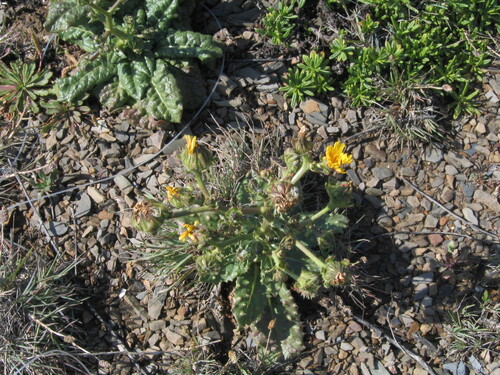
iNaturalist· cc-by-nc
(c) mick_photo, some rights reserved (CC BY-NC), uploaded by mick_photo
iNaturalist· cc-by-nc
(c) longviewca, some rights reserved (CC BY-NC)
iNaturalist· cc-by-nc
(c) James Bailey, some rights reserved (CC BY-NC), uploaded by James Bailey
Summary
Source: WikipediaCentaurea solstitialis, the yellow star-thistle, is a species of thorny plant in the genus Centaurea, which is part of the family Asteraceae. A winter annual, it is native to the Mediterranean Basin region and invasive in many other places. It is also known as golden starthistle, yellow cockspur and St. Barnaby's thistle (or Barnaby thistle).
Description
An annual plant. It grows 1 m tall. It is stiff and erect and has a downy white covering. The leaves at the base are much divided. The lobe at the end is the largest. The leaves on the stem do not have stalks. They are narrow and entire. They continue as wings down the stem. The bracts around the flower have spines. Some spines are smaller than others.
Edible Uses
The plant is used as a cooked vegetable, though the specific part consumed is not recorded.
Traditional Uses
It is also the source of a sweet honey. The leaves are boiled and seasoned with olive oil and eaten.
This uses section is brief — help expand it
Medicinal Uses
The powdered seed is used as a remedy for kidney or bladder stones. The powdered root is reputed to cure fistula and gravel.
Known Hazards
Grazing of the plant by horses can cause nigropallidal encephalomalacia or "chewing disease", a neurological condition. The disease generally follows consumption of 60–200% of the horse's body weight over an extended period of a month or more, or 2.3–2.6 kilograms (5.1–5.7 pounds) of star-thistle per 100 kg (220 lb) body weight per day. Though star-thistle is most dangerous when it is the only plant available or is delivered as a contaminant in dried hay, horses may develop a taste for it and seek it out. Many other grazing species, including mules and burros, are not affected.
Distribution
It is a Mediterranean plant. It grows in dry habitats and stony ground. It grows in warm temperate places. In Argentina it grows from sea level to 1,500 m above sea level. Tasmania Herbarium.
Where It Grows
Argentina, Australia, Britain, Central Asia, Chile, Europe*, France, Greece, Italy, Mediterranean, North America, Saudi Arabia, South America, Spain, Tajikistan, Tasmania, Turkey, Türkiye, Uruguay, USA,
Cultivation
Succeeds in ordinary garden soil. Prefers a well-drained fertile soil and a sunny position. Tolerates dry, low fertility and alkaline soils. A good bee and butterfly plant the flowers are rich in nectar. Members of this genus are rarely if ever troubled by browsing deer.
Propagation
Sow seed in April in a cold frame. Once large enough to handle, prick seedlings out into individual pots and plant into permanent positions during the summer. With sufficient seed, it can be sown directly in situ in spring; an autumn sowing in situ may also be worth trying.
Other Uses
None known. The plant attracts wildlife.
Notes
There are 400 to 600 Centaurea species. A disease of horses has been recorded in the USA from eating this plant.
Also Known As
Cakirdikeni, Ciarrucciolo, Histiti cavbellok, Histrizerk, Pincar, Strizerk, Zimane civike
References (18)
- Al-Sodany, Y. M., et al, 2013, Medicinal Plants in Saudi Arabia: I. Sarrwat Mountains at Taif, KSA. Academic Journal of Plant Sciences 6 (4): 134-145
- Biscotti, N. & Pieroni, A., 2015, The hidden Mediterranean diet: wild vegetables traditionally gathered and consumed in the Gargano area, Apulia, SE Italy. Acta Societatis Botanicorum Poloniae 84 (3): 327-338
- Biscotti, N. et al, 2018, The traditional food use of wild vegetables in Apulia (Italy) in the light of Italian ethnobotanical literature. Italian Botanist 5:1-24
- Blamey, M and Grey-Wilson, C., 2005, Wild flowers of the Mediterranean. A & C Black London. p 456
- Bodkin, F., 1991, Encyclopedia Botanica. Cornstalk publishing, p 236
Show all 18 references Hide references
- Demir, I. & Ayaz, N., 2022, Wild edible plants contributing to the traditional foods of Mardin (Turkey) Province. Indian Journal of Traditional Knowledge Vol 21(3), July 2022, pp 569-582
- Dogan, Y., 2012, Traditionally used wild edible greens in the Aegean Region of Turkey. Acta Societatis Botanicorum Poloniae 81(4): 329-342
- Ertug, F., 2004, Wild Edible Plants of the Bodrum Area. (Mugla, Turkey). Turk. J. Bot. 28 (2004): 161-174
- Ertug, F, Yenen Bitkiler. Resimli Türkiye Florası -I- Flora of Turkey - Ethnobotany supplement
- Facciola, S., 1998, Cornucopia 2: a Source Book of Edible Plants. Kampong Publications, p 35
- Hussey, B.M.J., Keighery, G.J., Cousens, R.D., Dodd, J., Lloyd, S.G., 1997, Western Weeds. A guide to the weeds of Western Australia. Plant Protection Society of Western Australia. p 92
- Kaya, O. M., et al, 2020, An ethnobotanical research in Sanhurfa central district and attached Villages (Turkey). Indian Journal of Traditional Knowledge. Vol. 19(1) pp 7-23
- Lamp, C & Collet F., 1989, Field Guide to Weeds in Australia. Inkata Press. p 62
- Morley, B.D., & Toelken, H.R., (Eds), 1983, Flowering Plants in Australia. Rigby. p 311
- Paczkowska, G. & Chapman, A.R., 2000, The Western Australian Flora. A Descriptive Catalogue. Western Australian Herbarium. p 159
- Plants for a Future database, The Field, Penpol, Lostwithiel, Cornwall, PL22 0NG, UK. http://www.scs.leeds.ac.uk/pfaf/
- Sp. pl. 2:917. 1753
- Tasmanian Herbarium Vascular Plants list p 6