Washingtonia filifera
(Linden ex Andre) H. Wendl.
Desert Fan Palm, Washington Fan palm
iNaturalist· cc-by-nc
(c) Cameron W Barrows, some rights reserved (CC BY-NC)
iNaturalist· cc-by-nc
(c) Cameron W Barrows, some rights reserved (CC BY-NC)
iNaturalist· cc-by-nc
(c) Cameron W Barrows, some rights reserved (CC BY-NC)
Summary
Source: WikipediaWashingtonia filifera, commonly known as the California fan palm, cotton palm or desert fan palm, is a flowering plant in the family Arecaceae, native to the far southwestern United States and northwestern Mexico. It typically grows 15–20 m (49–66 ft) tall and 3–6 m (10–20 ft) wide, with a sturdy, columnar trunk and waxy, fan-shaped (palmate) leaves. As a monocot, it is evergreen and exhibits a tree-like growth habit. It is the only palm species native to the southwestern United States, forming groves around perennial water sources in the Colorado, Mojave, and Sonoran deserts. These stands provide critical habitat for wildlife and were historically used by Indigenous peoples of the region for food, shelter, and materials. Today the California fan palm is widely planted as an ornamental tree in arid and subtropical climates, though wild populations face pressures from groundwater decline, and habitat alteration. In California, where the majority of its native groves occur, the species forms iconic desert oases such as the Oasis of Mara in Joshua Tree National Park, the Thousand Palms Oasis in the Coachella Valley Preserve, Lost Palms Oasis, and Fortynine Palms Oasis. Outside California, notable populations are protected at Castle Creek in Arizona's Bradshaw Mountains, the Hassayampa River Preserve, and Kofa National Wildlife Refuge.
Description
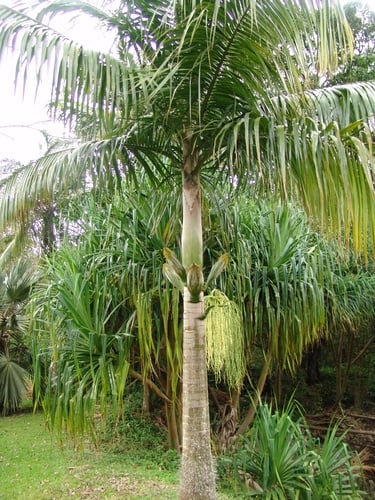
A palm which grows up to 16 m tall. It has a large canopy of several dozen leaves. The trunk is swollen at the base. It is covered with hanging dead leaf stalks. The leaves are like a fan and greyish-green. They are 1m long and 2 m wide. They are divided about half way along into 50-70 segments. These bend and split. The leaves have prickles along the edge. The flowers are white to apricot and occur as many along a branched stalk. This stalk is 3-5 m long and hangs downwards among the leaves. The flowers have both sexes. Pollination is by wind and insects. The fruit are small and berry like. They are brownish black with a thin sweet pulp. Each fruit has a single seed.
Edible Uses
The fruit can be eaten raw, cooked, or dried for later use. It can be made into jellies and drinks, or dried and ground into a meal. The seed can be ground together with the dried fruit and eaten as a porridge. The fruit is small and hard with a thin, sweet pulp that tastes somewhat like dates; each ovoid fruit is about 6mm long and 4mm wide. The young central bud can be roasted, though harvesting it kills the tree since it cannot produce side branches. Young leaf bases can be eaten raw or cooked. The seed can also be cooked alone, ground into a powder, and used for making bread or porridge.
Traditional Uses
The fruit are eaten fresh or dried. They are also ground into a flour and made into a drink. The terminal bud or cabbage is roasted and eaten.
This uses section is brief — help expand it
Medicinal Uses
None known
Distribution
They suit areas with a Mediterranean type climate. They can tolerate temperatures down to -7°C. They can withstand wind and do best in a sunny position. They can grow on most types of soil. It can grow in very alkaline soils with a pH of 9.2. They can survive drought but benefit from moisture. They often form colonies in arid regions near water. In Adelaide Botanical Gardens. National Arboretum Canberra. It suits plant hardiness zones 9-11.
Where It Grows
Africa, Asia, Australia, Cayman Islands, Central America, Colombia, Dominican Republic, East Africa, Guatemala, Hawaii, India, Mediterranean, Mexico, Nepal, North America, Pacific, Pakistan, Slovenia, Turkey, Türkiye, USA, West Indies,
Cultivation
Plants are grown from seed. Seed germinate in 6-8 weeks.
Propagation
Seed is best sown as soon as it is ripe in a greenhouse. Pre-soaking stored seed for 24 hours in warm water may speed up germination. Prick seedlings out into individual pots when large enough to handle and grow on in the greenhouse for at least the first two winters. Plant out into permanent positions in late spring or early summer, after the last expected frosts, and provide cold protection for at least the first two winters outdoors.
Other Uses
A fibre from the leaves is used in basket making and for cordage. Whole leaves are woven together to form the side walls and roofs of huts and temporary dwellings. The seeds have been used as rattles inside gourd rattles. The wood is light and soft and has been used to make cooking implements and spoons.
Production
The fruit are harvested when ripe. The seeds are also edible.
Notes
There are 2 Washingtonia species.
Synonyms
Also Known As
American Cotton Palm, Californian Cotton Palm, Californian Fan palm, Kalifornijska pahljačasta palma, Petticoat palm
References (42)
- Ambasta, S.P. (Ed.), 2000, The Useful Plants of India. CSIR India. p 687
- Beckstrom-Sternberg, Stephen M., and James A. Duke. "The Foodplant Database." http://probe.nalusda.gov:8300/cgi-bin/browse/foodplantdb.(ACEDB version 4.0 - data version July 1994)
- Balick, M.J. and Beck, H.T., (Ed.), 1990, Useful palms of the World. A Synoptic Bibliography. Colombia p 109, 160, 586,
- Blamey, M and Grey-Wilson, C., 2005, Wild flowers of the Mediterranean. A & C Black London. p 502
- Blomberry, A. & Rodd, T., 1982, Palms. An informative practical guide. Angus & Robertson. p 179
Show all 42 references Hide references
- Bodkin, F., 1991, Encyclopedia Botanica. Cornstalk publishing, p 1024
- Bot. Zeitung (Berlin) 37:lxi, 68. 1879
- Brickell, C. (Ed.), 1999, The Royal Horticultural Society A-Z Encyclopedia of Garden Plants. Convent Garden Books. p 1058
- CORNETT,
- Cundall, P., (ed.), 2004, Gardening Australia: flora: the gardener's bible. ABC Books. p 1482
- Desert Survivors Online Plant Database
- Dharani, N., 2002, Field Guide to common Trees & Shrubs of East Africa. Struik. p 297
- Ertug, F, Yenen Bitkiler. Resimli Türkiye Florası -I- Flora of Turkey - Ethnobotany supplement
- Estrada-Castillon, E., et al, 2014, Ethnobotany in Rayones, Nuevo Leon, Mexico. Journal of Ethnobiology and Ethnomedicine, 10:62
- Facciola, S., 1998, Cornucopia 2: a Source Book of Edible Plants. Kampong Publications, p 31
- Flora of Pakistan. www.eFloras.org
- Gibbons, M., 1993, Palms. Compact study Guide and Identifier. Sandstone. p 78
- Gibbons, M., 2003, A pocket guide to Palms. Chartwell Books. p 223
- Grandtner, M. M., 2008, World Dictionary of Trees. Wood and Forest Science Department. Laval University, Quebec, Qc Canada. (Internet database http://www.wdt.qc.ca)
- Haynes, J., & McLaughlin, J., 2000, Edible palms and Their Uses. University of Florida Fact sheet MCDE-00-50-1 p 2
- Hedrick, U.P., 1919, (Ed.), Sturtevant's edible plants of the world. p 688
- Henderson, A., Galeano, G and Bernal, R., 1995, Field Guide to the Palms of the Americas. Princeton. p 62
- Hibbert, M., 2002, The Aussie Plant Finder 2002, Florilegium. p 308
- http://www.botanic-gardens-ljubljana.com/en/plants
- Hussey, B.M.J., Keighery, G.J., Cousens, R.D., Dodd, J., Lloyd, S.G., 1997, Western Weeds. A guide to the weeds of Western Australia. Plant Protection Society of Western Australia. p 20
- Jones, D.L., 1994, Palms throughout the World. Smithtonian Institution, Washington. p 54, 378
- Kermath, B. M., et al, 2014, Food Plants in the Americas: A survey of the domesticated, cultivated and wild plants used for Human food in North, Central and South America and the Caribbean. On line draft. p 924
- Krishen P., 2006, Trees of Delhi, A Field Guide. DK Books. p 318
- Llamas, K.A., 2003, Tropical Flowering Plants. Timber Press. p 122
- Lyle, S., 2006, Discovering fruit and nuts. Land Links. p 309
- Marinelli, J. (Ed), 2004, Plant. DK. p 380
- MINNIS
- Moerman, D. F., 2010, Native American Ethnobotany. Timber Press. p 600
- Paczkowska, G. & Chapman, A.R., 2000, The Western Australian Flora. A Descriptive Calatogue. Western Australian Herbarium. p 36
- Riffle, R.L. & Craft, P., 2003, An Encyclopedia of Cultivated Palms. Timber Press. p 473
- Roa, J. A. G. & Boada, D. S. G., 2018, Fundación para el Fortalecimiento de la Fruticultura y Plantas Alimenticias no Convencionales en Colombia.
- Saunders, C.F., 1948, Edible and Useful Wild Plants. Dover. New York. p 112
- Schuler, S., (Ed.), 1977, Simon & Schuster's Guide to Trees. Simon & Schuster. No. 68
- Staples, G.W. and Herbst, D.R., 2005, A tropical Garden Flora. Bishop Museum Press, Honolulu, Hawaii. p 629
- Swaminathan, M.S., and Kochnar, S.L., 2007, An Atlas of major Flowering Trees in India. Macmillan. p 280
- Wickens, G.E., 1995, Edible Nuts. FAO Non-wood forest products. FAO, Rome. p171
- World Checklist of Useful Plant Species 2020. Royal Botanic Gardens, Kew