Warburgia ugandensis
Sprague
East African green wood, Kenya Greenheart
iNaturalist· cc-by-nc
(c) Scamperdale, some rights reserved (CC BY-NC)
iNaturalist· cc-by-nc
(c) Scamperdale, some rights reserved (CC BY-NC)
iNaturalist· cc-by-nc
(c) jepkemeibungei, some rights reserved (CC BY-NC)
Summary
Source: WikipediaWarburgia ugandensis, also known as Ugandan greenheart or simply greenheart tree, is a species of evergreen tree native to East Africa. Countries in which the plant species is found include Kenya, Tanzania and Uganda. The wood is resistant to insect attack and very strong. It was commonly used for the yoke pole of ox-wagons, the Disselboom. Early Indian immigrants to Kenya, working on the construction of the railway, used the leaves to flavor their curries before the chilli plant was commonly introduced. The flavor is hot and subtly different from chillies. Extracts of W. ugandensis have been reported to show some antimalarial, antifungal, and antibacterial properties in vitro or in animal models. Unsustainable overharvesting of the bark reduced the population of the longifolia subspecies to the Rondo Forest Reserve in Tanzania, which prompted the IUCN to list it as vulnerable in its Red List of Threatened Species.
Description
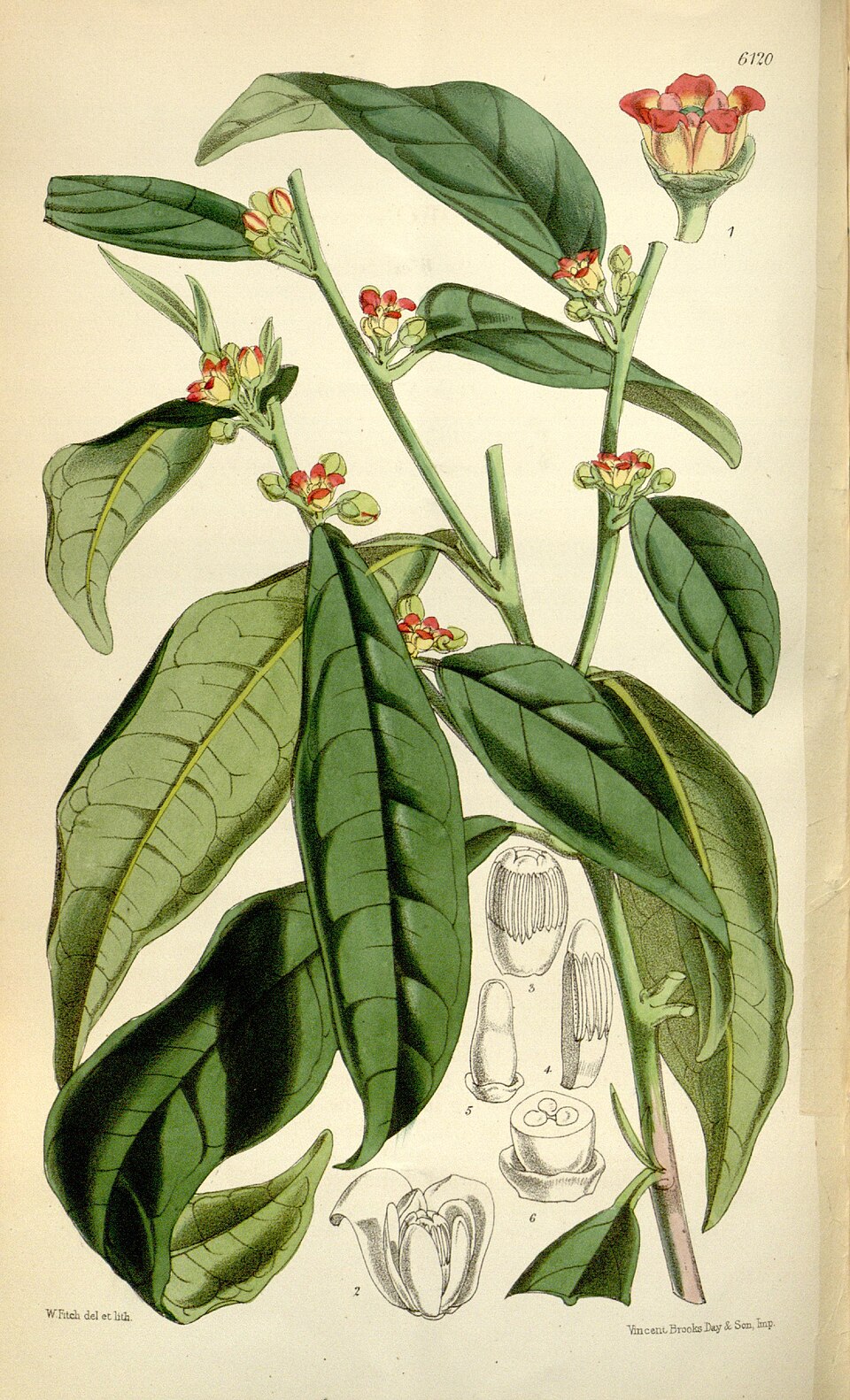
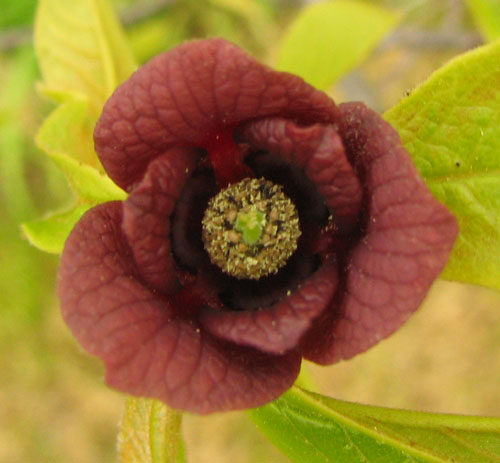
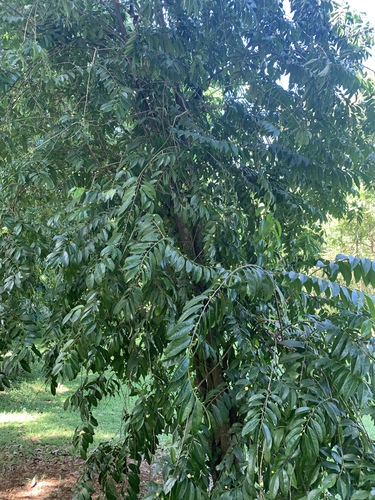
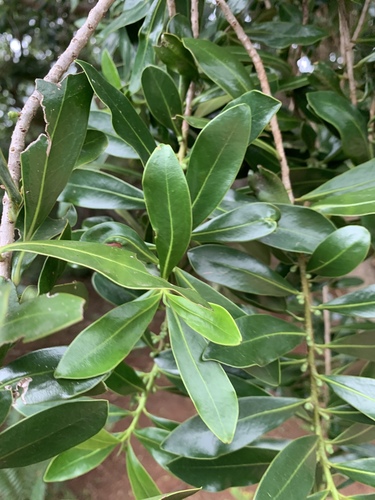
It is an evergreen tree. It grows to 25-30 m tall. The leaf canopy is dense and leafy. The bark is rough and brown-black. The bark cracks into rectangular scales. The leaves are dark green and shiny on the upper surface and with the midrib very clear below. The leaves are 10 cm long and the edges of the leaves are wavy. The flowers are green-cream and not easily seen. The fruit is round or egg shaped and 5 cm long. Fruit are on short stalks. The fruit are green to purple and with a waxy white surface. Several seeds occur in the pulp. The seeds are flat and heart shaped. This species has larger fruit than Warburgia salutaris but has sometimes been included with it.
Edible Uses
The fruit is used as a seasoning. The leaves, bark, young shoots, and fruit are added to curries, providing a hot peppery flavor. The roots are used in soups.
Traditional Uses
The fruit is used as a seasoning. The leaves, bark, young shoots and fruit can be used in curries. They have a hot peppery taste. The roots are used in soup.
Medicinal Uses
Traditional uses indicate medicinal applications, though specific remedies are not detailed in the available data.
Distribution
A tropical plant. It grows in East Africa from sea level to 2,000 m altitude. It grows on the edges of forests and in dry sites.
Where It Grows
Africa, Asia, Congo DR, East Africa, Eswatini, Ethiopia, India, Kenya, Malawi, South Africa, Swaziland, Tanzania, Uganda,
Cultivation
Plants can be grown from seeds or cuttings. Seeds germinate in about 15 days. Seed should be sown fresh wihout drying out.
Other Uses
The heartwood contains sesquiterpenoids that can be used against army worms, which are widely occurring African crop pests. The heartwood contains novel sesquiterpenoids such as bemadienolide, cinnamide, drimenol, muzigadial, polygodial, warburganal, warburgiadione, warburgin, ugandensidial and ugandensolide. These compounds exhibit antifeedant activity against army worm (Spodoptera littoralis and S. exepta), widely occurring African crop pests. The antifeedant activities of warburganal and muzigadial are comparable. These two compounds belong to the strongest group of anti-feedants against African army worm found so far. In addition, they exhibit very potent antifungal, antiyeast and plant-growth regulating activity. A resin obtained from the stem is used as a glue. The wood makes good timber for building and making furniture. The wood is used for fuel and to make charcoal. It has a high oil content and burns well with an incense-like smell. Heartwood yellow or greenish, becoming brown on exposure; very fragrant when freshly cut, the scent somewhat resembling that of sandalwood. Good timber for building and furniture, but not termite resistant. It saws easily, planes well and takes a high polish, but it is not durable and is liable to split on nailing. The wood somewhat resembles teak and shows a satin lustre; its fragrance persists over 4 years of storage. Milling of the wood gives rise to a dust that is very fragrant and causes sneezing. Fallen leaves provide green manure and mulch.
Production
The plant is fairly slow growing.
Also Known As
Mukuzanume, Museka, Musunui, Muthiga, Muziga, Ol-msohoni, Ol-sogunoi, Ol-sokoni, Omenyarige, Pepper-bark tree, Sok, Sorget, Zogdom
References (16)
- Asfaw, Z. and Tadesse, M., 2001, Prospects for Sustainable Use and Development of Wild Food Plants in Ethiopia. Economic Botany, Vol. 55, No. 1, pp. 47-62
- Bekele-Tesemma A., Birnie, A., & Tengnas, B., 1993, Useful Trees and Shrubs for Ethiopia. Regional Soil Conservation Unit. Technical Handbook No 5. p 446
- Dale, I. R. and Greenway, P. J., 1961, Kenya Trees and Shrubs. Nairobi. p 111
- Dharani, N., 2002, Field Guide to common Trees & Shrubs of East Africa. Struik. p 184
- Glover, et al, 1966b,
Show all 16 references Hide references
- Grivetti, L. E., 1980, Agricultural development: present and potential role of edible wild plants. Part 2: Sub-Saharan Africa, Report to the Department of State Agency for International Development. p 44
- Grubben, G. J. H. and Denton, O. A. (eds), 2004, Plant Resources of Tropical Africa 2. Vegetables. PROTA, Wageningen, Netherlands. p 566
- Heywood, V.H., Brummitt, R.K., Culham, A., and Seberg, O. 2007, Flowering Plant Families of the World. Royal Botanical Gardens, Kew. p 84
- Jardin, C., 1970, List of Foods Used In Africa, FAO Nutrition Information Document Series No 2.p 169
- Katende, A.B., Birnie, A & Tengnas B., 1995, Useful Trees and Shrubs for Uganda. Identification, Propagation and Management for Agricultural and Pastoral Communities. Technical handbook No 10. Regional Soil Conservation Unit, Nairobi, Kenya. p 668
- Mbuya, L.P., Msanga, H.P., Ruffo, C.K., Birnie, A & Tengnas, B., 1994, Useful Trees and Shrubs for Tanzania. Regional Soil Conservation Unit. Technical Handbook No 6. p 510
- Mutie, F. M., et al, 2023, Important Medicinal and Food Taxa (Orders and Families) in Kenya, Based on Three Quantitative Approaches. Plants 2023, 12, 1145
- Peters, C. R., O'Brien, E. M., and Drummond, R.B., 1992, Edible Wild plants of Sub-saharan Africa. Kew. p 75
- White, F., Dowsett-Lemaire, F. and Chapman, J. D., 2001, Evergreen Forest Flora of Malawi. Kew. p 180
- World Checklist of Useful Plant Species 2020. Royal Botanic Gardens, Kew
- www.worldagroforestrycentre.org/treedb/