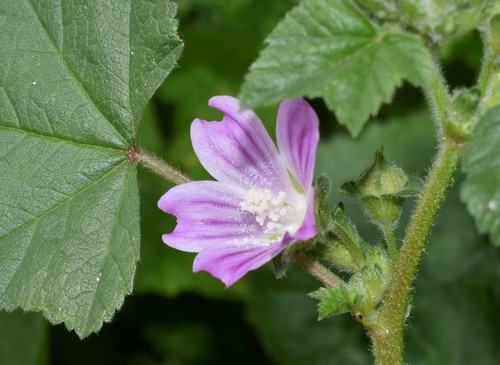
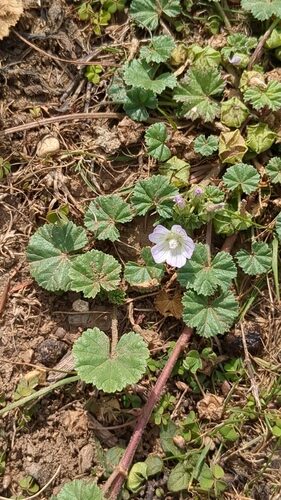
Waltheria indica
L.
Walteria
iNaturalist· cc0
no rights reserved, uploaded by 葉子
iNaturalist· cc-by-nc
(c) Finn McGhee, some rights reserved (CC BY-NC), uploaded by Finn McGhee
iNaturalist· cc-by-sa
(c) Judy Gallagher, some rights reserved (CC BY-SA), uploaded by Judy Gallagher
Summary
Source: WikipediaWaltheria indica is a species of flowering plant in the mallow family, Malvaceae, that has a pantropical distribution. It is believed to have originated in the Neotropics. Common names include sleepy morning, basora prieta, hierba de soldado, guimauve, mauve-gris, moto-branco, fulutafu, kafaki, and ʻuhaloa (Hawaii). W. indica is a short-lived subshrub or shrub, reaching a height of 2 m (6.6 ft) and a stem diameter of 2 cm (0.79 in). It is most common in dry, disturbed or well-drained, moist habitats. In Puerto Rico, it grows in areas that receive 750–1,800 mm (30–71 in) of annual rainfall and at elevations from sea level to more 400 m (1,300 ft).
Description
A herb or shrub. It grows 4 m high. The leaves are simple and 2-10 cm long by 1-4 cm wide. There are white stellate hairs on both sides. The flowers are in groups in the axils of leaves or at the ends of branches. The flowers are 3-4 mm wide. They have 5 yellow or orange petals. The fruit is a capsule. They are brown and 2 mm long and have 1 valve. They are tightly clustered together and are hairy. There is 1 seed.
Edible Uses
The leaves are eaten as a vegetable. The fruit is also edible.
Traditional Uses
The leaves are eaten as a vegetable.
This uses section is brief — help expand it
Medicinal Uses
The roots, leaves and flowers of W. indica are all used medicinally in some cultures.
Distribution
A tropical plant. It grows on sandy shores. It grows in monsoon and vine forests throughout the tropics. It also grows in woodland and savannah. In tropical Queensland it grows from sea level to 800 m altitude. In Argentina it grows from sea level to 1,000 m above sea level. In Yunnan.
Where It Grows
Africa, America, Anguilla, Argentina, Asia, Australia, Barbados, Botswana, Brazil, British Indian Ocean Terr., BIOT, Burkina Faso, Central America*, Chile, China, Cuba, Dominican Republic, East Africa, East Timor, Easter Island, Eswatini, Fiji, Guiana, Guianas, Guinea, Guinée, Guinea-Bissau, Guyana, Haiti, India, Indochina, Jamaica, Laos, Lesser Antilles*, Malawi, Malaysia, Mali, Marquesas, Mexico*, Mozambique, Myanmar, Nauru, North America, Pacific, Paraguay, Philippines, Puerto Rico, SE Asia, Senegal, Sierra Leone, Somalia, South Africa, Southern Africa, South America*, Suriname, Swaziland, Taiwan, Thailand, Timor-Leste, Tuvalu, Uganda, Venezuela, Virgin Islands, West Africa, West Indies*, Zambia, Zimbabwe,
Cultivation
Succeeds in a wide range of soils. The plant is a ubiquitous weed and early colonizer in disturbed ground, tolerant of a wide spectrum of habitats and elevations. It is considered to be invasive in many areas. The plant can flower and produce fruit all year round.10] Whereas Waltheria indica plants from Central America are homostylous, plants in India are reported as heterostylous[3.
Propagation
Seed - the fruit is a small, round, dry capsule containing one seed. Collect the tiny capsules when they are mature, but before they have turned completely brown. Dry them in a paper container for about a week and sift the resulting material though a strainer to separate the seeds. Sow the seeds on the surface of a planting mix; gently firm the seeds into the soil; place them in a shaded area and keep the mix damp until germination, although be careful to avoid excessive moisture. Germination takes 1 to 3 months.
Other Uses
|The bark yields a fibre similar to jute (Corchorus spp.), but is of no commercial interest.
Notes
There are about 30-60 Waltheria species. They are mostly in tropical America. It is used in medicine. Some authorities put it in the Sterculiaceae and Byttneriaceae.
Synonyms
Also Known As
Asum katito, Bauk-hpyaw, Bauk-hpyu, Bauk mya, Botongue-bandanuele, Bueta-rufera, Cujucujient, Dabada, Delelemukula, Egweret, Ensano, Fulutafu, Fulutalut, Futidorum-assai, Kafafe, Khain, Khar dudhi, Khwe-tayaw, Maracheera, Mefaga, Meidebossie, Nallabenda, Siigarab, Sinni, Sochinconhedje, Taansaai, Tambu, Tan sai, Uhadaaru-xoxoco, Uhaloa, Umputiputi
References (26)
- Ambasta, S.P. (Ed.), 2000, The Useful Plants of India. CSIR India. p 687
- Burkill, H. M., 1985, The useful plants of west tropical Africa, Vol. 5. Kew.
- Burkill, I.H., 1966, A Dictionary of the Economic Products of the Malay Peninsula. Ministry of Agriculture and Cooperatives, Kuala Lumpur, Malaysia. Vol 2 (I-Z) p 2294
- Cancilla, D., 2018, Ethnobotanical and Ethnozoological Values Desktop Assessment - Eliwana Project. p 15
- Cherikoff V. & Isaacs, J., The Bush Food Handbook. How to gather, grow, process and cook Australian Wild Foods. Ti Tree Press, Australia p 191
Show all 26 references Hide references
- Cooper, W. and Cooper, W., 2004, Fruits of the Australian Tropical Rainforest. Nokomis Editions, Victoria, Australia. p 535
- Cowie, I, 2006, A Survey of Flora and vegetation of the proposed Jaco-Tutuala-Lore National Park. Timor-Lests (East Timor) www.territorystories.nt/gov.au p 53
- Diarra, N. et al, 2016, Etude ethnobotanique des plantes alimentaires utilisées en période de soudure dans les régions Sud du Mali. Int. J. Biol. Chem. Sci. 10(1): 184-197
- Garcia, G. S. C., 2006, The mother-child nexus. Knowledge and valuation of wild food plants in Wayanad, Western Ghats, India. Journal of Ethnobiology and Ethnomedicine, 2:39
- Goode, P., 1989, Edible Plants of Uganda. FAO p 36
- Jackes, B.R., 2001, Plants of the Tropics. Rainforest to Heath. An Identification Guide. James Cook University. p 84
- Kenneally, K.E., Edinger, D. C., and Willing T., 1996, Broome and Beyond, Plants and People of the Dampier Peninsula, Kimberley, Western Australia. Department of Conservation and Land Management. p 191
- Magwede, K., van Wyk, B.-E., & van Wyk, A. E., 2019, An inventory of Vhavenḓa useful plants. South African Journal of Botany 122 (2019) 57–89
- Narayanan Ratheesh, M. K. et al, 2011, Wild edible plants used by the Kattunaikka, Paniya and Kuruma tribes of Wayanad District, Kerala, India. Journal of Medicinal Plants Research Vol. 5(15), pp. 3520-3529
- Paczkowska, G . & Chapman, A.R., 2000, The Western Australian Flora. A Descriptive Calatogue. Western Australian Herbarium. p 547
- Pickering, H., & Roe, E., 2009, Wild Flowers of the Victoria Falls Area. Helen Pickering, London. p 45
- Plants of Haiti Smithsonian Institute http://botany.si.edu/antilles/West Indies
- Ruiters-Welcome, A. K., 2019, Food plants of southern Africa. Ph.D. thesis. Univ. of Johannesburg p 78
- Smith, A.C., 1981, Flora Vitiensis Nova, Lawaii, Kuai, Hawaii, Volume 2 p 394
- Sp. pl. 2:673. 1753
- Thaman, R. R, 2016, The flora of Tuvalu. Atoll Research Bulletin No. 611. Smithsonian Institute p 116
- Topp, J. M. W., 1988, An Annotated Check List of the Flora of Diego Garcia, British Ocean Territory. Atoll Research Bulletin No. 313 (Rare)
- Welcome, A. K. & Van Wyk, B.-E., 2019, An inventory and analysis of the food plants of southern Africa. South African Journal of Botany 122 (2019) 136–179
- Wheeler, J.R.(ed.), 1992, Flora of the Kimberley Region. CALM, Western Australian Herbarium, p 196
- World Checklist of Useful Plant Species 2020. Royal Botanic Gardens, Kew
- Zizka, G., 1991, Flowering Plants of Easter Island. Palmarum Hortus Francofurtensis