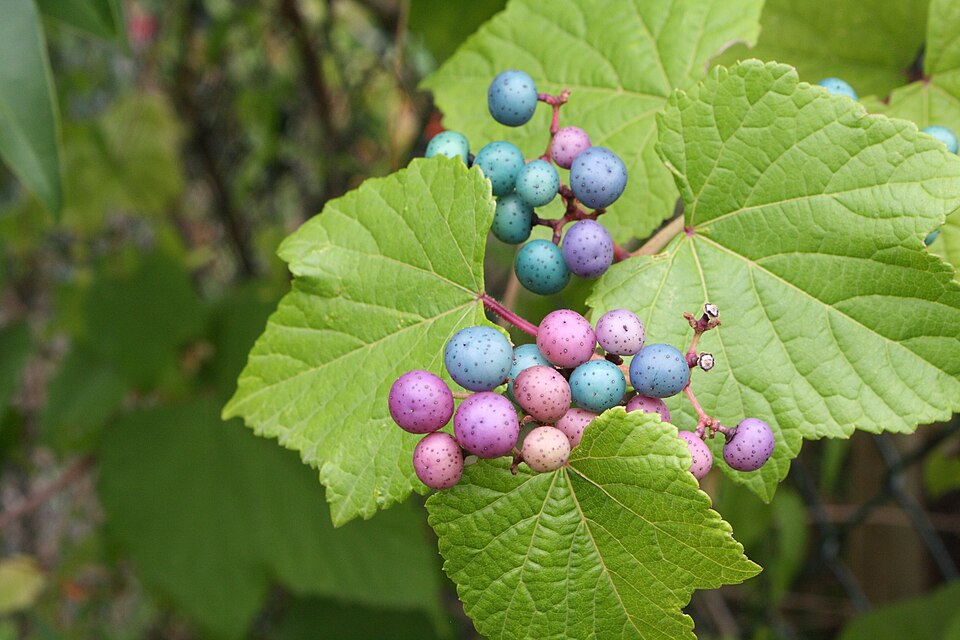
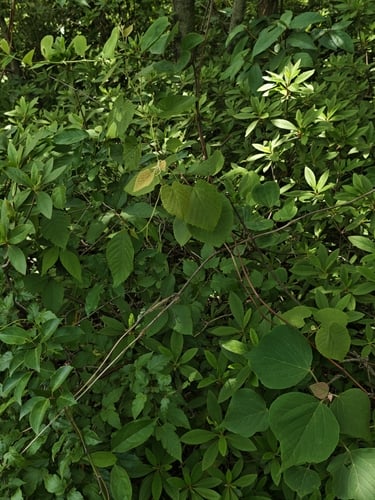
Vitis flexuosa
Thunberg
White-leaved bramble
wikimedia· cc0
Viala et Vermorel (via Wikimedia Commons)
wikimedia· cc-by-sa
Sten Porse (via Wikimedia Commons)
wikimedia· cc-by-sa
A W (via Wikimedia Commons)
iNaturalist· cc0
no rights reserved, uploaded by 葉子
iNaturalist· cc0
no rights reserved, uploaded by 葉子
iNaturalist· cc-by-nc-nd
(c) Bahamut Chao, some rights reserved (CC BY-NC-ND)
Summary
Source: WikipediaVitis flexuosa is a species of liana in the grape family. It has a very large native range in Asian tropical and temperate climate zones.
Description
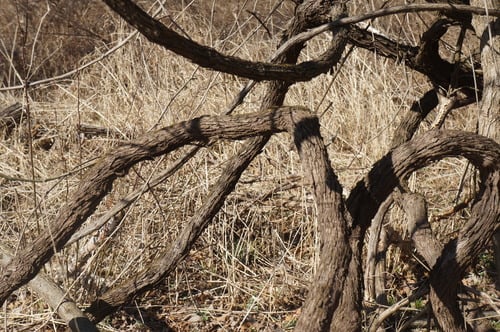
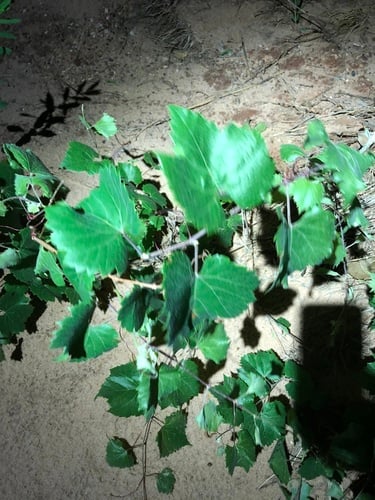
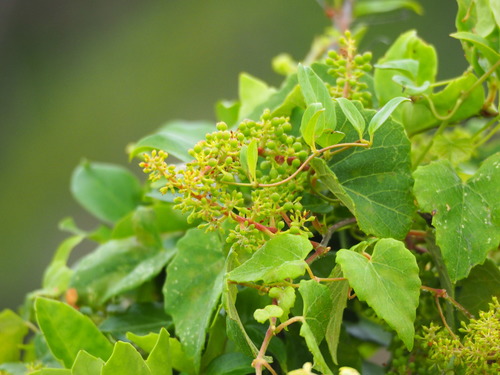
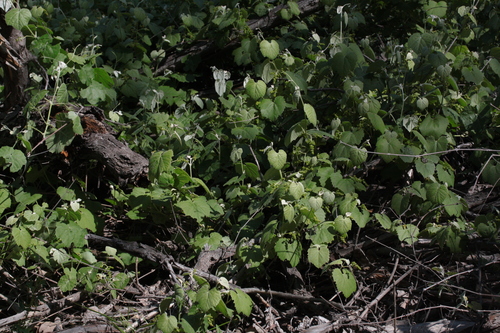
A woody creeper or vine. It loses its leaves during the year. The young branches are slender. They have soft hairs. The leaves are flattened oval shape. They are 4-11 cm long by 3-10 cm wide. The base it heart shaped or flat. There are unequal teeth along the edge. The flowers are small and 2 mm across. They are in groups 6-12 cm long. The fruit are berries 6-8 mm across. They are purple-black.
Edible Uses
The fruit, carried in bunches of roughly 7mm diameter berries, can be eaten raw or dried for winter use. Some forms of this plant produce palatable leaves — while no forms are known to be poisonous, some may be more palatable than others. Young leaves can be wrapped around other foods and baked, imparting a pleasant flavour. Young tendrils are edible raw or cooked. The sap has a sweet taste and can be made into a drink.
Traditional Uses
The fruit have been used to make wine. The fruit can be eaten raw.
This uses section is brief — help expand it
Medicinal Uses
The fruit is considered restorative, strengthening, and tonic. The sap is traditionally used to restore youth and black hair. The root is said to have a warming effect on the sinews.
Distribution
A subtropical plant. It is native to warm areas of China. It grows between 100-2,300 m above sea level.
Where It Grows
Asia, China, Himalayas, India, Indochina, Indonesia, Japan, Korea, Laos, Nepal, Pacific, Pakistan, Philippines, SE Asia, Thailand, Vietnam,
Cultivation
Prefers a deep rich moist well-drained moderately fertile loam. Grows best in a calcareous soil. Succeeds in sun or partial shade though a warm sunny position is required for the fruit to ripen. A very ornamental plant, it climbs by means of tendrils. Any pruning should be carried out in winter when the plants are dormant otherwise they bleed profusely. Plants in this genus are notably susceptible to honey fungus.
Propagation
Seed is best sown in a cold frame as soon as it ripens. Six weeks of cold stratification improves germination rates, so stored seed should be sown in a cold frame as soon as it is obtained. Germination usually occurs in the first spring but may take another 12 months. Prick seedlings into individual pots when large enough to handle, overwinter in a cold frame, and plant out in early summer. Hardwood cuttings of the current season's growth can be taken in December or January and rooted in a frame. These may be 15–30cm long, or short single-bud sections about 5cm long. For the shorter sections, remove a thin strip of bark roughly 3cm long from the lower side to encourage callusing and rooting; these smaller cuttings need more protection than longer ones. Layering is also an option.
Other Uses
A yellow dye is obtained from fresh or dried leaves.
Notes
There are 60 to 70 species of Vitis.
Dangerous Lookalikes
This plant can be confused with the following toxic species. Always verify identification carefully before consuming any wild plant.
Canadian Moonseed
Menispermum canadense
Cbaile19
White-leaved bramble
Vitis flexuosa
Viala et Vermorel (via Wikimedia Commons)
Canadian Moonseed: No tendrils, single crescent/moon-shaped seed, leaf stem attaches to underside of leaf.
White-leaved bramble: Vine with tendrils, round seeds, leaf stem at edge of leaf, bark that peels.
Synonyms
Also Known As
Areuj sirarah, Bu reng, Malavo, Pan-laguli
References (14)
- Ahmad, K. & Pieroni, A., 2016, Folk knowledge of wild food plants among the tribal communities of Thakht-e-Sulaiman Hills, North-West Pakistan. Journal of Ethnobiology and Ethnomedicine, 12:17
- Burkill, I.H., 1966, A Dictionary of the Economic Products of the Malay Peninsula. Ministry of Agriculture and Cooperatives, Kuala Lumpur, Malaysia. Vol 2 (I-Z) p 2283
- Chen, B. & Qiu, Z., Consumer's Attitudes towards Edible Wild Plants, Ishikawa Prefecture, Japan. p 26 www.hindawi.com/journals/ijfr/aip/872413.pdf
- Cheng, Z., et al, 2022, Ethnobotanical study on wild edible plants used by Dulong people in northwestern Yunnan, China. Journal of Ethnobiology and Ethnomedicine (2022) 18:3
- Hu, Shiu-ying, 2005, Food Plants of China. The Chinese University Press. p 535
Show all 14 references Hide references
- Hui, Y. H., Handbook of Food Science, Technology, and Engineering. Volume 2. Table 98:2
- Hwang, H., et al, 2013, A Study on the Flora of 15 Islands in the Western Sea of Jeollanamdo Province, Korea. Journal of Asia-Pacific Biodiversity Vol. 6, No. 2 281-310
- Hwang, HS, et al, 2014, Distribution characteristics of plant in the Ungseokbong Mountain, Gyeongsangnam-do, Korea. Journal of Asia-Pacific Biodiversity. 7(2014) e164-e178
- Plants for a Future database, The Field, Penpol, Lostwithiel, Cornwall, PL22 0NG, UK. http://www.scs.leeds.ac.uk/pfaf/
- PROSEA handbook Volume 9 Plants yielding non-seed carbohydrates. p 190
- Reis, S. V. and Lipp, F. L., 1982, New Plant Sources for Drugs and Foods from the New York Botanical Garden herbarium. Harvard. p 175
- Trans. Linn. Soc. London 2:332. 1794
- Upreti, K., et al, 2010, Diversity and Distribution of Wild Edible Fruit Plants of Uttarakhand. Bioversity Potentials of the Himalaya. p 193
- World Checklist of Useful Plant Species 2020. Royal Botanic Gardens, Kew