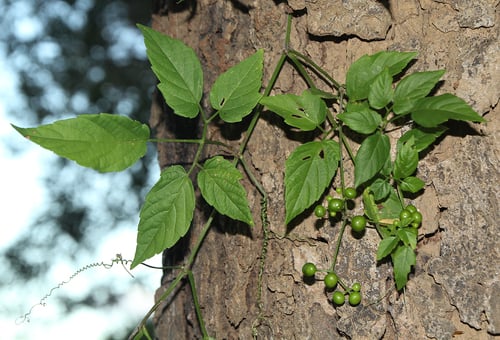
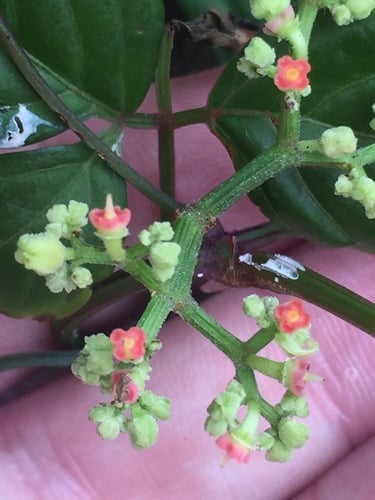
Vitis coignetiae
Pulliat ex Planch.
Crimson glory vine
iNaturalist· cc-by-nc
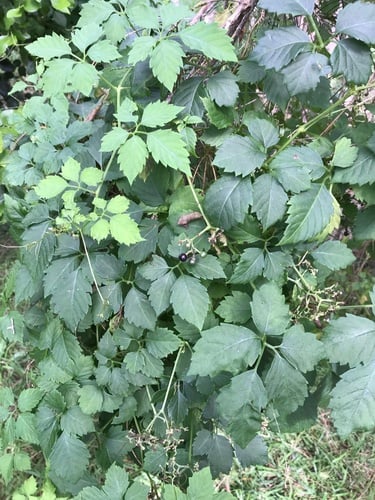
(c) Alexander Yakovlev, some rights reserved (CC BY-NC), uploaded by Alexander Yakovlev
iNaturalist· cc-by-nc
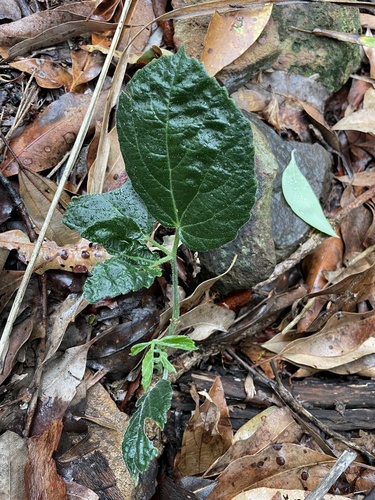
(c) Елена Линник, some rights reserved (CC BY-NC)
Summary
Source: WikipediaVitis coignetiae, commonly called crimson glory vine, is a species of grapevine belonging to the family Vitaceae. Is native to the temperate climes of Asia and can be found in the Russian Far East (Sakhalin), Korea, and Japan (Hokkaido, Honshu, Shikoku). It was described botanically in 1883. It is called meoru (머루) in Korean and yama-budo (ヤマブドウ) in Japanese.
Description
A climber. It grows 15-22 m long. The leaves are dark green and heart-shaped. They can be 30 cm long with 3-5 lobes. The veins are deeply sunk and the underside is like felt and rusty red. In autumn the leaves turn orange, purplish-brown and scarlet, then fall. The fruit are black.
Edible Uses
The fruit, about 12mm in diameter and carried in bunches, is scarcely edible. It can be eaten raw or dried for winter use. Young leaves can be wrapped around other foods and baked, imparting a pleasant flavour. Young tendrils can be eaten raw or cooked. Young stems and leafstalks can be boiled.
Traditional Uses
The ripe fruit are eaten raw. They are also brewed into wine. The young stems and leaf stalks are boiled and eaten.
This uses section is brief — help expand it
Medicinal Uses
None known
Distribution
It is a temperate plant. It does best in well-composted, moist and well-drained soils. It needs an open, sunny position. It is frost hardy. It suits hardiness zones 5-9. Arboretum Tasmania. Mt Lofty Botanical Gardens.
Where It Grows
Asia, Australia, Canada, Japan*, Korea, North America, Russia, Tasmania,
Cultivation
Prefers a deep rich moist well-drained moderately fertile loam. Grows best in a calcareous soil. Succeeds in sun or partial shade though a warm sunny position is required for the fruit to ripen. The fully dormant plant is hardy to about -25°c, though the young growth in spring can be damaged by late frosts. Plants climb by means of tendrils. Any pruning should be carried out in winter when the plants are dormant otherwise they bleed profusely. A fast growing climber, attaching itself by means of tendrils, it is ideal for growing into large trees. Plants are often slow to establish, taking 1 - 2 years from planting out before they make much new growth. A very ornamental plant with its large leaves which colour well in the autumn. Plants in this genus are notably susceptible to honey fungus.
Propagation
Seed is best sown in a cold frame as soon as it is ripe. Six weeks of cold stratification improves germination, so stored seed should also be sown in a cold frame as soon as it is obtained. Germination usually occurs in the first spring but can take another 12 months. Prick out seedlings into individual pots when large enough to handle and grow on in a cold frame through their first winter, then plant out in early summer. Cuttings of mature wood from the current season's growth can be taken in December or January and rooted in a frame. These can be 15–30cm long, or short sections about 5cm long with a single bud at the top. For the shorter sections, remove a thin, narrow strip of bark about 3cm long from the lower portion of one side to encourage callusing and root formation; shorter cuttings need a more sheltered environment than longer ones. Note that cuttings are difficult with this species. Layering is the most reliable method for this species.
Other Uses
A yellow dye is obtained from the fresh or dried leaves. The plant can also be used as a ground cover in a sunny position, with plants spaced about 3.5 metres apart each way. To establish ground cover, lay brushwood flat on the ground and peg it into position to encourage the vines to spread; the brushwood will eventually rot and the plant will take over completely.
Other Information
It is cultivated.
Notes
There are 60 to 70 species of Vitis.
Dangerous Lookalikes
This plant can be confused with the following toxic species. Always verify identification carefully before consuming any wild plant.
Canadian Moonseed
Menispermum canadense
Cbaile19
Crimson glory vine
Vitis coignetiae
(c) Alexander Yakovlev, some rights reserved (CC BY-NC), uploaded by Alexander Yakovlev
Canadian Moonseed: No tendrils, single crescent/moon-shaped seed, leaf stem attaches to underside of leaf.
Crimson glory vine: Vine with tendrils, round seeds, leaf stem at edge of leaf, bark that peels.
Synonyms
Also Known As
Meogu, Meolgu, Meoru, Yama-budo
References (16)
- Chen, B. & Qiu, Z., Consumer's Attitudes towards Edible Wild Plants, Ishikawa Prefecture, Japan. p 26 www.hindawi.com/journals/ijfr/aip/872413.pdf
- Cundall, P., (ed.), 2004, Gardening Australia: flora: the gardener's bible. ABC Books. p 1478 (Fruit said to be inedible)
- Facciola, S., 1998, Cornucopia 2: a Source Book of Edible Plants. Kampong Publications, p 245
- Flowerdew, B., 2000, Complete Fruit Book. Kyle Cathie Ltd., London. p 92
- Hibbert, M., 2002, The Aussie Plant Finder 2002, Florilegium. p 308
Show all 16 references Hide references
- Joyce, D., 1998, The Garden Plant Selector. Ryland, Peters and Small. p 188 (fruit described as inedible)
- Lord, E.E., & Willis, J.H., 1999, Shrubs and Trees for Australian gardens. Lothian. p 339
- Ong, H. G., et al, 2015, Ethnobotany of the wild edible plants gathered in Ulleung Island, South Korea. Genet Resourc Crop Evol. Springer
- Plants for a Future database, The Field, Penpol, Lostwithiel, Cornwall, PL22 0NG, UK. http://www.scs.leeds.ac.uk/pfaf/
- Ryan, S., 2008, Dicksonia. Rare Plants Manual. Hyland House. p 79
- Song, M., et al, 2013, Traditional knowledge of wild edible plants in Jeju Island, Korea. Indian Journal of Traditional Knowledge. 12(2) pp 177-194
- Tanaka,
- Vigne Amer. Vitic. Eur. 7:186. 1883
- Wiersema, J. H. & Leon, B., 2013, World Economic Plants. A Standard Reference CRC Press. 2nd Ed. p 725
- Williams, D., 2017, Ainu Ethnobiology. Contributions in Ethnobiology. Society of Ethnobiology. p 148
- World Checklist of Useful Plant Species 2020. Royal Botanic Gardens, Kew