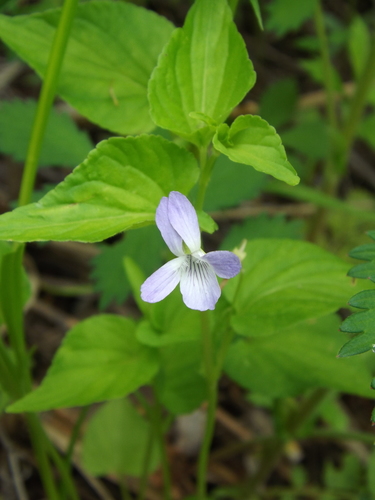
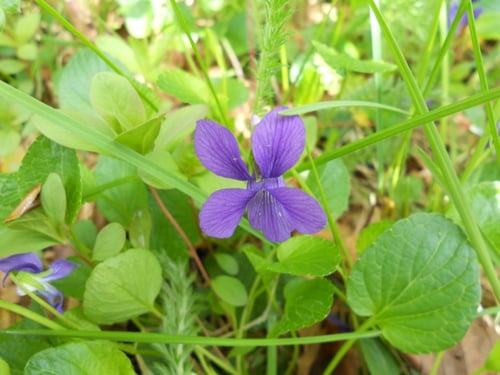
Viola abyssinica
Steud. ex Oliv.
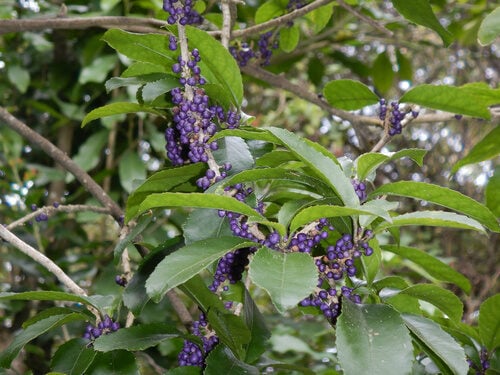
iNaturalist· cc-by-nc
(c) Zein et Carlo, some rights reserved (CC BY-NC), uploaded by Zein et Carlo
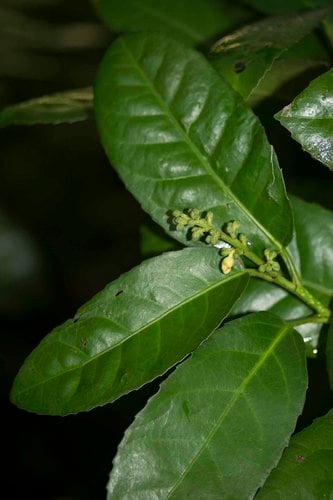
iNaturalist· cc-by-nc
(c) Bart Wursten, some rights reserved (CC BY-NC), uploaded by Bart Wursten
iNaturalist· cc-by-nc
(c) Berit Gehrke, some rights reserved (CC BY-NC)
Summary
Source: WikipediaViola abyssinica is a low perennial plant with long trailing stems and whitish or light purple flowers with purple markings on the lip, that is assigned to the violet family. In the wild it grows in moist grassland, forest glades and margins, at altitudes between 1,200 and 3,400 m (3,900 and 11,200 ft), in eastern Africa, from South Africa to Ethiopia, in Cameroun and Nigeria, and on Madagascar and Bioko. Vernacular names are bezongozongo in Madagascar, and dukunsha in Ethiopia.
Description
A herb that lies along the ground. The stems are slender. They form roots along the stem. The leaves are heart shaped. The flower petals form a sac.
Edible Uses
The leaves are occasionally cooked and eaten as a vegetable.
Traditional Uses
The leaves are occasionally cooked and eaten.
This uses section is brief — help expand it
Medicinal Uses
In Ethiopia, leaves of Viola abyssinica are crushed and squeezed to get the juice, which is applied to hard leather, which it helps to soften. In Madagascar it is given as an antidote and to stimulate vomiting in a traditional medicine. Along the eastern border of Congo, it is rubbed with other herbs in butter to make a massage oil. Several unique cyclotides have been isolated from this species, that have cytotoxic properties and may be of use in the development of future medicines.
Distribution
A tropical plant. It grows in evergreen forest at high altitude in Malawi. It can grow between 1,200-2,500 m above sea level and can reach 3,350 m.
Where It Grows
Africa, Cameroon, Central Africa, East Africa, Equatorial Guinea, Ethiopia, Madagascar, Malawi, Mozambique, Nigeria, West Africa, Zambia, Zimbabwe,
Notes
There are about 550 Viola species. About 100 are in tropical America. They are mostly in temperate regions.
Synonyms
References (8)
- Chapman, J. D. & Chapman, H. M., 2001, The Forest Flora of Taraba and Andamawa States, Nigeria. WWF & University of Canterbury. p 207
- Jardin, C., 1970, List of Foods Used In Africa, FAO Nutrition Information Document Series No 2.p 109
- Grubben, G. J. H. and Denton, O. A. (eds), 2004, Plant Resources of Tropical Africa 2. Vegetables. PROTA, Wageningen, Netherlands. p 565
- Martin, F.W. & Ruberte, R.M., 1979, Edible Leaves of the Tropics. Antillian College Press, Mayaguez, Puerto Rico. p 224
- Peters, C. R., O'Brien, E. M., and Drummond, R.B., 1992, Edible Wild plants of Sub-saharan Africa. Kew. p 199
Show all 8 references Hide references
- Fl. trop. Afr. 1:105. 1868
- Williamson, J., 2005, Useful Plants of Malawi. 3rd. Edition. Mdadzi Book Trust. p 264
- World Checklist of Useful Plant Species 2020. Royal Botanic Gardens, Kew