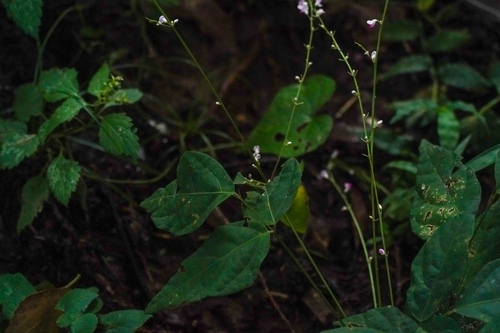
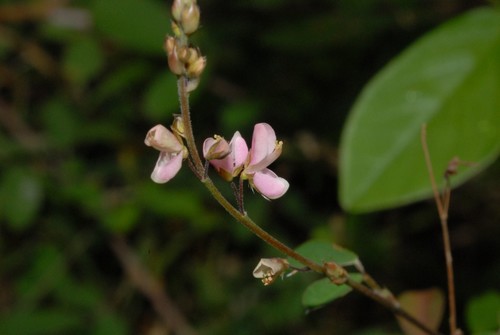
Vicia tetrasperma
(L.) Schreb.
Smooth tare, Four-leaved slender vetch, Slender tare
iNaturalist· cc-by-nc
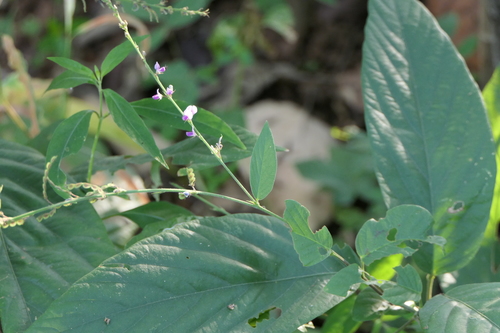
(c) Philip Mark Osso, some rights reserved (CC BY-NC), uploaded by Philip Mark Osso
iNaturalist· cc-by-nc-nd
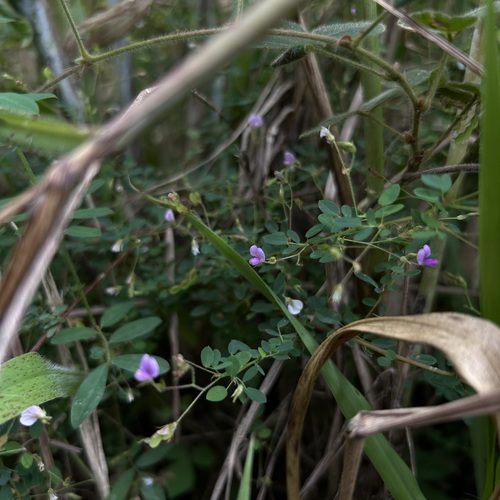
(c) Bastiaan, some rights reserved (CC BY-NC-ND)
iNaturalist· cc-by-nc-nd
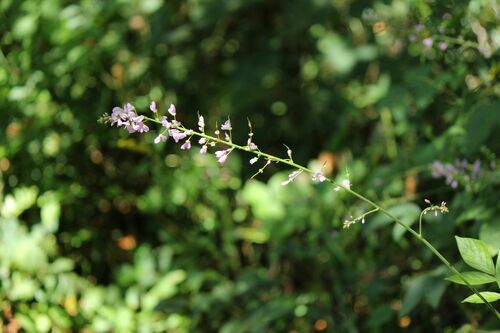
(c) Bastiaan, some rights reserved (CC BY-NC-ND)
Summary
Source: WikipediaVicia tetrasperma (syn. Ervum tetraspermum) the smooth tare, smooth vetch, lentil vetch or sparrow vetch, is a species of flowering plant in the bean family Fabaceae.
Description
A slender scrambling annual herb. The leaves have 3-6 pairs of leaflets. They are usually alternate. They are narrowly oblong and 5-20 mm long by 1-3 mm wide. They have a very small sharp tip. The stalk of the leaf has a tendril at the end. There are 1 or 2 flowers in a group. The flower stalks are 2-4 cm long. The petals are pale blue and there is a purple spot on the keel. The pods are oblong and 10-15 mm long by 3.5 mm wide. There are usually 4 seeds. The pods are smooth and light brown. The seeds are almost round and 2 mm across. The seeds are brown.
Edible Uses
Young leaves and shoots are cooked and eaten as a vegetable. The plant also serves as a coffee substitute, with the roasted seeds almost certainly being the part used for this purpose.
Traditional Uses
The young leaves and shoots are eaten. They are also used as a coffee substitute.
This uses section is brief — help expand it
Medicinal Uses
None known.
Distribution
It is a temperate plant. In China it grows from sea level to 2,900 m above sea level. Tasmania Herbarium. In Sichuan and Yunnan.
Where It Grows
Afghanistan, Africa, Australia, Bhutan, Britain, Central Asia, China, Europe, France, Himalayas, India, Iran, Italy, Japan, Kazakhstan, Korea, Kyrgyzstan, Luxembourg, Mediterranean, Middle East, Norfolk Island, North Africa, North America, Pakistan, Portugal, Russia, Spain, Taiwan, Tajikistan, Tasmania, Turkey, Türkiye, USA, Uzbekistan,
Propagation
Pre-soak seed for 24 hours in warm water, then sow in situ in spring or autumn.
Other Uses
Fixes atmospheric nitrogen.
Notes
There are about 140 Vicia species. They are mostly temperate.
Synonyms
Also Known As
Kasuma-gusa
References (8)
- Blamey, M and Grey-Wilson, C., 2005, Wild flowers of the Mediterranean. A & C Black London. p 89
- Facciola, S., 1998, Cornucopia 2: a Source Book of Edible Plants. Kampong Publications, p 112
- Flora of Australia Volume 49, Oceanic Islands 1, Australian Government Publishing Service, Canberra. (1994) p 189
- Hyde-Wyatt, B.H. & Morris D.I., 1975, Tasmanian Weed Handbook. Dept of Ag Tasmania. p 102
- Plants for a Future database, The Field, Penpol, Lostwithiel, Cornwall, PL22 0NG, UK. http://www.scs.leeds.ac.uk/pfaf/
Show all 8 references Hide references
- Spic. fl. lips. 26. 1771
- Tanaka,
- Tasmanian Herbarium Vascular Plants list p 32