Viburnum trilobum
Marshall
Highbush cranberry, Cranberry Viburnum, American Cranberry bush
Wikipedia· cc-by-sa
Wikimedia Commons - Highbush_Cranberry.jpg
iNaturalist· cc-by-nc
(c) Keith Kutsko, some rights reserved (CC BY-NC)
Summary
Source: WikipediaViburnum trilobum (cranberrybush viburnum, American cranberrybush, high bush cranberry, or highbush cranberry) is a species of Viburnum native to northern North America, from Newfoundland west to British Columbia, south to Washington state and east to northern Virginia. It is very closely related to the European and Asian Viburnum opulus, and is often treated as a variety of it, as Viburnum opulus L. var. americanum Ait., or as a subspecies, Viburnum opulus subsp. trilobum (Marshall) Clausen.
Description
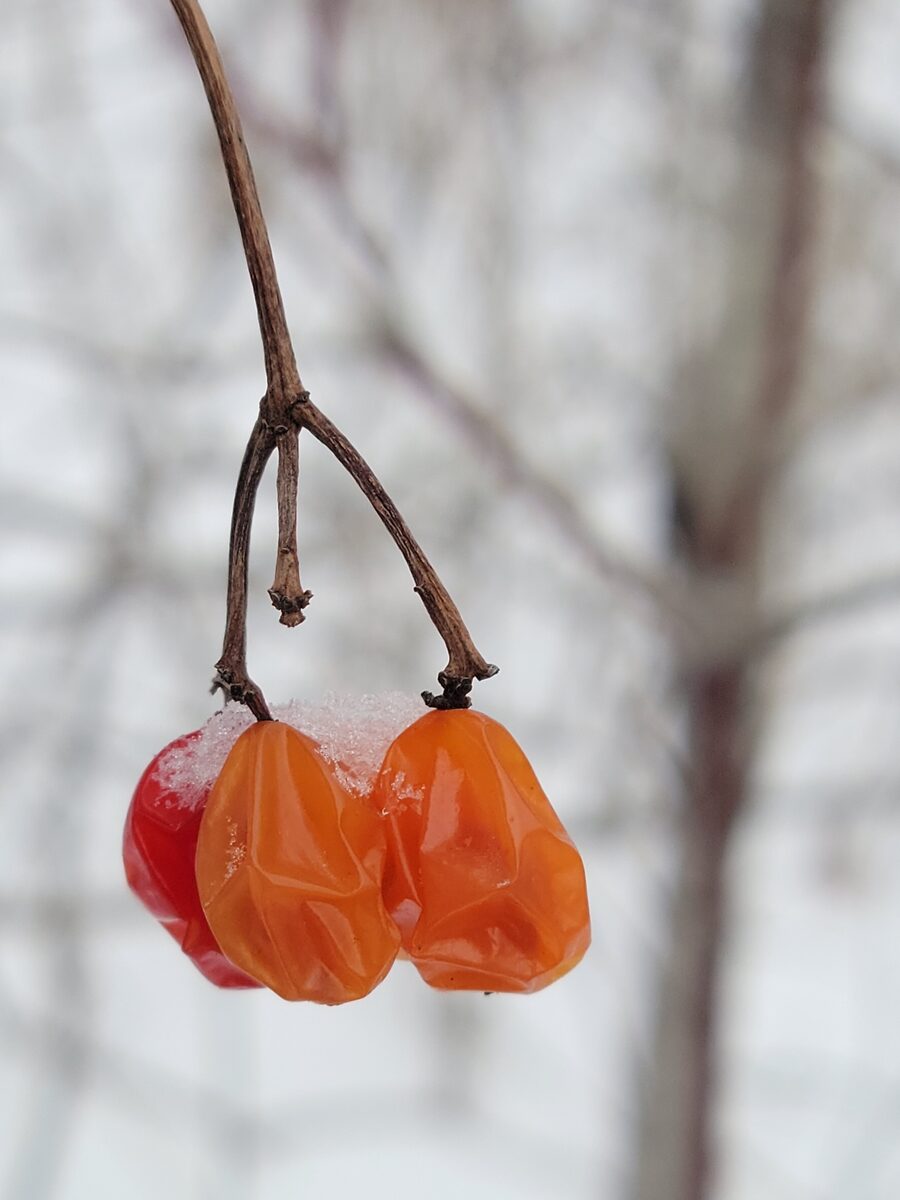
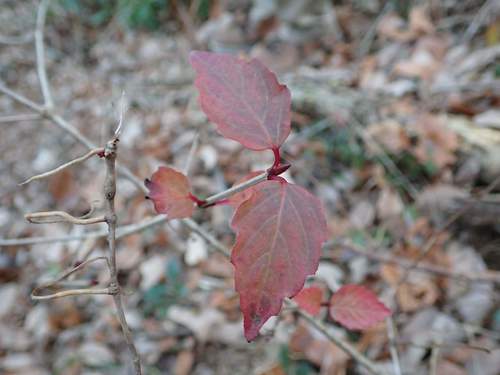
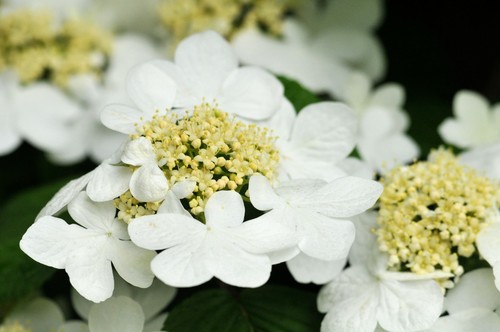
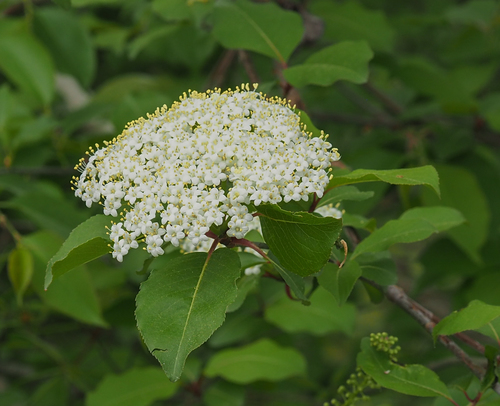
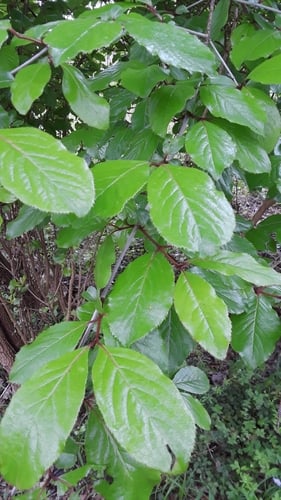
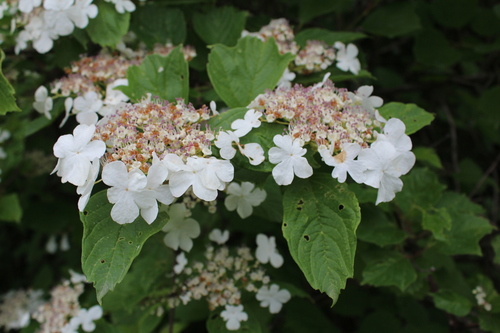
A shrub. The leaves are 5-11 cm long and almost as wide. They have 3 lobes. They are maple like. The edges are smooth or have sparse teeth. The leaf stalks are 2-4 cm long and have a groove. There are several small club shaped glands where the stalk meets the leaf blade. The flowers are in flat topped clusters. These are at the ends of branches. They can be 10 cm across. The outer flowers are larger, white and sterile. The inner flowers are small and fertile. The fruit is bright red or orange. They are 8-10 mm across. They are edible.
Edible Uses
The fruit can be eaten raw or cooked. It is juicy but acid, with the best flavour developing after a frost. The fruits are rich in vitamin C and make an excellent substitute for cranberries, working well in preserves, jams, and similar preparations — a jam made from the fruit has a very pleasant flavour that pairs well with porridge. Each fruit is about 8 mm in diameter and contains a single large seed.
Traditional Uses
The fruit are used in stews and for drinks. They can be used as a substitute for cranberries. They can be used in sauce, drinks, jams, jellies and wine. The flowers can be added to pancakes and fritters.
Medicinal Uses
An infusion of the roots has been used to treat prolapse of the uterus, and a decoction of the branches to treat a fallen womb after birth. A decoction has also been given to babies with fevers. The bark is laxative, and an infusion of the inner bark has been used to treat stomach cramps. An infusion of the roots has been used as an emetic in the treatment of bad blood and fevers.
Known Hazards
Large quantities of the fruit can cause vomiting and diarrhoea. The fruit is of very low or zero toxicity, it only causes mild upsets when eaten unripe or in large quantities.
Distribution
It is a temperate plant. They prefer well drained soil. They are shade tolerant. Melbourne Botanical gardens. It suits hardiness zones 2-8.
Where It Grows
Australia, Canada, North America, USA,
Cultivation
An easily grown plant, it succeeds in most soils but is ill-adapted for poor soils and for dry situations. It grows well in heavy clay soils. Established plants are drought tolerant. Prefers a deep rich loamy soil in sun or semi-shade. Best if given shade from the early morning sun in spring. This species is considered by some botanists to be no more than a superior fruiting form of V. opulus that was taken to America by early settlers. Occasionally cultivated for its edible fruit, there are some named varieties. The fruit is very attractive to birds. Some reports say that this species is self-fertile whilst others say it is self-incompatible. It is probably best to grow at least two different cultivars in order to produce fruit and fertile seed.
Propagation
Seed is best sown in a cold frame as soon as it is ripe. Germination can be slow, sometimes taking more than 18 months. If seed is harvested green — fully developed but not yet fully ripened — and sown immediately in a cold frame, it should germinate in spring. Stored seed requires 2 months warm then 3 months cold stratification and can still take 18 months to germinate. Prick out seedlings into individual pots when large enough to handle and grow on in a cold frame or greenhouse. Plant out into permanent positions in late spring or early summer of the following year. Softwood cuttings taken in early summer in a frame: pot up into individual pots once rooting begins and plant out in late spring or early summer the following year. Half-ripe cuttings, 5–8 cm long with a heel if possible, taken in July/August in a frame: pot up as soon as rooting starts. These cuttings can be difficult to overwinter and are best kept in a greenhouse or cold frame until the following spring before planting out. Mature wood cuttings taken in winter in a frame should root in early spring — pot up when large enough and plant out in summer if sufficient new growth has been made, otherwise overwinter in a cold frame and plant out the following spring. Layering of current season's growth in July/August takes 15 months.
Other Uses
None known
Notes
The fruit is rich in Vit C. There are about 150 Viburnum species. Also put in the family Caprifoliaceae.
Synonyms
References (20)
- Arbust. amer. 162. 1785
- Beckstrom-Sternberg, Stephen M., and James A. Duke. "The Foodplant Database." http://probe.nalusda.gov:8300/cgi-bin/browse/foodplantdb.(ACEDB version 4.0 - data version July 1994)
- Bodkin, F., 1991, Encyclopedia Botanica. Cornstalk publishing, p 1016
- Brickell, C. (Ed.), 1999, The Royal Horticultural Society A-Z Encyclopedia of Garden Plants. Convent Garden Books. p 1051
- Cormack, R. G. H., 1967, Wild Flowers of Alberta. Commercial Printers Edmonton, Canada. p 330
Show all 20 references Hide references
- Cundall, P., (ed.), 2004, Gardening Australia: flora: the gardener's bible. ABC Books. p 1469
- Elias, T.S. & Dykeman P.A., 1990, Edible Wild Plants. A North American Field guide. Sterling, New York p 224, 250
- Esperanca, M. J., 1988. Surviving in the wild. A glance at the wild plants and their uses. Vol. 2. p 13
- Facciola, S., 1998, Cornucopia 2: a Source Book of Edible Plants. Kampong Publications, p 73
- Farrar, J.L., 1995, Trees of the Northern United States and Canada. Iowa State University press/Ames p 179
- Fisk, J. R. & Hoover, E., 2015, Wild Fruits of Minnesota. A Field Guide. University of Minnesota p 33
- Flowerdew, B., 2000, Complete Fruit Book. Kyle Cathie Ltd., London. p 172
- Glowinski, L., 1999, The Complete Book of Fruit Growing in Australia. Lothian. p 183
- Hanelt, P. et al, (Eds.), 2001, Mansfield's encyclopedia of agricultural and horticultural crops. p 1701
- Hibbert, M., 2002, The Aussie Plant Finder 2002, Florilegium. p 306
- Kermath, B. M., et al, 2014, Food Plants in the Americas: A survey of the domesticated, cultivated and wild plants used for Human food in North, Central and South America and the Caribbean. On line draft. p 907
- Kiple, K.F. & Ornelas, K.C., (eds), 2000, The Cambridge World History of Food. CUP p 1785
- Lord, E.E., & Willis, J.H., 1999, Shrubs and Trees for Australian gardens. Lothian. p 270
- MacKinnon, A., et al, 2009, Edible & Medicinal Plants of Canada. Lone Pine. p 126
- Plants for a Future database, The Field, Penpol, Lostwithiel, Cornwall, PL22 0NG, UK. http://www.scs.leeds.ac.uk/pfaf/