Vaccinium koreanum
Nakai
iNaturalist· cc-by-nc
(c) Mingyu Sung, some rights reserved (CC BY-NC)
iNaturalist· cc-by-nc
(c) Mingyu Sung, some rights reserved (CC BY-NC)
iNaturalist· cc-by-nc
(c) Alexander Ganse, some rights reserved (CC BY-NC)
Summary
Source: WikipediaVaccinium koreanum, the Korean blueberry, Korean: 산앵도나무, romanized: sanaedonamu, Chinese: 红果越桔; pinyin: hóngguǒyuèjié, is a plant species native to Korea and neighboring Liaoning Province in China. It is a deciduous shrub with toothed leaves and red, ellipsoid berries.
Description
A small shrub. It loses its leaves during the year. It grows 50 cm high. The leaves turn red in autumn. The flowers are small and white. The fruit are bright red berries. Possibly Vaccinium hirtum var. koreanum (Nakai) Kitam.
Edible Uses
The fruit can be eaten raw or cooked.
Medicinal Uses
None known
Known Hazards
None known
Distribution
It is a temperate plant. In north China it grows in rocky places on mountain summits between 600-1,000 m above sea level.
Where It Grows
Asia, Australia, China, Japan, Korea*,
Cultivation
We have very little information on this species and do not know if it will be hardy in Britain, though judging by its native range it should succeed outdoors in most parts of the country. The following notes are based on the general needs of the genus. Requires a moist but freely-draining lime free soil, preferring one that is rich in peat or a light loamy soil with added leaf-mould. Prefers a very acid soil with a pH in the range of 4.5 to 6, plants soon become chlorotic when lime is present. Succeeds in full sun or light shade though it fruits better in a sunny position. Requires shelter from strong winds. Dislikes root disturbance, plants are best grown in pots until being planted out in their permanent positions. Plants in this genus are notably resistant to honey fungus.
Propagation
Sow seed in late winter in a greenhouse using a lime-free potting mix, barely covering the seed. Stored seed may need up to 3 months of cold stratification. Alternatively, sow fresh seed in a greenhouse as soon as it is ripe. Prick seedlings out into individual pots once they reach about 5cm tall, and grow on in a lightly shaded position in the greenhouse through at least their first winter. Plant out into permanent positions in late spring or early summer, after the last expected frosts. Cuttings of half-ripe wood, 5–8cm with a heel, can be taken in August and rooted in a frame, though this is slow and difficult. Layering can be done in late summer or early autumn, or in spring according to some sources, and takes 18 months. Suckers can be divided in spring or early autumn.
Other Uses
None known
Dangerous Lookalikes
This plant can be confused with the following toxic species. Always verify identification carefully before consuming any wild plant.
Deadly Nightshade
Atropa belladonna
Joan Simon from Barcelona, España
Vaccinium koreanum
Vaccinium koreanum
(c) Mingyu Sung, some rights reserved (CC BY-NC)
Deadly Nightshade: Tall herbaceous plant (1-2m), single shiny black cherry-sized berries, star-shaped calyx, large oval leaves, sweet but dangerous taste.
Vaccinium koreanum: Low woody shrub, berries in clusters with crown/remnant calyx ring, sweet taste.
References (4)
- Hwang, HS, et al, 2014, Distribution characteristics of plant in the Ungseokbong Mountain, Gyeongsangnam-do, Korea. Journal of Asia-Pacific Biodiversity. 7(2014) e164-e178 (As Vaccinium hirtum var. koreanum (Nakai) Kitam.)
- Plants for a Future database, The Field, Penpol, Lostwithiel, Cornwall, PL22 0NG, UK. http://www.scs.leeds.ac.uk/pfaf/
- Ryan, S., 2008, Dicksonia. Rare Plants Manual. Hyland House. p 60
- Trees shrubs Japan 1:191. fig. 113. 1922
More from Ericaceae
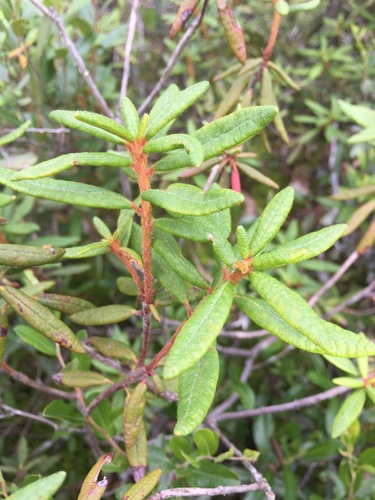
Ledum palustre subsp. decumbens
Marsh labrador tea
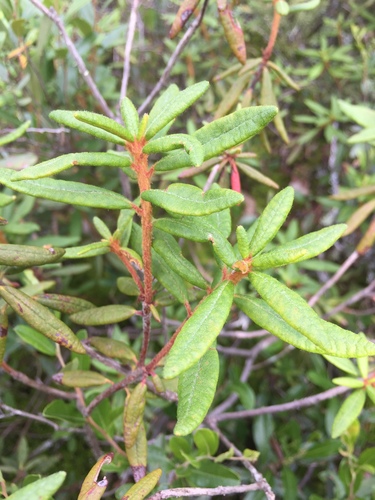
Ledum palustre subsp. groenlandicum
Labrador tea
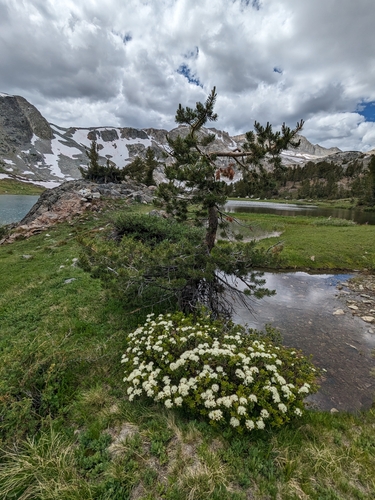
Ledum x columbianum
Coast Labrador tea
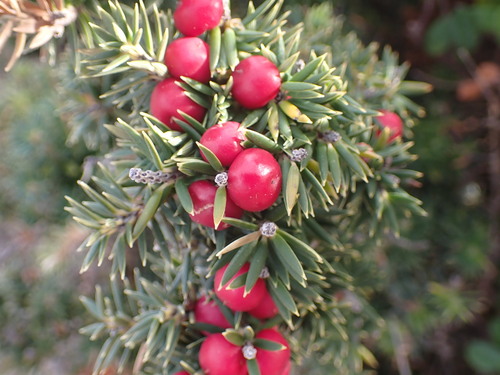
Leptecophylla abietina
Seaspray pinkberry
Leptecophylla juniperina
Mingimingi, Prickly mingimingi
Leptecophylla juniperina subsp. oxycedrus
Crimson berry, Pink Berry, Coastal pinkberry