Urera obovata
Benth.
Scratch bush
gbif· cc-by-nc-sa
MBG
gbif· cc-by-nc-sa
MBG
gbif· cc-by
Meise Botanic Garden
Description
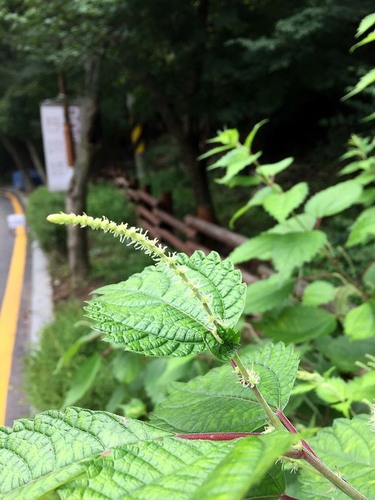
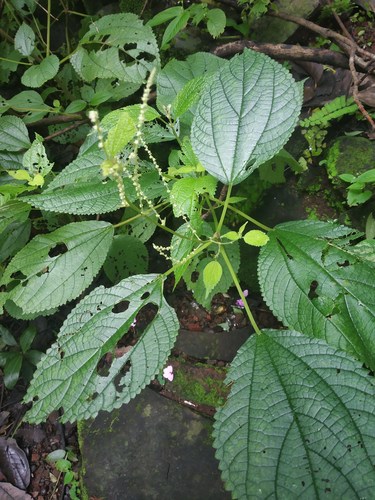
A woody creeper. It grows 30 m long. The stems attach by roots that develop from the stem. Young branches have stinging hairs. The leaves are simple and arranged alternately. The leaf blade is broadly oval and 16 cm long. The base is rounded and it tapers to a short tip. There are rounded teeth along the edge. Plants are separately male and female. The flowers are small. The fruit is dry and 2.5 mm long. It has a fleshy envelope around it.
Edible Uses
The slimy leaves are cooked as a vegetable, added to soups, and mixed with cassava leaves. The fruits are also edible, though the plant is primarily used as a minor locally used vegetable.
Traditional Uses
The leaves are cooked as a vegetable and added to soups. They are slimy and are mixed with cassava leaves.
This uses section is brief — help expand it
Medicinal Uses
The plant has several medicinal uses. A leaf decoction is used to treat dysentery and as an aphrodisiac.
Known Hazards
The plant bears irritant hairs, those on the leaves having a particularly strong sting. Sap from the leaves, flowers and fruit will raise a rash on even the toughest skin.
Distribution
A tropical plant. It grows in lowland forest often in humid places.
Where It Grows
Africa, Benin, Côte d'Ivoire, Ghana, Ivory Coast, Liberia, Niger, Nigeria, Sierra Leone, Togo, West Africa,
Cultivation
A dioecious species, both male and female forms need to be grown if fruit and seed are required.
Other Uses
A fibre is obtained from the bark.
Other Information
A minor locally used vegetable.
Nutrition
| Part | Moisture | kJ | kcal | Protein | Vit A | Vit C | Iron | Zinc |
|---|---|---|---|---|---|---|---|---|
| Leaves raw | 81.2 | 222 | 53 | 2.8 | — | — | — | — |
References (9)
- Bosch, C.H., 2004. Urera obovata Benth. [Internet] Record from Protabase. Grubben, G.J.H. & Denton, O.A. (Editors). PROTA (Plant Resources of Tropical Africa / Ressources végétales de l’Afrique tropicale), Wageningen, Netherlands. < http://database.prota.org/search.htm>. Accessed 23 October 2009
- Burkill, H. M., 1985, The useful plants of west tropical Africa, Vol. 5. Kew.
- Busson, 1965,
- Food Composition Tables for use in Africa FAO http://www.fao.org/infoods/directory No. 777
- Grubben, G. J. H. and Denton, O. A. (eds), 2004, Plant Resources of Tropical Africa 2. Vegetables. PROTA, Wageningen, Netherlands. p 539
Show all 9 references Hide references
- J. D. Hooker & G. Bentham in W. J. Hooker, Niger Fl. 516. 1849
- Jardin, C., 1970, List of Foods Used In Africa, FAO Nutrition Information Document Series No 2.p 108, 166
- Peters, C. R., O'Brien, E. M., and Drummond, R.B., 1992, Edible Wild plants of Sub-saharan Africa. Kew. p 196
- World Checklist of Useful Plant Species 2020. Royal Botanic Gardens, Kew