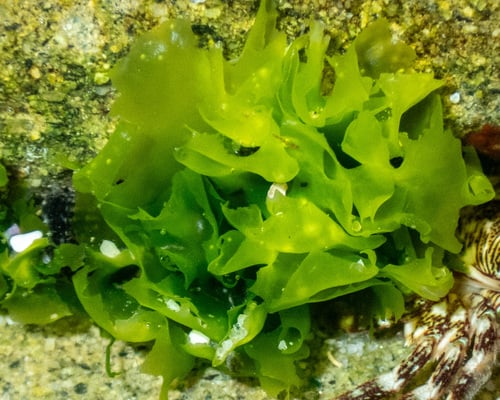
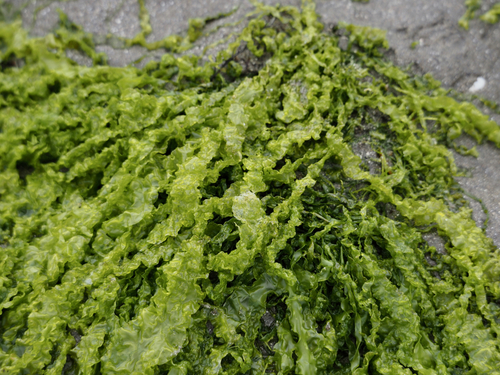
Ulva conglobata
Kjellman
Green algae
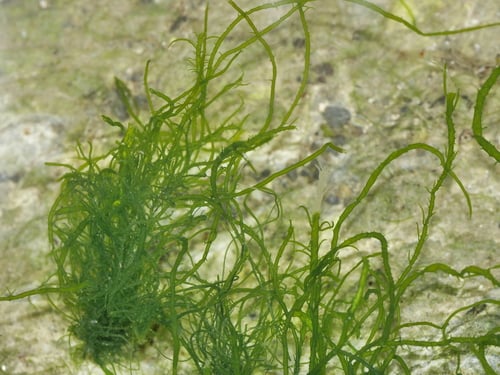
iNaturalist· pd
Frans Reinhold Kjellman (1846–1907), no known copyright restrictions (public domain)
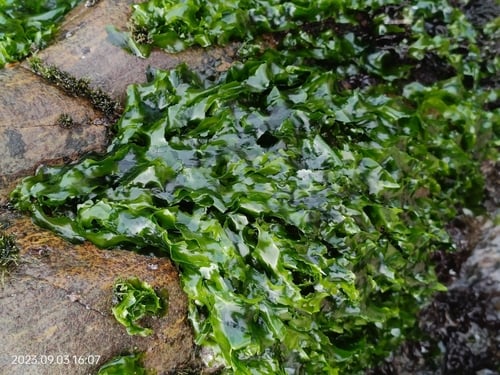
iNaturalist· cc-by-nc
(c) yah_japan, some rights reserved (CC BY-NC)
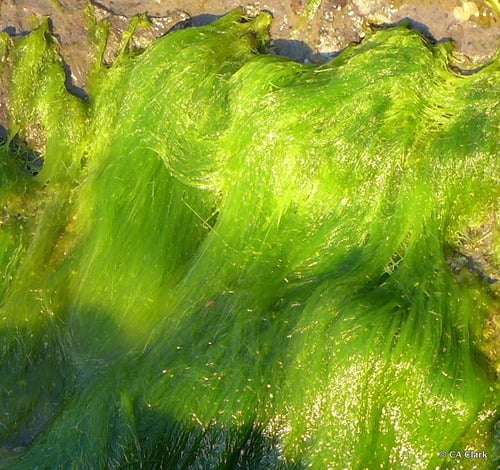
iNaturalist· cc-by-nc
(c) yah_japan, some rights reserved (CC BY-NC)
Summary
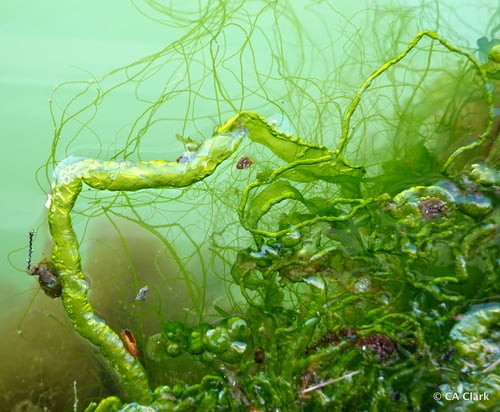
Source: WikipediaUlva conglobata is a species of seaweed in the family Ulvaceae that can be found on Jeju Island of Korea, Qingdao province of China and Yokohama, Japan.
Description
A tropical seaweed in the family Ulvaceae.
This description is brief — help expand it
Edible Uses
The fronds are eaten as tea or used as seaweed/algae.
Medicinal Uses
Its methanol extract is used to treat Alzheimer's disease while its ethanol have polysaccharides which contains 23.04-35.20% of sulfate ester with 10.82-14.91% of uronic acid, and 3.82-451% of protein. It also produces crude enzyme when its mixed with linoleic acid which is widely used to fight influenza.
Distribution
It is a tropical plant.
Where It Grows
Asia, China, India, Indochina, Japan, Korea, Malaysia, SE Asia, Taiwan, Vietnam,
References (3)
- Kiple, K.F. & Ornelas, K.C., (eds), 2000, The Cambridge World History of Food. CUP p 235
- Wang, Wei-Lung and Chiang, Young-Meng, 1994, Potential Economic Seaweeds of Hengchun Peninsula, Taiwan, Economic Botany, Vol. 48, No. 2, pp. 182-189
- Xia, B., and Abbott, I. A., 1987, Edible seaweeds of China and their place in the Chinese diet. Economic Botany 41:341-53