Arthropodium minus
R. Br.
Small Vanilla-lily
iNaturalist· cc-by-nc-sa
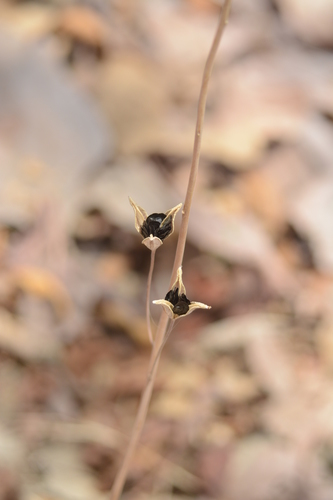
(c) Reiner Richter, some rights reserved (CC BY-NC-SA), uploaded by Reiner Richter
iNaturalist· cc-by-nc
(c) catherine, some rights reserved (CC BY-NC), uploaded by catherine
iNaturalist· cc-by-nc
(c) Bernadette Lingham, some rights reserved (CC BY-NC), uploaded by Bernadette Lingham
Summary
Source: WikipediaArthropodium minus, the small vanilla lily, is a species of herbaceous perennial plants native to the Southern Hemisphere. Valued as bush tucker as the roots are edible raw. Found in a variety of habitats from the coast to alpine areas of eastern Australia. Eucalyptus forests, woodlands and sub-alpine meadows, favouring drier habitats than Arthropodium milleflorum. The grasslike leaves have a strong scent of vanilla. The plant is deciduous in drought, and resprouts after fire. Some 35 cm in height, the flowers which appear September–December are purple or pink. The fruit matures during January–February and contains about 16 seeds. A. minus is a garden ornamental easily cultivated from seed.
Description
A perennial plant which grows 30 cm high. It can grow as an annual. It spreads 10-20 cm across. It forms tufts. Plants produce 4-5 tubers. These can be 3 cm long. The leaves are small and 5 mm wide. They are usually lax and on the ground. The flowers are 1 cm across. They usually occur singly but can be in groups of 2 or 3. The flowers droop. The flower stem is usually less than 30 cm tall and often 10 cm tall. It is deep purple. The fruit is a black capsule with several seeds.
Edible Uses
Edible Parts: Root Edible Uses: Root - cooked. Rather watery with a slightly sweet or bitter flavour. Plants produce about 4 - 5 tubers, each of which are up to 3cm long.
Traditional Uses
The root/corm is eaten, cooked.
This uses section is brief — help expand it
Medicinal Uses
None known
Distribution
It is a temperate plant. It grows from sea level to alpine places. It grows in well-drained sandy soils. It needs a sheltered sunny position. It occurs in grassland and grassy woodlands. Tasmania Herbarium.
Where It Grows
Australia*, Tasmania*,
Cultivation
Prefers a well-drained sandy peaty loam in a warm, sheltered sunny position. Succeeds in areas where temperatures seldom fall much below freezing so long as it is given a sunny sheltered position and a well-drained soil. Plants are hardy to at least -7°c in Australian gardens, though this cannot be translated directly to British gardens due to our cooler summers and colder longer and wetter winters. The plant has a strong scent of vanilla, this is especially noticeable on warm days.
Propagation
Seed - sow late winter in a cold greenhouse. When large enough to handle, prick the seedlings out into individual pots and grow them on for at least their first winter in a greenhouse. Plant out in late spring or early summer, after the last expected frosts. Division in spring.
Other Uses
None known Special Uses Scented Plants
Notes
There are 12 Arthropodium species. Also put in the family Laxmanniaceae.
Also Known As
Parm, Pike, Puewan
References (15)
- Cherikoff V. & Isaacs, J., The Bush Food Handbook. How to gather, grow, process and cook Australian Wild Foods. Ti Tree Press, Australia p 194
- Curtis, W.M., & Morris, D.I., 1994, The Student's Flora of Tasmania. Part 4B St David's Park Publishing, Tasmania, p 385
- De Angelis, D., 2005, Aboriginal Plant Use of the Greater Melbourne Area. La Trobe University Environment Collective
- Elliot, W.R., & Jones, D.L., 1982, Encyclopedia of Australian Plants suitable for cultivation. Vol 2. Lothian. p 235
- Gilfedder, L et al, 2003, The Nature of the Midlands. Midlands Bushweb. PO Box 156 Longford, Tasmania. p 68
Show all 15 references Hide references
- Gott, B & Conran, J., 1991, Victorian Koorie Plants. PO Box 666 Hamilton, Victoria 3300, Australia. p 11
- Hibbert, M., 2002, The Aussie Plant Finder 2002, Florilegium. p 33
- Lazarides, M. & Hince, B., 1993, Handbook of Economic Plants of Australia, CSIRO. p 26
- Lim, T. K., 2015, Edible Medicinal and Non Medicinal Plants. Volume 9, Modified Stems, Roots, Bulbs. Springer p 12
- Low, T., 1991, Wild Food Plants of Australia. Australian Nature FieldGuide, Angus & Robertson. p 102
- Plants for a Future database, The Field, Penpol, Lostwithiel, Cornwall, PL22 0NG, UK. http://www.scs.leeds.ac.uk/pfaf/
- Tasmanian Herbarium Vascular Plants list p 68
- Whiting, J. et al, 2004, Tasmania's Natural Flora. Tasmania's Natural Flora Editorial Committee PO Box 194, Ulverstone, Tasmania, Australia 7315 p 346
- www.ceres.org/au/bushfood catalogue
- Zola, N., & Gott, B., 1992, Koorie Plants Koorie People. Koorie Heritage Trust. p 24, 42