Uapaca guineensis
(Don.) Mull. Arg.
Sugar plum
iNaturalist· cc-by-nc-sa
(c) Günter Baumann, some rights reserved (CC BY-NC-SA)
iNaturalist· cc-by-nc-sa
(c) Günter Baumann, some rights reserved (CC BY-NC-SA)
iNaturalist· cc-by-nc-sa
(c) Günter Baumann, some rights reserved (CC BY-NC-SA)
Description
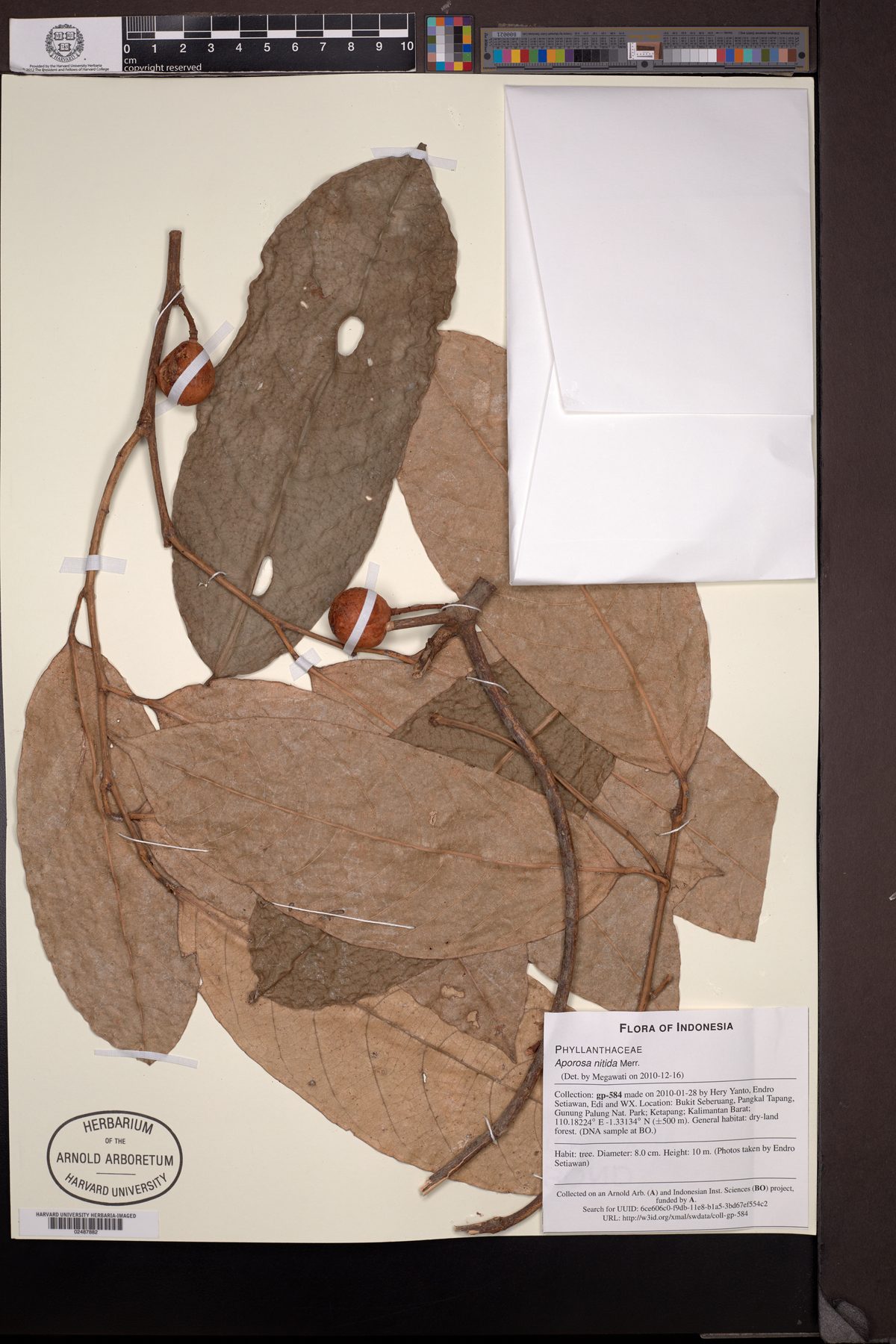
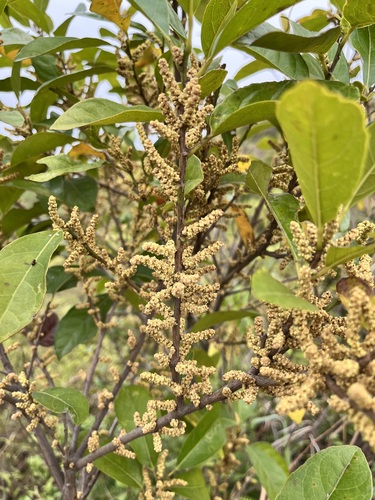
A large tree. It grows up to 30 m high. The trunk is straight and it often branches low down. The trunk has stilt roots. The bark is reddish-brown. The young twigs have short hairs at first. The leaves are 6-30 cm long by 2.5-12.5 cm wide. The leaves are thin and wavy. They are dark green and glossy. The leaf stalk is 1-3 cm long. The flowers are yellow. The male heads are 6 mm across. The female flower has an ovary covered with small glands as spots. The fruit have warts on their surface. They are round and 2.5 cm across. They contain 3-4 seeds. The fruit are edible.
Edible Uses
Fruit - raw. A sweetish pulp, it can be made into a refreshing drink. The flavour is said to be similar to the medlar (Mespilus germanica). Fruits from trees growing in forest areas is more esteemed than those from trees in the savannah. The fruit is said to be rich in vitamins. The more or less globose fruit can be 18 - 25mm in diameter.
Traditional Uses
The fruit are eaten raw. The pulp is sweet. It is also used to make a drink.
This uses section is brief — help expand it
Medicinal Uses
The leaves, pulped with palm-oil, are used externally as a massage to maturate furuncles and to relieve migraine and rheumatism They are also used to massage children who are late in learning to walk. A decoction of the root-bark is taken by mouth or by enema for treating oedemas and gastro-intestinal troubles. Bark decoctions are also used as a treatment for female sterility, tooth-troubles, rheumatism, piles and as a strengthener to rachitic or premature babies. Used in enemas, it is said to be antiemetic. A lotion made from the root bark with salt is used in the treatment of skin-complaints, including leprosy. The powdered bark is used to treat nasal cancer. The roots are considered antiabortive, aphrodisiac, to be a good treatment for male impotence, and to be expectorant. A preparation is recommended for young women in labour. A tisane made from the roots is given as a treatment for rhino-pharyngeal and pulmonary affections; flu with headache; and to relieve fever-pains; while the affected parts are also embrocated with the lees. An inhalation of steam from water in which the roots are boiled is said to relieve headache. The unripe fruit, used while the capsule is still green and spongy, is used in cough-medicines.
Known Hazards
The flowers and bark are sometimes put into Nigerian arrow-poisons as ingredients that are supposed to make the flesh putrefy around the wound.
Distribution
It is a tropical plant. It grows in the rainforest. It suits humid locations. It is common along rivers. It grows from sea level to 1,100 m altitude. It grows in seasonally flooded forest.
Where It Grows
Africa, Benin, Burkina Faso, Cameroon, Central Africa, Central African Republic, CAR, Congo DR, Congo R, Côte d'Ivoire, East Africa, Gabon, Gambia, Ghana, Guinea, Guinée, Guinea-Bissau, Ivory Coast, Liberia, Malawi, Mali, Nigeria, Sao Tome and Principe, Senegal, Sierra Leone, Tanzania, Togo, Uganda, West Africa, Zambia, Zimbabwe,
Cultivation
Plants can be grown from seed. Fresh seed need to be used. Seeds do not store well. It can be grown by cuttings.
Propagation
Seed - it has a short viability and should be sown when still fresh. The germination rate is up to 80%.
Other Uses
The leaves, which may reach 30 cm long by 15 cm wide, are used to wrap kola nuts. The bark has a sickly odour when fresh, and on young twigs exudes a red sticky sap which dries as a gum. This is used as a dye. A bark-preparation is used to dye fishing-lines. The wood and bark contain much tannin. The heart-wood is red to reddish-brown; the sapwood is whitish tinged red. The wood is hard, durable and moderately heavy, and when quarter-sawn is attractively figured with a silver grain. It is easy to work and is used in local carpentry, in planks, beams, furniture, etc. Traditionally, it has been used for making dugout canoes. The stilt-roots and branches are suitable for boat-ribs and they are also used for the feet or props of beds. The wood produces a good firewood and charcoal. The stilt-rooted habit of this riverside species has raised the suggestion that it is able to stabilise river-banks, to curb wash and to break the flood movement of water in dry-forest zone rivers. The tree is used to provide shade and could be planted in coffee and cocoa plantations.
Production
In Central African Republic plants have been observed flowering January to March.
Nutrition
| Part | Moisture | kJ | kcal | Protein | Vit A | Vit C | Iron | Zinc |
|---|---|---|---|---|---|---|---|---|
| Fruit raw | 73.4 | 385 | 92 | 1.8 | — | — | — | — |
Synonyms
Also Known As
Abo-emido, Assam, Bichine, Bossambi, Bupoko, Do'bo, Iagale, Kasela-kulongo, Kidianga, Kondii, Kontan, Kuntan, Lesambo, Lissamba, Musela, N'chambana, N'sanvi, Oyen, Psegha, Rikio, Samfi, Sengui
References (25)
- Abbiw, D.K., 1990, Useful Plants of Ghana. West African uses of wild and cultivated plants. Intermediate Technology Publications and the Royal Botanic Gardens, Kew. p 48
- Billong Fils, P. E., et al, 2020, Ethnobotanical survey of wild edible plants used by Baka people in southeastern Cameroon. Journal or Ethnobiology and Ethnomedicine. 16:64 p 9
- Burkill, H. M., 1985, The useful plants of west tropical Africa, Vol. 2. Kew.
- Busson, 1965,
- Dalziel, 1937,
Show all 25 references Hide references
- Danforth, R.M., & Boren, P.D., 1997, Congo Native fruits. Twenty-five of the best. Privately published. p 67
- Facciola, S., 1998, Cornucopia 2: a Source Book of Edible Plants. Kampong Publications, p 243
- Food Composition Tables for use in Africa FAO http://www.fao.org/infoods/directory No. 1045
- Grivetti, L. E., 1980, Agricultural development: present and potential role of edible wild plants. Part 2: Sub-Saharan Africa, Report to the Department of State Agency for International Development. p 32
- Hwang, L. C., et al, 2020, Traditional Botanical Uses of Non-Timber Forest Products (NTFP) in Seven Counties in Liberia. ACS Symposium Series; American Chemical Society: Washington, DC, 2020.
- Jardin, C., 1970, List of Foods Used In Africa, FAO Nutrition Information Document Series No 2.p 166
- JSTOR Global Plants edible
- Jusu, A. & Cuni-Sanchez, A., 2017, Priority indigenous fruit trees in the African rainforest zone: insights from Sierra Leone. Genet Resour Crop Evol (2017) 64:745–760
- Keay, R.W.J., 1989, Trees of Nigeria. Clarendon Press, Oxford. p 163
- Kitambala, M.M., 2008. Uapaca guineensis Müll.Arg. [Internet] Record from Protabase. Schmelzer, G.H. & Gurib-Fakim, A. (Editors). PROTA (Plant Resources of Tropical Africa), Wageningen, Netherlands. < http://database.prota.org/search.htm>. Accessed 23 October 2009
- Latham, P & Mbuta, A., 2017, Useful Plants of Central Province, Democratic Republic of Congo. Volume 2. Salvation Army p 231
- Oteng-Amoako, A. A. (Ed.), 2006, 100 Tropical African Timber Trees from Ghana. Forestry Research Institute of Ghana. p 252
- Peters, C. R., O'Brien, E. M., and Drummond, R.B., 1992, Edible Wild plants of Sub-saharan Africa. Kew. p 113
- Savill, P. S. & Fox, J. E. D., Trees of Sierra Leone. p 126
- Terashima, H., et al, 1992, Ethnobotany of the Lega in the Tropical Rainforest of Eastern Zaire (Congo): Part Two, Zone de Walikale, African Study Monographs, Suppl. 19:1-60
- Uphof,
- Vivien, J. & Faure, J.J., 1985, Abres des forets dense d'Afrique Centrale. Agence de Cooperation Culturelle et Technique. Paris. p 206
- Vivien, J., & Faure, J.J., 1996, Fruitiers Sauvages d'Afrique. Especes du Cameroun. CTA p 156
- White, F., Dowsett-Lemaire, F. and Chapman, J. D., 2001, Evergreen Forest Flora of Malawi. Kew. p 263
- World Checklist of Useful Plant Species 2020. Royal Botanic Gardens, Kew (Also as Uapaca mole)