Brachiaria subquadripara
(Trin.) A. Hitchc.
Green Summer grass, Arm grass millet
iNaturalist· cc-by
(c) Cheng-Tao Lin, some rights reserved (CC BY)
iNaturalist· cc-by
(c) Cheng-Tao Lin, some rights reserved (CC BY)
iNaturalist· cc-by-nc
(c) Mike Ross, some rights reserved (CC BY-NC)
Description
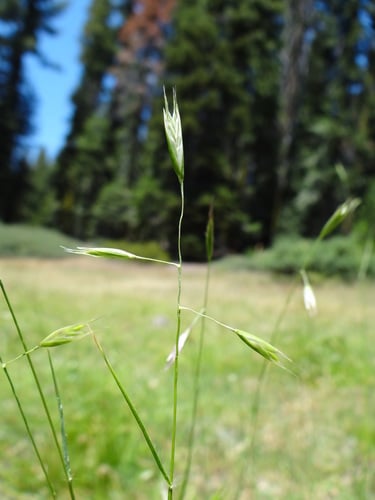
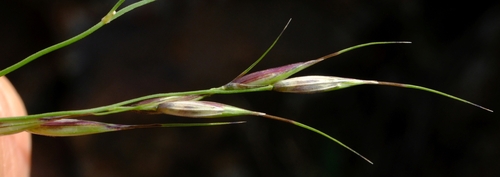
An annual or short lived millet grass. The culms are slender. They are straggling and root at the nodes. It is 20-60 cm tall. The leaf blades are sword shaped and 4-15 cm long by 0.4-1 cm wide. They have thickened edges. The sheaths are loose and longer than the internodes. The flowering stalk has 3-4 widely spaced racemes. These are 2-5 cm long. The spikelets are plump and pointed. They are 3 mm or longer. The spikelets are on one side only.
Edible Uses
The seeds are ground to a paste and cooked.
Traditional Uses
The seeds are ground to a paste and cooked.
This uses section is brief — help expand it
Known Hazards
This plant can be a troublesome weed.
Distribution
A tropical plant. It grows in hill slopes and grassy places in S China. It grows on sand plains. It grows in dry soils. It grows between 1-1,300 m above sea level. It grows in areas with an annual rainfall above 300 mm. It can grow in arid places. In Yunnan.
Where It Grows
Africa, American Samoa, Asia, Australia, Bangladesh, Central Africa, Central America, China, Congo, Cook Islands, Costa Rica, Côte d'Ivoire, East Africa, Fiji, Ghana, Guam, Himalayas, India, Indochina, Indonesia, Ivory Coast, Kenya, Madagascar, Malaysia, Mauritius, Myanmar, Nepal, New Caledonia, Nigeria, Pacific, Papua New Guinea, PNG, Philippines, Reunion, Rotuma, Samoa, SE Asia, Seychelles, Sri Lanka, Taiwan, Tanzania, Thailand, Tonga, Trinidad & Tobago, Tuvalu, Uganda, Vanuatu, Vietnam, West Africa,
Cultivation
Brachiaria subquadripara is widely adapted to the warm lowland tropics, but it is particularly suited to monsoon environments. It can also succeed in warm temperate climates where winters are mild and frosts are few or none. Prefers medium to light-textured soils of medium to high fertility. Plants are fairly shade tolerant. Brachiaria distachya is a very aggressive plant, especially in humid areas and wetlands. It has escaped from cultivation and become a weed in many parts of the tropics and is likely to become a threat in disturbed wetlands, riparian habitats, and dune systems by altering these ecosystems, displacing native species, or threatening local populations. Because it is highly competitive and produces a large volume of biomass, the species reduces species diversity and the functional diversity of indigenous macrophytes. Its allelopathic components, resistance to long periods of drought, and high germination capacity in low light conditions increase its competitive ability. When it forms extensive mats it impacts the native diversity of plants and also of fishes. Commonly invasive along margins of lakes and multiple use reservoirs, the presence of this species in water bodies generates water loss by transpiration, reduces water flow in canals, increases siltation, and generates higher maintenance costs.
Other Uses
The plant is a good soil-binder in sandy areas such as coconut plantations and dunes, and, because of its ability to tolerate shade, can also be used as a ground cover under other tree crops. It should not be introduced until the coconuts are at least 30 years old or there will be too much low shade. It is sometimes cultivated as a lawn-grass, where it may become a troublesome weed because of its rampant habit.
Notes
There are about 100 Brachiaria species. This one can be a troublesome weed.
Synonyms
Also Known As
Atuta, Si sheng bei xing cao
References (9)
- Cherikoff V. & Isaacs, J., The Bush Food Handbook. How to gather, grow, process and cook Australian Wild Foods. Ti Tree Press, Australia p 188 (As Brachiaria miliiformis)
- Franklin, J., Keppel, G., & Whistler, W., 2008, The vegetation and flora of Lakeba, Nayau and Aiwa Islands, Central Lau Group, Fiji. Micronesica 40(1/2): 169–225, 2008
- Hardwick, G., 2001, Economically Useful Plants for Northern Australia: Master Species List. Crusader eBooks. (As Brachiaria miliiformis)
- Isaacs, J., 1987, Bush Food, Aboriginal Food and Herbal Medicine. Weldons. p 114 (As Brachiaria miliiformis)
- Lazarides, M. & Hince, B., 1993, Handbook of Economic Plants of Australia, CSIRO. p 36 and p 35 (As Brachiaria miliiformis)
Show all 9 references Hide references
- Lingnan Sci. J. 7:214. 1931
- Petheram, R.J. and Kok, B., 2003, Plants of the Kimberley Region of Western Australia. UWA Press p 71
- Royal Botanic Gardens, Kew (1999). Survey of Economic Plants for Arid and Semi-Arid Lands (SEPASAL) database. Published on the Internet; http://www.rbgkew.org.uk/ceb/sepasal/internet [Accessed 8th May 2011]
- Thaman, R. R, 2016, The flora of Tuvalu. Atoll Research Bulletin No. 611. Smithsonian Institute p 52