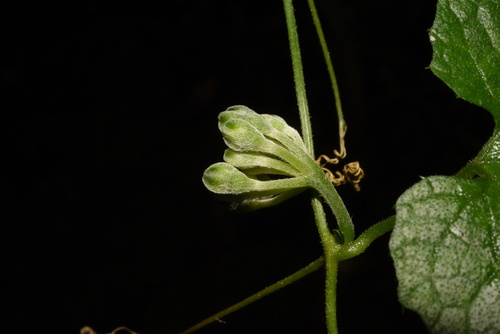
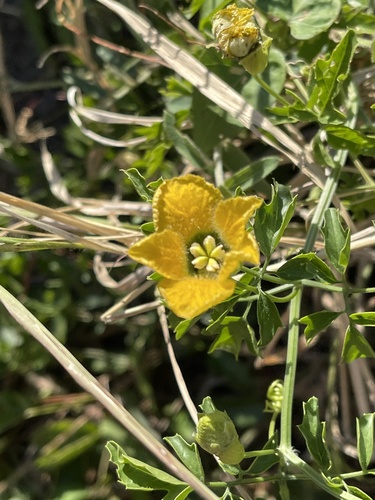
Trichosanthes ovigera
Blume
Japanese Snake gourd
iNaturalist· cc-by
(c) 潘立傑 LICHIEH_PAN, some rights reserved (CC BY)
iNaturalist· cc-by
(c) 潘立傑 LICHIEH_PAN, some rights reserved (CC BY)
iNaturalist· cc-by
(c) 潘立傑 LICHIEH_PAN, some rights reserved (CC BY)
Summary
Trichosanthes ovigera is a fast-growing perennial climber, frost tender, hardy to UK zone 10. In leaf May to October, flowering July to September with seeds ripening September to October. Monoecious with both flower sexes on same plant, pollinated by insects. Tolerates light sandy, medium loamy, and heavy clay soils with good drainage and mildly acidic to basic pH. Requires full sun and prefers moist soil.
Description
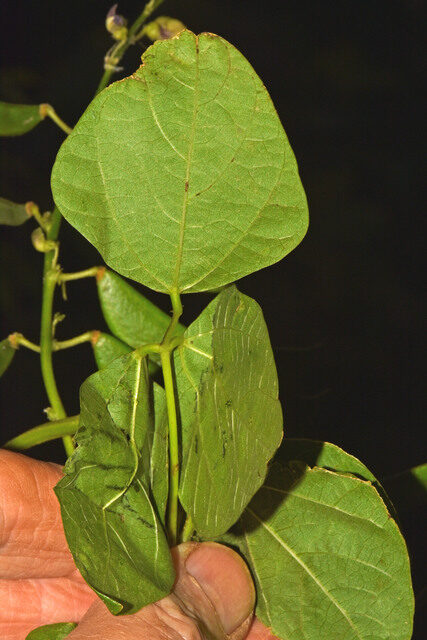
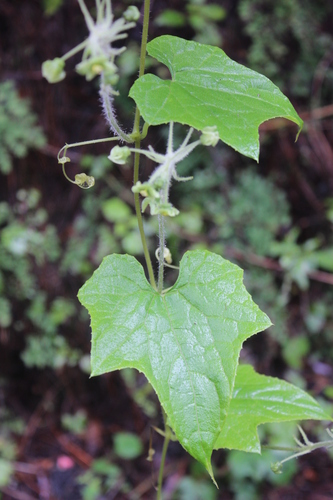
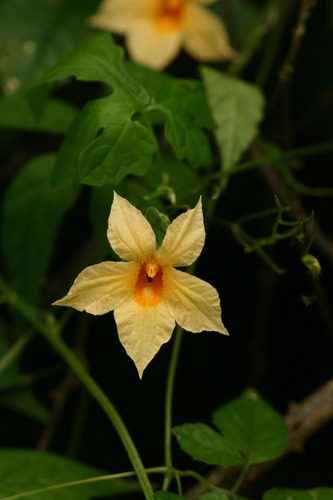
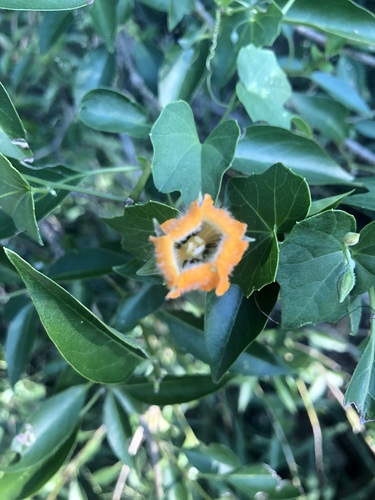
A pumpkin family plant. It is a climbing herb. The tendrils can be simple or have 2 or 3 branches. They arise near the leaf. The leaves have 3-5 lobes. They are 5-16 cm long and 4.5-13.5 cm wide. The leaf stalks are 2-6.5 cm long. The flowers are white. They are 3.5-4 cm across. The fruit are oval. They are orange or reddish and 3.5-6 cm long by 2.5-3.5 cm wide. There are several seeds.
Edible Uses
An edible starch is obtained from the root. Immature fruit is preserved in miso or salt; mature fruit reaches about 7cm in length. The seed contains 33.8% protein and 56.3% fat. While there is no specific record of the seed being eaten as a food, seeds of many related plants in this family are eaten in the Orient as a vermifuge. A nutritional analysis of the dry fruit (per 100g) shows: 316 calories, 15.8g protein, 0g fat, 78.9g carbohydrate, 8.8g fibre, 5.3g ash; minerals: calcium 333mg, phosphorus 596mg, iron 17.5mg, potassium 2159mg; vitamins: A 14210mg, thiamine (B1) 0.7mg, riboflavin (B2) 0.9mg, niacin 12.3mg, C 105mg.
Traditional Uses
The roots are used for starch.
This uses section is brief — help expand it
Medicinal Uses
The plant is diuretic. The seed is vermifuge. The root is anodyne, antiphlogistic, a blood purifier, depurative, febrifuge and resolvent, and is used as a poultice or made into a decoction to treat abscesses, boils, fevers and sore throats. The fruit is used to treat coughs, diabetes and jaundice.
Distribution
It is a tropical plant. In Vietnam it grows at 2,000 m altitude. In Australia it grows in rainforest or monsoon forest between 70-1000 m altitude.
Where It Grows
Asia, Australia, Bangladesh, China, Himalayas, India, Indochina, Indonesia, Japan, Malaysia, Myanmar, Nepal, Pacific, Papua New Guinea, PNG, SE Asia, Taiwan, Thailand, Vanuatu, Vietnam,
Cultivation
Requires a rich well-drained soil and plenty of moisture in the growing season. Plants are not hardy in Britain and normally require greenhouse cultivation, but it may be possible to grow them as a spring-sown annual in a very warm sheltered bed outdoors.
Propagation
Sow seed in March into pots in a warm greenhouse using a rich soil, placing 2–3 seeds per pot and thinning to the strongest plant. Grow on quickly and plant out after the last expected frosts, providing protection such as a frame or cloche until the plants are establishing well.
Other Uses
The dried fruit serves as a soap substitute.
Synonyms
Also Known As
Mak mak simi, Qualau trung, Sivoghai
References (20)
- Arora, R. K., 2014, Diversity in Underutilized Plant Species - An Asia-Pacific Perspective. Bioversity International. p 51
- Bijdr. 934. 1826
- Cabalion, P. and Morat, P., 1983, Introduction le vegetation, la flore et aux noms vernaculaires de l'ile de Pentcoste (Vanuatu), In: Journal d'agriculture traditionnelle et de botanique appliquee JATBA Vol. 30, 3-4
- Cooper, W. and Cooper, W., 2004, Fruits of the Australian Tropical Rainforest. Nokomis Editions, Victoria, Australia. p 144
- Flora of Australia, Volume 8, Lecythidales to Batales, Australian Government Publishing Service, Canberra (1982) p 195
Show all 20 references Hide references
- Henning, B. M., 2014, The Diversity of Conservation: Exploring Narratives, Relationships and Ecosystem Services in Melanesian Market-based Biodiversity Conservation. Ph D dissertation, Uni of Minnesota. p 216
- Jha, P. K., et al, 1996, Plant genetic resources of Nepal: A guide for plant breeders of agricultural, horticultural and forestry crops. Euphytica 87:189-210
- Martin, F.W. & Ruberte, R.M., 1979, Edible Leaves of the Tropics. Antillian College Press, Mayaguez, Puerto Rico. p 190
- Paczkowska, G. & Chapman, A.R., 2000, The Western Australian Flora. A Descriptive Catalogue. Western Australian Herbarium. p 221
- Pham-Hoang Ho, 1999, An Illustrated Flora of Vietnam. Nha Xuat Ban Tre. p 573
- Plants for a Future database, The Field, Penpol, Lostwithiel, Cornwall, PL22 0NG, UK. http://www.scs.leeds.ac.uk/pfaf/
- PROSEA handbook Volume 9 Plants yielding non-seed carbohydrates. p 190
- Terra, G.J.A., 1973, Tropical Vegetables. Communication 54e Royal Tropical Institute, Amsterdam, p 79
- USDA, ARS, National Genetic Resources Program. Germplasm Resources Information Network - (GRIN). [Online Database] National Germplasm Resources Laboratory, Beltsville, Maryland. Available: www.ars-grin.gov/cgi-bin/npgs/html/econ.pl (10 April 2000)
- Walter, A. & Lebot, V., 2007, Gardens of Oceania. ACIAR Monograph No. 122. p 217
- Wheeler, J.R.(ed.), 1992, Flora of the Kimberley Region. CALM, Western Australian Herbarium, p 253
- Wiersema, J. H. & Leon, B., 2013, World Economic Plants. A Standard Reference CRC Press. 2nd Ed. p 694
- World Checklist of Useful Plant Species 2020. Royal Botanic Gardens, Kew
- Yang, Si-Lin and Walters, T. W., 1992, Ethnobotany and the Economic role of the Cucurbitaceae of China. Economic Botany, Vol. 46, No. 4, pp. 349-367
- Zeven, A. C. & de West, J. M. J., 1982, Dictionary of cultivated plants and their regions of diversity. Wageningen. p 35 (As Trichosanthes cucumeroides)