Trichosanthes cucumerina
L.
Snake gourd
iNaturalist· cc-by-nc-sa
(c) 106611639464075912591, some rights reserved (CC BY-NC-SA), uploaded by 106611639464075912591
iNaturalist· cc-by-nc
(c) Prajwal J Ullal, some rights reserved (CC BY-NC)
iNaturalist· cc-by-nc
(c) Dr. Ankur Mishra, some rights reserved (CC BY-NC)
Summary
Source: WikipediaTrichosanthes cucumerina is a tropical or subtropical vine. Its variety T. cucumerina var. anguina raised for its strikingly long fruit. In Asia, it is eaten immature as a vegetable much like the summer squash and in Africa, the reddish pulp of mature snake gourd is used as an economical substitute for tomato. Common names for the cultivated variety include snake gourd, serpent gourd, chichinda padwal and Snake Tomato. Trichosanthes cucumerina is found in the wild across much of South and Southeast Asia, including India, Bangladesh, Nepal, Pakistan, Sri Lanka, Indonesia, Malaysia, Myanmar(Burma) and southern China (Guangxi and Yunnan). It is also regarded as native in northern Australia. and naturalized in Florida, parts of Africa and on various islands in the Indian and Pacific Oceans. Formerly, the cultivated form was considered a distinct species, T. anguina, but it is now generally regarded as conspecific with the wild populations, as they freely interbreed: Trichosanthes cucumerina var. anguina (L.) Haines – cultivated variant Trichosanthes cucumerina var. cucumerina – wild variant
Description
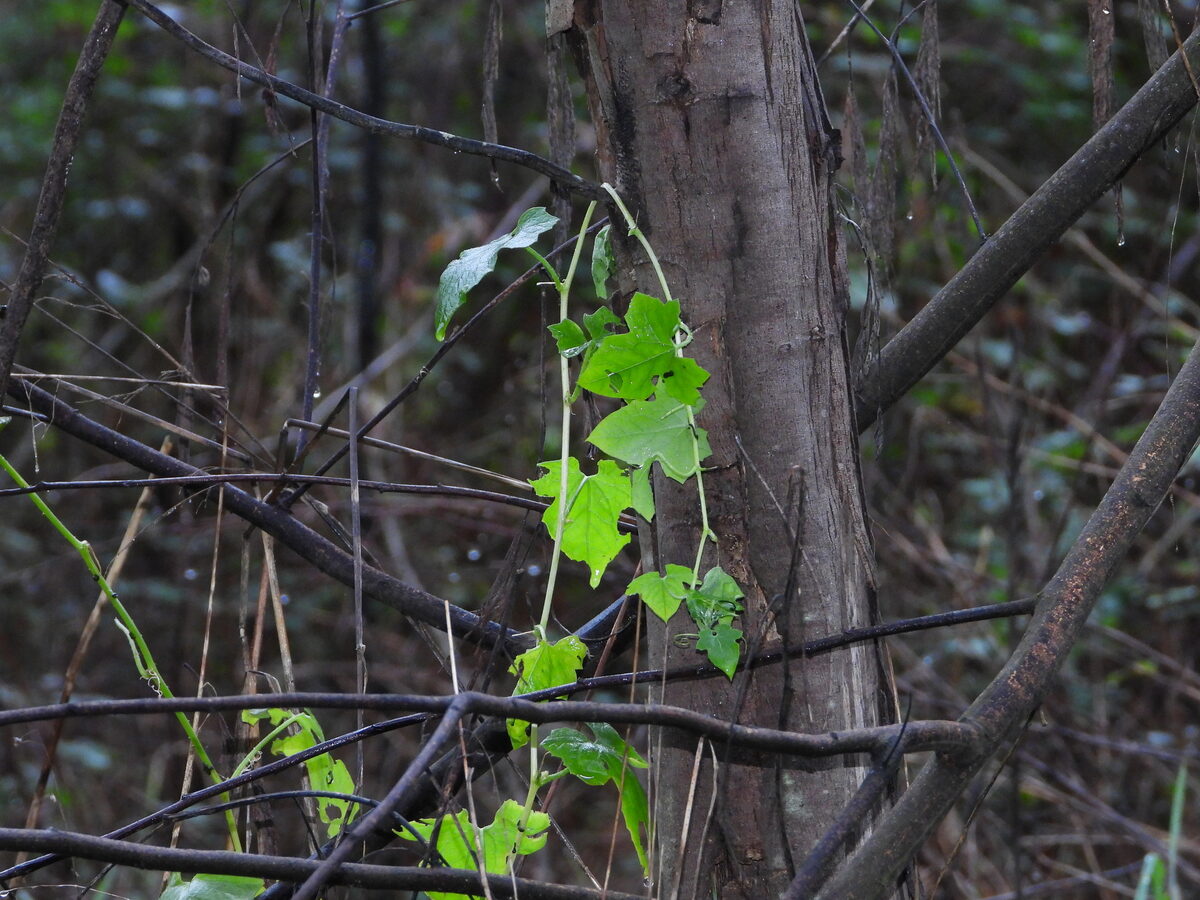
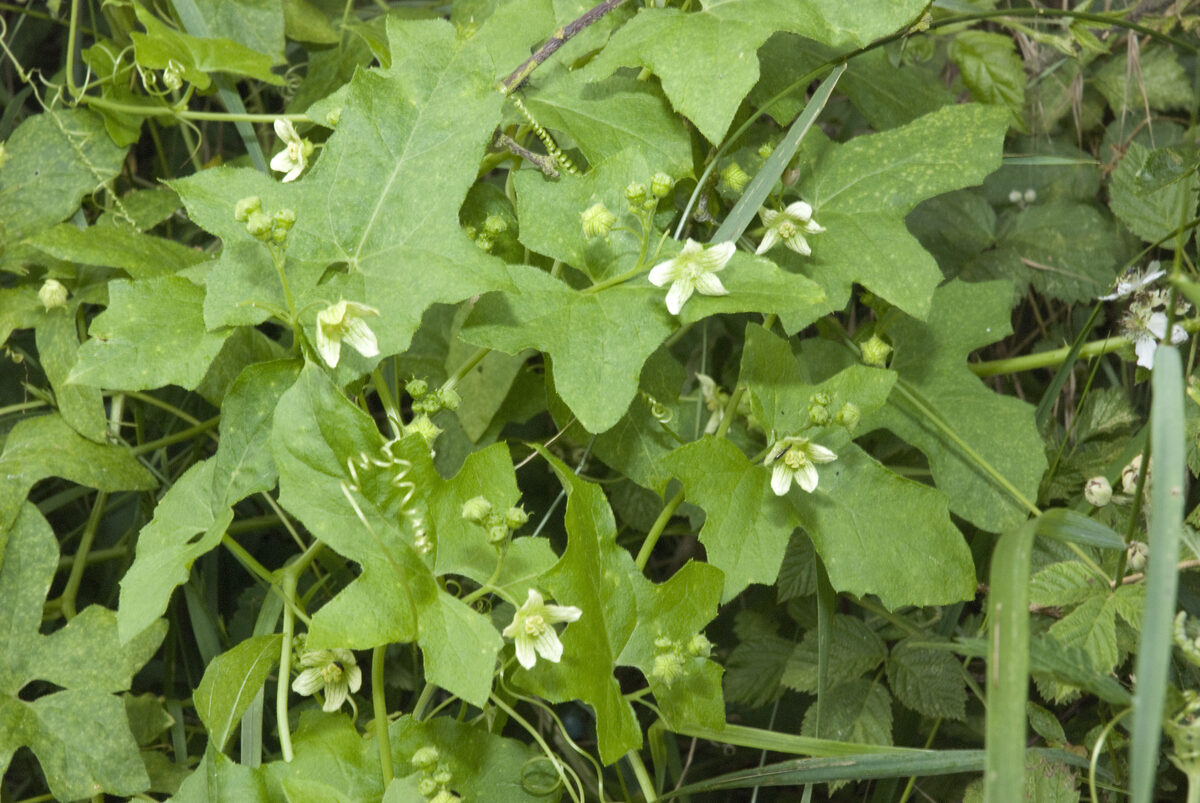
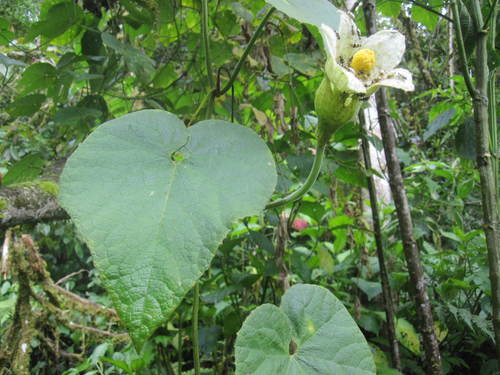
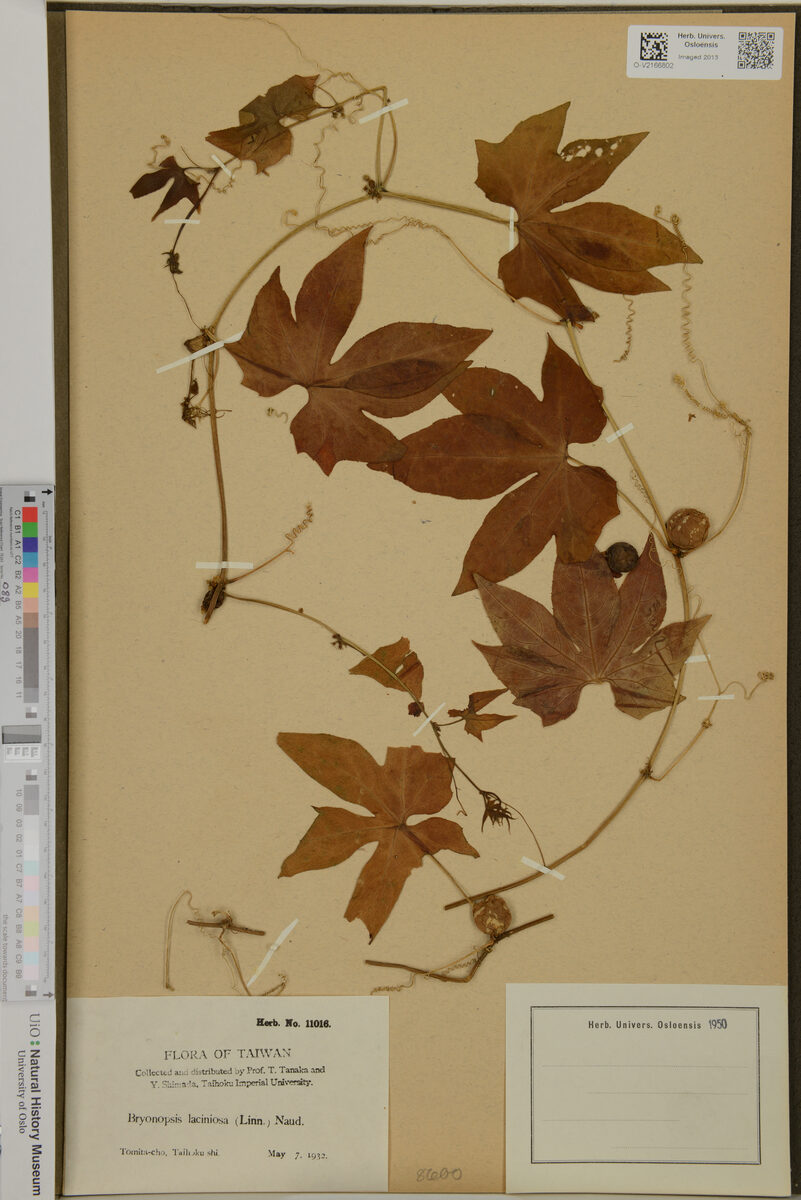
A pumpkin family plant. It is a climber with tendrils. It grows 2.4-6 m high and spreads 1.5-3 m wide. The vine has furrows along it. The leaves have 3 to 7 lobes and a tooth like edge. The flowers are white. The male flowers are without a bract and the female flowers are produced singly. The flowers have long stalks. The long fruit tend to curve. They can be 1-2 m long. When ripe they turn orange or red, but are grey and green when young.
Edible Uses
The common name "snake gourd" refers to the narrow, twisted, elongated fruit. The soft-skinned immature fruit can reach up to 150 cm (59 in) in length. Its soft, bland, somewhat mucilaginous flesh is similar to that of the luffa and the calabash. It is popular in the cuisines of South Asia and Southeast Asia and is now grown in some home gardens in Africa. The primary culinary use of snake gourds is in curries and stews. With some cultivars, the immature fruit has an unpleasant odor and a slightly bitter taste, both of which disappear in cooking. The fruit becomes too bitter to eat as it reaches maturity, but it does contain a reddish pulp that is used in Africa as a substitute for tomatoes. The shoots, tendrils and leaves are also eaten as greens.
Traditional Uses
The long immature fruit are eaten cooked. Sometimes a bitter taste occurs but this disappears with boiling. They can be baked, stuffed or used in curries and stews. Fruit are inedible when ripe. The young leaves are eaten cooked.
Medicinal Uses
The fruit is emetic, purgative and vermifuge. The inner pulp of the fruit is made into a syrup to treat cough.
Distribution
A tropical plant. It is common in the humid tropical lowlands up to 500 m. It does not tolerate dry soil and requires a good moisture reserve in the soil, but is sensitive to water-logging. The optimum temperature for growth is 30-35°C with a minimum of 20°C. It occurs throughout the Philippines at low and medium altitudes up to 1200 m. It suits hardiness zones 10-12. In Yunnan.
Where It Grows
Africa, Andamans, Asia, Australia, Bangladesh, Benin, Cameroon, Caribbean, Central Africa, China, Côte d'Ivoire, Cuba, East Africa, East Timor, Fiji, Gabon, Gambia, Ghana, Guinea-Bissau, Guyana, Hawaii, Himalayas, India, Indochina, Indonesia, Iraq, Ivory Coast, Japan, Kenya, Liberia, Madagascar, Malaysia, Maldives, Mauritius, Middle East, Myanmar, Nepal, Nigeria, Northeastern India, Pacific, Pakistan, Papua New Guinea, PNG, Philippines, SE Asia, Senegal, Sierra Leone, Solomon Islands, South America, Sri Lanka, St Lucia, Tanzania, Thailand, Timor-Leste, Togo, USA, Vanuatu, Vietnam, West Africa, West Indies,
Cultivation
Snake gourd is grown from seed. Seed germinate after 10 days. It requires 4-6 kg/ha. Seed can be sown in a nursery and transplanted at the 2 true leaf stage. More commonly plants are sown where they are to grow. A spacing of 60 - 100 cm is suitable. Plants need supports to climb. Often in home gardens this is a natural support such as a house. Plants respond to fertiliser but excessive nitrogen can produce too much vegetative growth. Pruning can improve the female to male flower ratio.
Production
Flowering starts 5 weeks after planting. Male flowers appear first then female flowers 3 days later. Pollination is normally by insects. Harvesting of fruit starts 6-7 weeks after planting and continues for 1 or 2 months. Fruit are picked 12-20 days after fruit set when they are 30-60 cm long. Fruit do not store well but can be stored for 10-14 days at a temperature of 16-17°C and relative humidity of 85-90%. By the time the fruit turn orange they are too mature to eat.
Other Information
It is a moderately commonly used tropical vegetable. It is cultivated. In Papua New Guinea it is most commonly seen in the Sepik or in gardens of Sepik people.
Notes
Trichosanthes anguina is a correct name and also Trichosanthes cucumerina.
Nutrition
| Part | Moisture | kJ | kcal | Protein | Vit A | Vit C | Iron | Zinc |
|---|---|---|---|---|---|---|---|---|
| Fruit | 95 | 76 | 18 | 0.9 | 810 | 6 | 1 | — |
| Bean | 97 | — | — | 0.2 | — | — | 0.2 | 0.1 |
Synonyms
Also Known As
Amritaphala, Ban chichinda, Banpatal, Banpatol, Ban potol, Begul, Bettada-padawala, Binisi noki, Boap nguu, Bonlon, Buap ngu, Buap nguu, Buap-khom, Calabaza de culebra, Chachinda, Chayud pottah, Chetipotla, Chhachhindara, Cichanda, Chichinda, Chichindo, Chichinga, Chikonda, Chichinda, Chirchira, Club gourd, Galartori, Hebi-uri, Jangli chachinda, Jangli-chachinda, Jangli chichanda, Kadwamparwal, Kashtbhanjan, Lilkaetha, Lingapotla, Melon-melonan, Na-we-ngon, Padavalanga, Padivilangu, Padval, Padwal, Padavali, Paeypuda, Pakupis, Pare welut, Pare-belut, Pathola, Pe-lin-mwe, Pe-lum-mwe-thi, Pepatolam, Pepoodel, Petola ular, Petola-ular, Podalangai, Potlakaaya, Pudal, Pu-lultha, Ranacha padawal, Sze gwa, Thabut-kha, Timun bengkok, Tola ular
References (93)
- Abbiw, D.K., 1990, Useful Plants of Ghana. West African uses of wild and cultivated plants. Intermediate Technology Publications and the Royal Botanic Gardens, Kew. p 42
- Achigan-Dako, E, et al (Eds), 2009, Catalogue of Traditional Vegetables in Benin. International Foundation for Science.
- Ali, A. M. S., 2005, Homegardens in Smallholder Farming Systems: Examples from Bangladesh. Human Ecology, Vol. 33, No. 2 pp. 245-270
- Ambasta, S.P. (Ed.), 2000, The Useful Plants of India. CSIR India. p 649 (Also as Trichosanthes anguina)
- Anderson, E. F., 1993, Plants and people of the Golden Triangle. Dioscorides Press. p 223 (As Trichosanthes anguina)
Show all 93 references Hide references
- Arora, R. K., 2014, Diversity in Underutilized Plant Species - An Asia-Pacific Perspective. Bioversity International. p 51
- Bandyopadhyay, S. et al, 2009, Wild edible plants of Koch Bihar district, West Bengal. Natural Products Radiance 8(1) 64-72 (Also as Trichosanthes anguina)
- Bot. Bihar Orissa 3:388. 1922
- Brickell, C. (Ed.), 1999, The Royal Horticultural Society A-Z Encyclopedia of Garden Plants. Convent Garden Books. p 1020
- Burkill, I.H., 1966, A Dictionary of the Economic Products of the Malay Peninsula. Ministry of Agriculture and Cooperatives, Kuala Lumpur, Malaysia. Vol 2 (I-Z) p 2217
- Chin, H. F., 1999, Malaysian Vegetables in Colour. Tropical Press. p 48
- Ching, L. S. & Mohamed, S., 2001, Alpha-Tocopherol Content in 62 Edible Tropical Plants. J. Agric. Food Chem. 2001, 49, 3101−3105
- Chowdhury, M. & Mukherjee, R., 2012, Wild Edible Plants Consumed by Local Communities of Maldah of West Bengal, India. Indian J.Sci.Res.3(2) : 163-170
- Cooper, W. and Cooper, W., 2004, Fruits of the Australian Tropical Rainforest. Nokomis Editions, Victoria, Australia. p 144
- Cundall, P., (ed.), 2004, Gardening Australia: flora: the gardener's bible. ABC Books. p 1428
- Dhyani, S.K., & Sharma, R.V., 1987, Exploration of Socio-economic plant resources of Vyasi Valley in Tehri Garwhal. J. Econ. Tax. Bot. Vol. 9 No. 2 pp 299-310 (As Trichosanthes anguina)
- Epenhuijsen C.W. van., 1974, Growing Native vegetables in Nigeria. FAO Rome, p 97
- Esquinas-Alcazar, et al, 1983, Genetic Resources of Cucurbitaceae. International Board of Plant Genetic Resources.
- Facciola, S., 1998, Cornucopia 2: a Source Book of Edible Plants. Kampong Publications, p 89
- Flora of Australia, Volume 8, Lecythidales to Batales, Australian Government Publishing Service,
- Foo, J.T.S.(ed), 1996, A Guide to Common Vegetables. Singapore Science Foundation. p 66 (As Trichosanthes anguina)
- Food Composition Tables for use in East Asia FAO http://www.fao.org/infoods/directory No. 739
- Furusawa, T., et al, 2014, Interaction between forest biodiversity and people's used of forest resources in Roviana, Solomon Islands: implications for biocultural conservation under socioeconomic changes. Journal of Ethnobiology and Ethnomedicine, 10:10
- Gangte, H. E., et al, 2013, Wild Edible Plants used by the Zou Tribe in Manipur, India. International Journal of Scientific and Research Publications, Volume 3, Issue 5 (As Trichosanthes anguina)
- Gautam, R. S., et al, 2022, Ethnobotanical Review of Wild Edible Plants of Nepal. Journal of Natural History Museum Volume 32, 2021-22 p 111
- Grubben, G. J. H. and Denton, O. A. (eds), 2004, Plant Resources of Tropical Africa 2. Vegetables. PROTA, Wageningen, Netherlands. p 532
- Guite, C., 2016, Study of wild edible plants associated with the Paite Tribe of Manipur, India. International Journal of Current Research. Vol. 8, Issue 11, pp. 40927-40932 (As Trichosanthes anguina)
- Sayur-sayuran. Balai Pustaka, Jakarta. p 86
- Hu, Shiu-ying, 2005, Food Plants of China. The Chinese University Press. p 712 (As Trichosanthes anguina)
- Jabeen, A., et al, 2009, Indigenous uses of economically important flora of Margallah Hills National Park, Islamabad, Pakistan. African Journal of Biotechnology Vol. 8 (5), pp. 763-784
- Jacquat, C., 1990, Plants from the Markets of Thailand. D.K. Book House p 57 (As Trichosanthes anguina)
- Jha, P. K., et al, 1996, Plant genetic resources of Nepal: A guide for plant breeders of agricultural, horticultural and forestry crops. Euphytica 87:189-210
- Kermath, B. M., et al, 2014, Food Plants in the Americas: A survey of the domesticated, cultivated and wild plants used for Human food in North, Central and South America and the Caribbean. On line draft. p 874
- Kohila, A. & Kensa, V. M., 2019, Survey of Wild Edible Plants of Dhanakarkulam Panchayath, Tirunelveli District, Tamil Nadu, India. Kong. Res. J. 6(2): 20-27, 2019
- Macmillan, H.F. (Revised Barlow, H.S., et al) 1991, Tropical Planting and Gardening. Sixth edition. Malayan Nature Society. Kuala Lumpur. p 336
- Manandhar, N.P., 2002, Plants and People of Nepal. Timber Press. Portland, Oregon. p 464 (As Trichosanthes anguina)
- Martin, F.W. & Ruberte, R.M., 1979, Edible Leaves of the Tropics. Antillian College Press, Mayaguez, Puerto Rico. p 190 (Also as Trichosanthes anguina)
- McMakin, P.D., 2000, Flowering Plants of Thailand. A Field Guide. White Lotus. p 92
- Medhi, P. & Borthakur, S. K., 2012, Phytoresources from North Cachur Hills of Assam -3: Edible plants sold at Hflong market. Indian Journal or Natural Products and Resources. 3(1) pp 84-109 (As Trichosanthes anguina)
- Menninger, E.A., 1977, Edible Nuts of the World. Horticultural Books. Florida p 109 (As Trichosanthes anguina)
- Miguel, E., et al, 1989, A checklist of the cultivated plants of Cuba. Kulturpflanze 37. 1989, 211-357
- Misra S. & Misra M., 2016, Ethnobotanical and Nutritional Evaluation of Some Edible Fruit Plants of Southern Odisha, India. International Journal of Advances in Agricultural Science and Technology, Vol.3 Issue.1, March- 2016, pg. 1-30
- Monsalud, M.R., Tongacan, A.L., Lopez, F.R., & Lagrimas, M.Q., 1966, Edible Wild Plants in Philippine Forests. Philippine Journal of Science. p 455
- Murtem, G. & Chaudhrey, P., 2016, An ethnobotanical note on wild edible plants of Upper Eastern Himalaya, India. Brazilian Journal of Biological Sciences, 2016, v. 3, no. 5, p. 63-81 (As Trichosanthes anguina)
- Murakami, A. et al, 2014, Screening for the In Vitro Anti-tumor-promoting Activities of Edible Plants from Malaysia. Bioscience, Biotechnology, and Biochemistry, 64:1, 9-16. (As Trichosanthes anguina)
- Nyadanu, D., et al, 2015, Agro-biodiversity and challenges of on-farm conservation: the case of plant genetic resources of neglected and underutilized crop species in Ghana. Genet. Resourc. Crop Evol. 62(7):
- Ochse, J.J. et al, 1931, Vegetables of the Dutch East Indies. Asher reprint. p 211 (As Trichosanthes anguina)
- Okigbo, B.N., Vegetables in Tropical Africa, in Opena, R.T. & Kyomo, M.L., 1990, Vegetable Research and development in SADCC countries. Asian Vegetable Research and development Centre. Taiwan. p 38
- Omawale, 1973, Guyana's edible plants. Guyana University, Georgetown p 90
- Paczkowska, G. & Chapman, A.R., 2000, The Western Australian Flora. A Descriptive Catalogue. Western Australian Herbarium. p 221 (Trichosanthes cucumerina)
- Peekel, P.G., 1984, (Translation E.E.Henty), Flora of the Bismarck Archipelago for Naturalists, Division of Botany, Lae, PNG. p 551, 550
- Pham-Hoang Ho, 1999, An Illustrated Flora of Vietnam. Nha Xuat Ban Tre. p 572
- Plants for a Future database, The Field, Penpol, Lostwithiel, Cornwall, PL22 0NG, UK. http://www.scs.leeds.ac.uk/pfaf/
- Purseglove, J.W., 1968, Tropical Crops Dicotyledons, Longmans. p 136
- Rajapaksha, U., 1998, Traditional Food Plants in Sri Lanka. HARTI, Sri Lanka. p 165 (As Trichosanthes anguina)
- Recher, P, 2001, Fruit Spirit Botanical Gardens Plant Index. www.nrg.com.au/~recher/ seedlist.html p 7
- Shah, G.L., 1984, Some economically important plant of Salsette Island near Bombay. J. Econ. Tax. Bot. Vol. 5 No. 4 pp 753-765 (As Trichosanthes anguina)
- Shaheen, N., et al, 2013, Food Composition Table for Bangladesh. University of Daka. p 24 (Also as Trichosanthes anguina)
- Sharma, B.B., 2005, Growing fruits and vegetables. Publications Division. Ministry of Information and broadcasting. India. p 184
- SHORTT,
- Singh, H.B., Arora R.K.,1978, Wild edible Plants of India. Indian Council of Agricultural Research, New Delhi. p 79
- Small, E., 2009, Top 100 Food Plants. The world's most important culinary crops. NRC Research Press. p 242
- Smith, A.C., 1981, Flora Vitiensis Nova, Lawaii, Kuai, Hawaii, Volume 2 p 687
- Smith, P.M., 1979, Snake gourd, in Simmonds, N.W., (ed), Crop Plant Evolution. Longmans. London. p 306
- Solomon, C., 2001, Encyclopedia of Asian Food. New Holland. p 176
- Sp. pl. 2:1008. 1753 (Also as Trichosanthes anguina)
- Staples, G.W. and Herbst, D.R., 2005, A tropical Garden Flora. Bishop Museum Press, Honolulu, Hawaii. p 269
- Sujanapal, P., & Sankaran, K. V., 2016, Common Plants of Maldives. FAO & Kerala FRI, p 276
- Terra, G.J.A., 1973, Tropical Vegetables. Communication 54e Royal Tropical Institute, Amsterdam, p 79 (Also as Trichosanthes anguina)
- Tindall, H.D., 1983, Vegetables in the tropics. Macmillan p. 187
- USDA, ARS, National Genetic Resources Program. Germplasm Resources Information Network - (GRIN). [Online Database] National Germplasm Resources Laboratory, Beltsville, Maryland. Available: www.ars-grin.gov/cgi-bin/npgs/html/econ.pl (10 April 2000)
- van Wyk, B., 2005, Food Plants of the World. An illustrated guide. Timber press. p 366
- Walter, A. & Lebot, V., 2007, Gardens of Oceania. ACIAR Monograph No. 122. p 217
- Walters, T. W., 1989, Historical Overview on Domesticated Plants in China with Special Emphasis on the Cucurbitaceae. Economic Botany 43(3): 297-313
- WATT,
- Wheeler, J.R.(ed.), 1992, Flora of the Kimberley Region. CALM, Western Australian Herbarium, p 253
- Woodward, P., 2000, Asian Herbs and Vegetables. Hyland House. p 127edia of Asian Food. New Holland. p 176
- Staples, G.W. and Herbst, D.R., 2005, A tropical Garden Flora. Bishop Museum Press, Honolulu, Hawaii. p 269
- Terra, G.J.A., 1973, Tropical Vegetables. Communication 54e Royal Tropical Institute, Amsterdam, p 79
- Tindall, H.D., 1983, Vegetables in the tropics. Macmillan p. 187
- Ulian, T., et al, 2020, Unlocking plant resources to support food security and promote sustainable agriculture. Plants, People, Planet. 2020;2:421–445.
- USDA, ARS, National Genetic Resources Program. Germplasm Resources Information Network - (GRIN). [Online Database] National Germplasm Resources Laboratory, Beltsville, Maryland. Available: www.ars-grin.gov/cgi-bin/npgs/html/econ.pl (10 April 2000)
- van Wyk, B., 2005, Food Plants of the World. An illustrated guide. Timber press. p 366
- Walter, A. & Lebot, V., 2007, Gardens of Oceania. ACIAR Monograph No. 122. p 217
- Walters, T. W., 1989, Historical Overview on Domesticated Plants in China with Special Emphasis on the Cucurbitaceae. Economic Botany 43(3): 297-313
- WATT,
- Wheeler, J.R.(ed.), 1992, Flora of the Kimberley Region. CALM, Western Australian Herbarium, p 253
- Wiersema, J. H. & Leon, B., 2013, World Economic Plants. A Standard Reference CRC Press. 2nd Ed. p 693
- Woodward, P., 2000, Asian Herbs and Vegetables. Hyland House. p 127
- World Checklist of Useful Plant Species 2020. Royal Botanic Gardens, Kew
- Xu, You-Kai, et al, 2004, Wild Vegetable Resources and Market Survey in Xishuangbanna, Southwest China. Economic Botany. 58(4): 647-667.
- Yang, Si-Lin and Walters, T. W., 1992, Ethnobotany and the Economic role of the Cucurbitaceae of China. Economic Botany, Vol. 46, No. 4, pp. 349-367 (Also as Trichosanthes anguina)
- Zeven, A. C. & de West, J. M. J., 1982, Dictionary of cultivated plants and their regions of diversity. Wageningen. p 51 (As Trichosanthes anguina), p 73