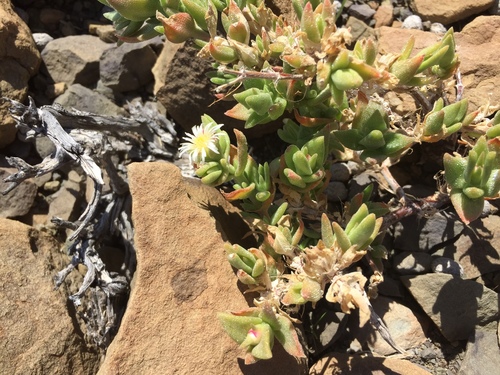
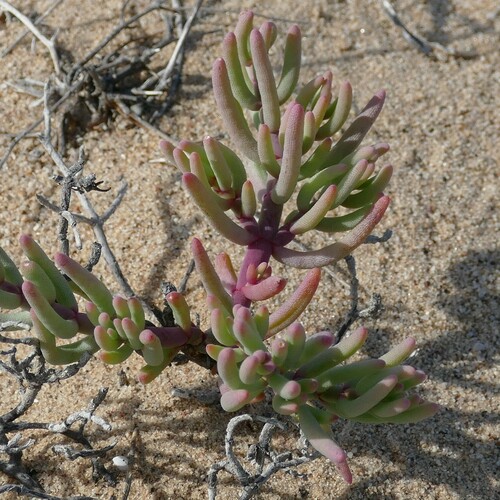
Trianthema triquetrum
Willd. ex Rottl.
Red spinach
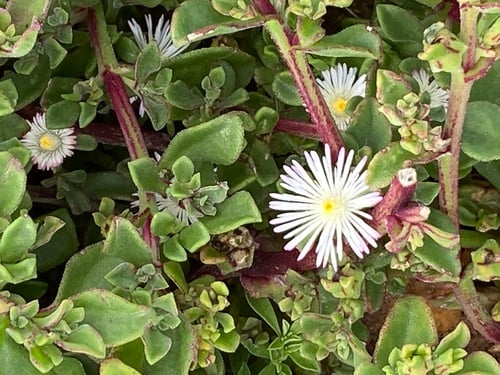
iNaturalist· cc-by-nc
(c) Joachim Keller, some rights reserved (CC BY-NC)
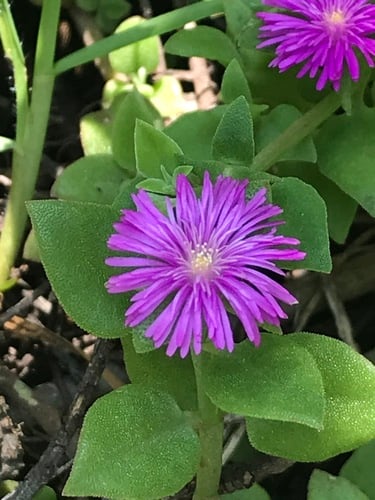
iNaturalist· cc-by-sa
(c) leandra-k_89, some rights reserved (CC BY-SA)
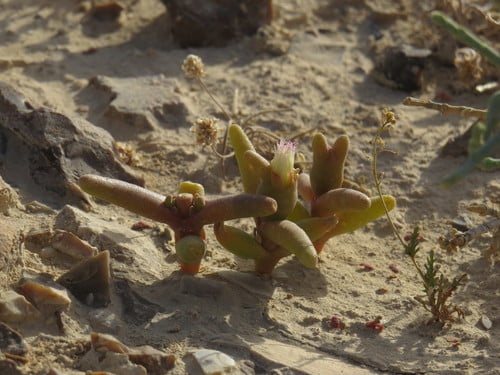
iNaturalist· cc-by-sa
(c) leandra-k_89, some rights reserved (CC BY-SA)
Description
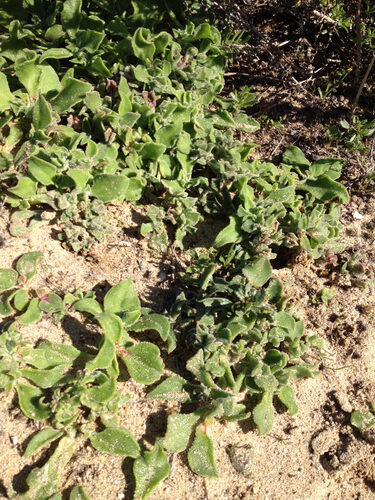
An annual herb. It lies along the ground or can curve up at the tips. It grows 2-20 cm high. The roots are often long and slender. The leaves are up to 1.2 cm long and 2-3 mm wide. The flowers occur singly. The flowers are pink, purple, white or green. The fruit is a capsule with a lid. It is 2 mm long. There is one seed. The seed is black and 1.1 mm across.
Edible Uses
The seeds can be eaten raw or used for flavoring porridge. The leaves and seeds are edible portions.
Traditional Uses
The seeds can be eaten raw and also used for flavouring porridge.
This uses section is brief — help expand it
Medicinal Uses
Not specified in available data.
Known Hazards
Not specified in available data.
Distribution
A tropical and subtropical plant. It grows on dry sandy soils. It can tolerate some salt. It can grow in arid regions. It grows in areas with a rainfall of 270-915 mm per year. It can grow in arid places.
Where It Grows
Africa, Asia, Australia, Botswana, East Africa, India, Middle East, Mozambique, Namibia, Pakistan, Saudi Arabia, Southern Africa, Zimbabwe,
Nutrition
| Part | Moisture | kJ | kcal | Protein | Vit A | Vit C | Iron | Zinc |
|---|---|---|---|---|---|---|---|---|
| 51.8 | 245 | 59 | 8.2 | — | — | 14.2 | 0.7 | — |
Synonyms
Also Known As
Alethi, Kukkapaalakoora, Naisoppu, Patharphor, Sirusharanai
References (13)
- Ambasta, S.P. (Ed.), 2000, The Useful Plants of India. CSIR India. p 647
- Cancilla, D., 2018, Ethnobotanical and Ethnozoological Values Desktop Assessment - Eliwana Project. p 15
- Checklist of NT Vascular Plant Species. January 2003.
- Cherikoff V. & Isaacs, J., The Bush Food Handbook. How to gather, grow, process and cook Australian Wild Foods. Ti Tree Press, Australia p 191
- Flora of Australia, Volume 4, Phytolaccaceae to Chenopodiaceae, Australian Government Publishing Service, Canberra (1984) p 58
Show all 13 references Hide references
- Kenneally, K.E., Edinger, D. C., and Willing T., 1996, Broome and Beyond, Plants and People of the Dampier Peninsula, Kimberley, Western Australia. Department of Conservation and Land Management. p 54
- Lazarides, M. & Hince, B., 1993, Handbook of Economic Plants of Australia, CSIRO. p 238
- Morley, B.D., & Toelken, H.R., (Eds), 1983, Flowering Plants in Australia. Rigby. p 73
- Paczkowska, G. & Chapman, A.R., 2000, The Western Australian Flora. A Descriptive Catalogue. Western Australian Herbarium. p 136
- Royal Botanic Gardens, Kew (1999). Survey of Economic Plants for Arid and Semi-Arid Lands (SEPASAL) database. Published on the Internet; http://www.rbgkew.org.uk/ceb/sepasal/internet [Accessed 24th March 2011]
- Sullivan, S., 1998, People plants and practice in drylands: Socio-political and ecological dimensions of resource-use by Damara farmers in north-west Namibia. Ph.D. Univ. College London.
- World Checklist of Useful Plant Species 2020. Royal Botanic Gardens, Kew
- Wheeler, J.R.(ed.), 1992, Flora of the Kimberley Region. CALM, Western Australian Herbarium, p 96