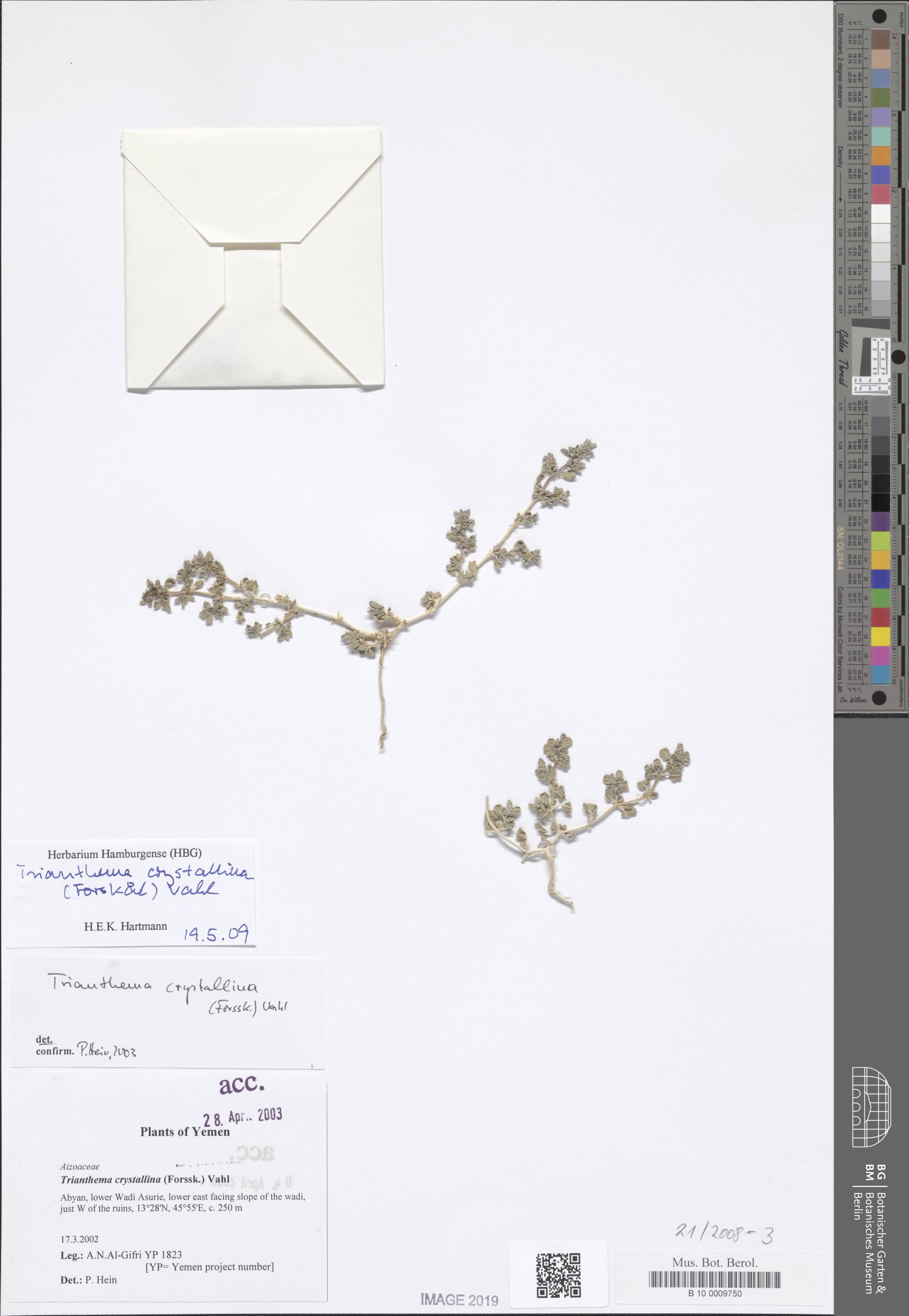
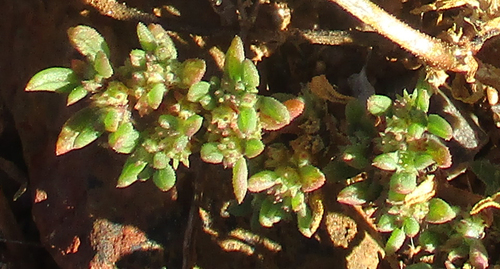
Trianthema portulacastrum
L.
Horse purslane, Giant pigweed
iNaturalist· cc0
no rights reserved, uploaded by 葉子
iNaturalist· cc-by-nc
(c) Heriberto Ávila-González, some rights reserved (CC BY-NC), uploaded by Heriberto Ávila-González
iNaturalist· cc0
no rights reserved, uploaded by 葉子
Summary
Source: WikipediaTrianthema portulacastrum is a species of flowering plant in the ice plant family known by the common names desert horsepurslane, black pigweed, and giant pigweed. It is native to areas of several continents, including Africa and North and South America, and present as an introduced species in many other areas. It grows in a wide variety of habitat types and it can easily take hold in disturbed areas and cultivated land as a weed. This species is a host plant for the beet leafhopper (Circulifer tenellus).
Description
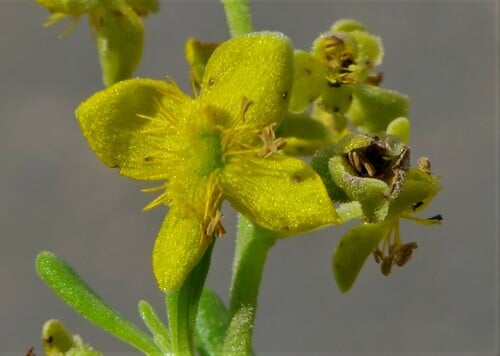
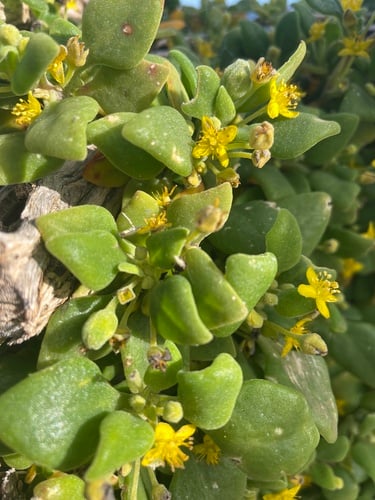
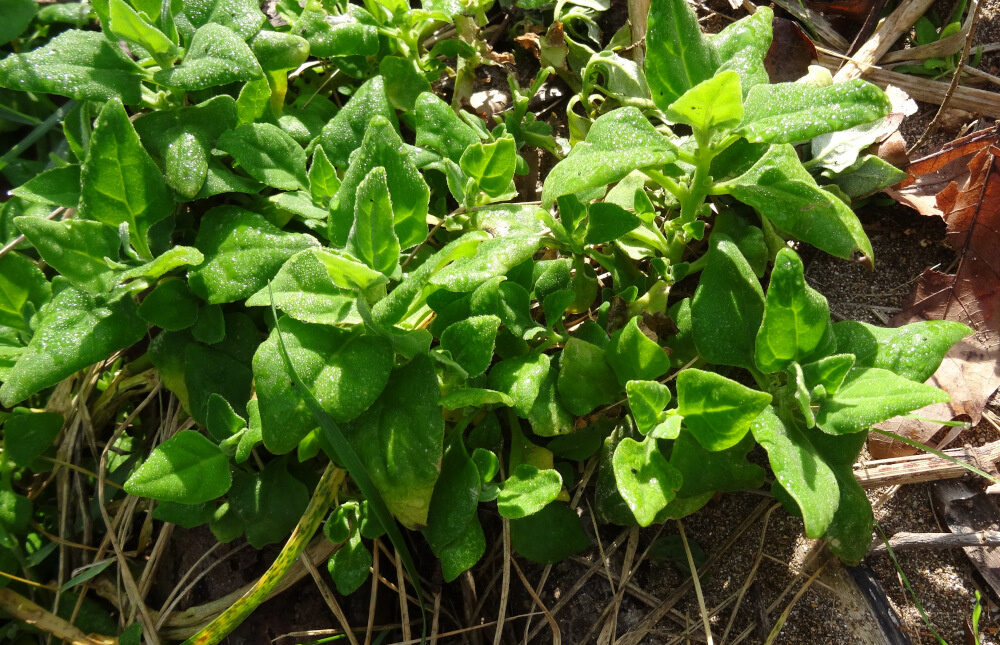
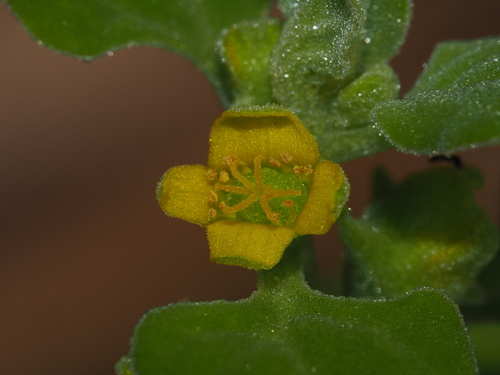
A low lying smooth branched and fleshy herb. It grows each year from seed. The stems are angular. The branches are up to 60 cm long. The leaves are opposite each other and rounded at the tip but wedge shaped at the base. They are 1 to 5 cm long. The flowers are pink and the seed capsule contains about 10 small seeds.
Edible Uses
The young leaves and branches are cooked and eaten as a vegetable or potherb. Leaves are traditionally boiled in water and mixed with salt and chilli. Seeds are also edible.
Traditional Uses
The branches and young leaves are cooked and eaten as a vegetable. They are used as a potherb. The leaves are boiled in water then mixed with salt and chilli. CAUTION: It should probably not be eaten in large amounts. Older leaves have caused paralysis. CAUTION: It may be poisonous unless properly cooked.
Medicinal Uses
The plant is used in times of food shortage.
Known Hazards
The plant should not be eaten in large amounts. Older leaves have caused paralysis. It may be poisonous unless properly cooked.
Distribution
A tropical plant. It grows in tropical sea coasts. It commonly occurs as a weed in the Philippines where land has recently been cleared or dug. It grows in open sunny dry sands; usually near sea or as weeds in fields. It is a tropical plant. Seeds germinate between 20°C to 45°C. In Nepal it grows up to 300 m altitude. It grows in moist unused areas. It grows well in soils with humus. Rajasthan.
Where It Grows
Africa, Argentina, Asia, Australia, Benin, Bolivia, Burkina Faso, Cambodia, Cameroon, Central Africa, China, Côte d'Ivoire, Cuba, Dominican Republic, East Africa, Gambia, Ghana, Guiana, Guinea, Guinée, Guinea-Bissau, Guyana, Haiti, Hawaii, Himalayas, India, Indochina, Ivory Coast, Mali, Mozambique, Nepal, Nigeria, Pacific, Pakistan, Papua New Guinea, PNG, Paraguay, Peru, Philippines, SE Asia, Senegal, Solomon Islands, South America, Sri Lanka, St Helena, Taiwan, Tanzania, Thailand, Venezuela, Vietnam, West Africa, West Indies*,
Cultivation
Plants are grown from seeds. They are sown 1 cm deep. It can also be grown by cuttings.
Propagation
Seed - sown in situ, it germinates at temperatures between 20 - 45°c, with an optimum at 35°c. More than 50% of fresh seeds germinate within 4 - 8 days of incubation. When stored under field conditions, germination increases during 7 - 8 months. Optimum sowing depth is 1cm.
Other Uses
The plant shows allelopathic effects on other weeds and crops including sorghum, pumpkin, eggplant, radish, several pulses and wheat, by inhibiting seed germination and vigour of seedlings. Interestingly, it is also auto-toxic, since plant extracts reduce its own seed germination, shoot length and vigour. The plant has a potential value as a source of organic matter because it contains considerable amounts of nitrogen, potassium and phosphorus.
Other Information
It is used in times of food shortage. It is cultivated in some places.
Notes
It is also put in the family Molluginaceae. It can become a troublesome weed.
Nutrition
| Part | Moisture | kJ | kcal | Protein | Vit A | Vit C | Iron | Zinc |
|---|---|---|---|---|---|---|---|---|
| Leaves raw | 87.9 | 130 | 31 | 3.5 | — | — | 4.3 | 0.5 |
| Leaves boiled | — | — | — | — | — | — | — | — |
| Shoots | — | — | — | — | — | — | — | — |
Synonyms
Also Known As
Adachitkana, Ambalimadu, Ambati-madu, Barsin, Bawra, Bishkapra, Charanai, Chungkueng prehs, Comida de vaca, Co tamkhoi, Desert horse purslane, Eitai, Gadabani, Gadapurina, Galijeru, Ghelijebghroo, Ghetuli, Hato, Hin sarana, Itsit, Jai hai ma chi, Khapra sag, Koppi geloodi, Kulfasag, Lal-sabuni, Lalsabuni, Lana, Muchchugoni, Ngubay gueleme, Omi guileme, Pa-yan-na-wa, Pasalaesoppu, Pasalikeera, Pathorchatta, Pollito yuyo, Pundharighentuli, Rogon yara, Safed, Santhi, Santo, Sata, Seto punarnava, Shaaranaj, Shanti, Sharunnai, Sharunnay, Shavalai, Svet-sa-buni, Topotiro, Toston, Totson, Ulisman, Upothaki, Vaca micuna, Vasu, Vattachanathi keerai, Verdolaga blanca, Verdolaga de caballo, Verdolaga rastrera
References (68)
- Altschul, S.V.R., 1973, Drugs and Foods from Little-known Plants. Notes in Harvard University Herbaria. Harvard Univ. Press. Massachusetts. no. 932
- Ambasta, S.P. (Ed.), 2000, The Useful Plants of India. CSIR India. p 647
- Arinathan, V., et al, 2007, Wild edibles used by Palliyars of the western Ghats, Tamil Nadu. Indian Journal of Traditional Knowledge. 6(1) pp 163-168
- Arora, R. K., 2014, Diversity in Underutilized Plant Species - An Asia-Pacific Perspective. Bioversity International. p 46
- Boedecker, J., et al, 2014, Dietary contribution of Wild Edible Plants to women’s diets in the buffer zone around the Lama forest, Benin – an underutilized potential. Food Sec. 6:833–849
Show all 68 references Hide references
- Brown, W.H., 1920, Wild Food Plants of the Philippines. Bureau of Forestry Bulletin No. 21 Manila. p 54
- Borrell, O.W., 1989, An Annotated Checklist of the Flora of Kairiru Island, New Guinea. Marcellin College, Victoria Australia. p 46
- Burkill, H. M., 1985, The useful plants of west tropical Africa, Vol. 1. Kew.
- Checklist of NT Vascular Plant Species. January 2003.
- Chowdery, T., et al, 2014, Wild edible plants of Uttar Dinajpur District, West Bengal. Life Science Leaflets. 47:pp 20-36 http://lifesciencesleaflets.ning.com
- Codjia, J. T. C., et al, 2003, Diversity and local valorisation of vegetal edible products in Benin. Cahiers Agricultures 12:1-12
- Dangol, D. R. et al, 2017, Wild Edible Plants in Nepal. Proceedings of 2nd National Workshop on CUAOGR, 2017.
- Dansi, A., et al, 2008, Traditional leafy vegetables and their use in the Benin Republic. Genet Resour Crop Evol (2008) 55:1239–1256
- Diouf, M., et al, Leafy Vegetables in Senegal. Bioversity webite
- Dobriyal, M. J. R. & Dobriyal, R., 2014, Non Wood Forest Produce an Option for Ethnic Food and Nutritional Security in India. Int. J. of Usuf. Mngt. 15(1):17-37
- Facciola, S., 1998, Cornucopia 2: a Source Book of Edible Plants. Kampong Publications, p 4
- Flora of Australia, Volume 4, Phytolaccaceae to Chenopodiaceae, Australian Government Publishing Service, Canberra (1984) p 58
- Flora of Solomon Islands
- Food Composition Tables for use in Africa FAO http://www.fao.org/infoods/directory No. 664
- GAMMIE, (As Trianthema monogyna)
- Garcia, G. S. C., 2006, The mother-child nexus. Knowledge and valuation of wild food plants in Wayanad, Western Ghats, India. Journal of Ethnobiology and Ethnomedicine, 2:39
- Gautam, R. S., et al, 2022, Ethnobotanical Review of Wild Edible Plants of Nepal. Journal of Natural History Museum Volume 32, 2021-22 p 100
- Grubben, G. J. H. and Denton, O. A. (eds), 2004, Plant Resources of Tropical Africa 2. Vegetables. PROTA, Wageningen, Netherlands. p 530
- Gueye, M. & Meissa, D., 2007, Traditional Leafy Vegetables in Senegal: Diversity and medicinal Uses. Afr. J. Trad. CAM (2007) 4 (4): 469 – 475
- GUPTA & KANODIA (As Trianthema monogyna)
- Gupta, S., et al, 2005, Analysis of nutrient and antinutrient content of underutilized green leafy vegetables. LWT 38:339-345
- Hedrick, U.P., 1919, (Ed.), Sturtevant's edible plants of the world. p 652
- Henty, E.E., & Pritchard, G.S., 1973, Weeds of New Guinea and their control. Botany Bulletin No 7, Division of Botany, Lae, PNG. p 53
- Henty, E.E., 1980, Harmful Plants in Papua New Guinea. Botany Bulletin No 12. Division Botany, Lae, Papua New Guinea. p 6, 7
- https://www.fireflyforest.com/flowers/category/edible-plants/ Edible Plants – Southeastern Arizona Wildflowers and Plants
- Hussey, B.M.J., Keighery, G.J., Cousens, R.D., Dodd, J., Lloyd, S.G., 1997, Western Weeds. A guide to the weeds of Western Australia. Plant Protection Society of Western Australia. p 76
- Jackes, B. R., 2010, Plants of Magnetic Island. 3rd Edition. James Cook University, Australia. p 19
- Jardin, C., 1970, List of Foods Used In Africa, FAO Nutrition Information Document Series No 2.p 107
- Joshi, N., et al, 2007, Traditional neglected vegetables of Nepal: Their sustainable utilization for meeting human needs. Tropentag 2007. Conference on International Agricultural Research for Development.
- Joshi, N. & Siwakoti, M., 2012, Wild Vegetables Used by Local Community of Makawanpur District and Their Contribution to Food Security and Income Generation. Nepal Journal of Science and Technology Vol. 13, No. 1 (2012) 59-66
- Kenneally, K.E., Edinger, D. C., and Willing T., 1996, Broome and Beyond, Plants and People of the Dampier Peninsula, Kimberley, Western Australia. Department of Conservation and Land Management. p 53
- Kermath, B. M., et al, 2014, Food Plants in the Americas: A survey of the domesticated, cultivated and wild plants used for Human food in North, Central and South America and the Caribbean. On line draft. p 873
- Khan, A. H., et al, 2023, Traditional foraging for ecological transition? Wild food ethnobotany among three ethnic groups in the highlands of the eastern Hindukush, North Pakistan. Journal of Ethnobiology and Ethnomedicine 19:9
- Lazarides, M. & Hince, B., 1993, Handbook of Economic Plants of Australia, CSIRO. p 238
- LU De-quan; Aizoaceae, Flora of China
- Maheshwari, J.K., & Singh, J.P., 1984, Contribution to the Ethnobotany of Bhoxa Tribe of Bijnor and Pauri Garhwal Districts, U.P. J. Econ. Tax. Bot. Vol.5. No.2 pp 253-
- Malezas Comestibles del Cono Sur, INTA, 2009, Buernos Aires
- Marandi, R. R. & Britto, S. J., 2015, Medicinal Properties of Edible Weeds of Crop Fields and Wild plants Eaten by Oraon Tribals of Latehar District, Jharkhand. International Journal of Life Science and Pharma Research. Vo. 5. (2) April 2015 (Also as Trianthema monogyna)
- Martin, F.W. & Ruberte, R.M., 1979, Edible Leaves of the Tropics. Antillian College Press, Mayaguez, Puerto Rico. p 172
- Moerman, D. F., 2010, Native American Ethnobotany. Timber Press. p 566
- Monsalud, M.R., Tongacan, A.L., Lopez, F.R., & Lagrimas, M.Q., 1966, Edible Wild Plants in Philippine Forests. Philippine Journal of Science. p 434
- MORTIMORE
- Panda, T., 2014, Traditional knowledge on wild edible plants as livelihood food in Odisha, India. Journal of Biology and Earth Sciences 2014; 4 (2): B144-B159
- Peters, C. R., O'Brien, E. M., and Drummond, R.B., 1992, Edible Wild plants of Sub-saharan Africa. Kew. p 46
- Pham-Hoang Ho, 1999, An Illustrated Flora of Vietnam. Nha Xuat Ban Tre. p 720
- Phon, P., 2000, Plants used in Cambodia. © Pauline Dy Phon, Phnom Penh, Cambodia. p 607
- Plants of Haiti Smithsonian Institute http://botany.si.edu
- Rajapaksha, U., 1998, Traditional Food Plants in Sri Lanka. HARTI, Sri Lanka. p 21
- Rajkalkshmi, P. et al, 2001, Total carotenoid and beta-carotene contents of forest green leafy vegetables consumed by tribals of south India. Plant Foods for Human Nutrition 56:225-238
- Ramachandran, V. S., 2007, Wild edible plants of the Anamalais, Coimbatore district, western Ghats, Tamil Nadu. Indian Journal or Traditional Knowledge. 6(1) pp 173-176
- Rao, M. L. S., et al, 2014, Indigenous Plant Foods which are commonly consumed by the tribal communities in Dumbriguda Area of Visakhapatnam District, Andhra Pradesh, India. Biolife. Vol 2, Issue 3
- SAXENA
- SAXENA (As Trianthema monogyna)
- Shekhawat, G.S. & Anand, S., 1984, An Ethnobotanical Profile of Indian Desert. J. Econ. Tax. Bot. Vol.5 No.3 pp 591-598
- SHORTT. (As Trianthema obcordata)
- Singh, H.B., Arora R.K.,1978, Wild edible Plants of India. Indian Council of Agricultural Research, New Delhi. p 38
- Singh, V. and Singh, P., 1981, Edible Wild Plants of Eastern Rajasthan. J. Econ. Tax. Bot. Vol 2 pp 197-207
- Sp. pl. 1:223. 1753
- Terra, G.J.A., 1973, Tropical Vegetables. Communication 54e Royal Tropical Institute, Amsterdam, p 79
- Uprety, Y., et al, 2016, Traditional use and management of NTFPs in Kangchenjunga Landscape: implications for conservation and livelihoods. Journal of Ethnobiology and Ethnomedicine (2016) 12:19
- WATT (As Trianthema monogyna)
- Wheeler, J.R.(ed.), 1992, Flora of the Kimberley Region. CALM, Western Australian Herbarium, p 94
- Zereen, A., et al, 2013, Ethnobotanical Studies of Wild Herbs of Central Punjab, Pakistan. Bangladesh J. Plant Taxon 20(1): 67-76