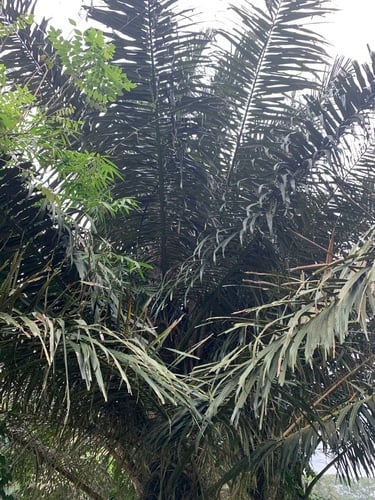
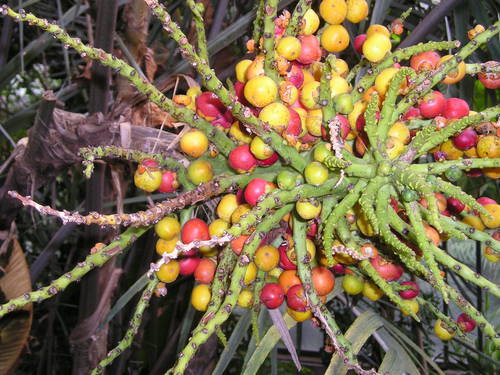
Trachycarpus martianus
(Wall.) H. A. Wendl.
Martius' fan palm, Himalayan palm
iNaturalist· cc-by-nc
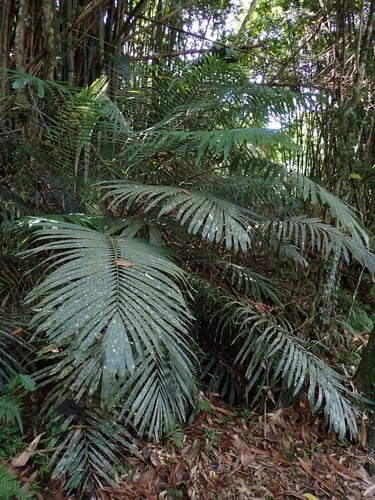
(с) Basu Dev Neupane, некоторые права защищены (CC BY-NC), загрузил Basu Dev Neupane
iNaturalist· cc-by-nc
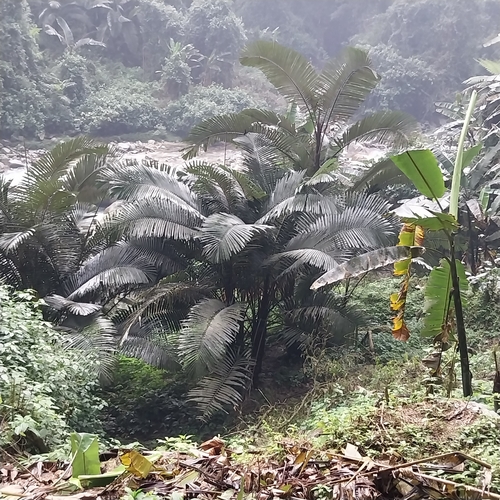
(с) Ángel Fernández Cancio, некоторые права защищены (CC BY-NC), загрузил Ángel Fernández Cancio
iNaturalist· cc-by-nc
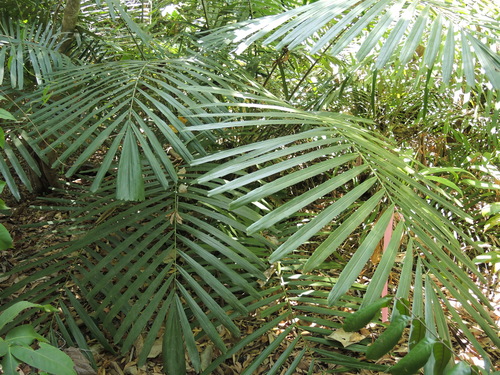
(с) Ángel Fernández Cancio, некоторые права защищены (CC BY-NC), загрузил Ángel Fernández Cancio
Summary
Source: WikipediaTrachycarpus martianus (also known as Martius' fan palm) is a tree in the family Arecaceae. There are two distinct populations: one at 1,500 m (5,000 ft) in the Khasia Hills of Meghalaya state, in northeast India, the other at 2,400 m (8,000 ft) in central northern Nepal. Other populations have been reported in Assam, Sikkim, Burma and southern China. The main identifying characteristics are the regular leaf splits (to about halfway), the coffee-bean-shaped seeds (similar looking to Trachycarpus latisectus) and the bare, as opposed to fibrous trunk. The new leaf spear and edges of the petioles are covered with a white tomentum. The species is named after the German botanist Carl Friedrich Philipp von Martius (1794-1868). It is used in making Jhapi, a traditional head cover often used to felicitate guests in Assam.
Description
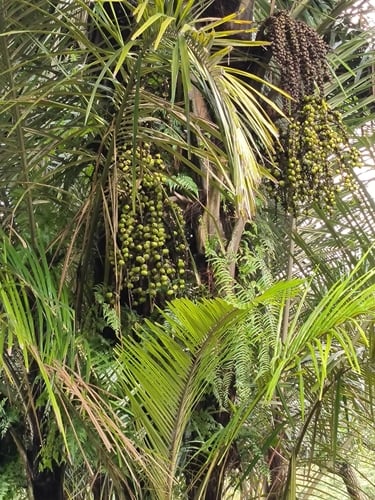
A fan palm. It grows 10-12 m high and is 15 cm across the trunk. The trunk is bare except for tight fibres for about 60 cm below the crown. The leaf splits to about half way. The new leaf spear and edges of the leaf stalks are covered with a white covering. The leaves are large. They can be 1 m across. They are dark green and shiny but with a grey-green bloom underneath. The flowering stalk is drooping with yellow flowers. The fruit are yellow but turn blue-black when ripe. They are oblong. The seeds are coffee bean shape. The seed has a groove along it. The fruit have a thin layer of edible flesh. The fruit are 12 mm long by 7-8 mm across.
Edible Uses
The fruit can be eaten raw or cooked, though the flesh is scanty and almost tasteless. Based on the closely related T. fortunei, young flower buds are likely cooked and used like bamboo shoots, and the fresh flowers and terminal bud are also apparently consumed.
Medicinal Uses
Based on the closely related T. fortunei, the flowers and seed are astringent and haemostatic. The root or fruit is decocted as a contraceptive. Ashes from the plant's silky hairs are haemostatic and, mixed with boiling water, are used to treat haemoptysis, nosebleeds, haematemesis, blood in stools, metrorrhagia, gonorrhoea, and other venereal diseases.
Distribution
It grows at 1500 m altitude in the hills of NE India. They also occur at 2400 m in Nepal. They grow on acid soil. They can tolerate occasional light frost. It suits subtropical to temperate zones. They need an open sunny location and acidic and well drained soil. It suits hardiness zones 9-11.
Where It Grows
Asia, Australia, China, Himalayas, India, Indochina, Myanmar, Nepal, SE Asia,
Cultivation
Plants are grown from seed. Seeds germinate quite easily.
Propagation
Scarify or pre-soak seed for 24 hours in warm water, then sow in a cold frame in mid to late winter. Move into the greenhouse about 4–6 weeks later; seed should germinate in roughly 4–8 weeks at 25°C. Prick seedlings into individual pots as soon as they are large enough to handle, and grow on in the greenhouse for at least their first winter. Plant out into permanent positions in late spring or early summer after the last expected frosts, and consider providing cold protection during their first winter outdoors. Pot up suckers in late spring and plant out into permanent positions 12 months later.
Other Uses
Based on the closely related T. fortunei, fibres from within the leafstalk are used for brushes, ropes, and coarse cloth. A matting is made from the bark mixed with some stem fibres, and the leaves are woven into hats, rough coats, and fans.
Production
It is slow growing.
Notes
There are 6 Trachycarpus species.
References (9)
- Blomberry, A. & Rodd, T., 1982, Palms. An informative practical guide. Angus & Robertson. p 173
- Cundall, P., (ed.), 2004, Gardening Australia: flora: the gardener's bible. ABC Books. p 1426
- Gay, Bull. Soc. Bot. France 8:429. ("1861"). 1863
- Gibbons, M., 1993, Palms. Compact study Guide and Identifier. Sandstone. p 74
- Gibbons, M., 2003, A pocket guide to Palms. Chartwell Books. p 211
Show all 9 references Hide references
- Hedrick, U.P., 1919, (Ed.), Sturtevant's edible plants of the world. p 651
- Jones, D.L., 1994, Palms throughout the World. Smithtonian Institution, Washington. p 55, 368
- Plants for a Future database, The Field, Penpol, Lostwithiel, Cornwall, PL22 0NG, UK. http://www.scs.leeds.ac.uk/pfaf/
- Riffle, R.L. & Craft, P., 2003, An Encyclopedia of Cultivated Palms. Timber Press. p 466