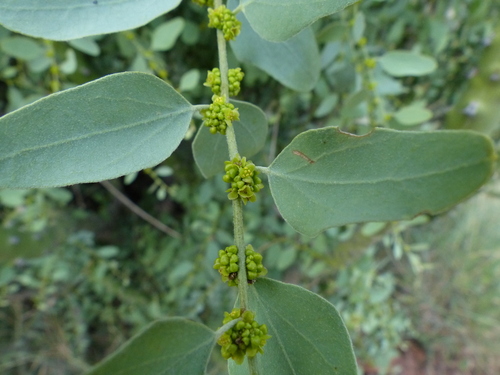
Tiliacora triandra
(Colebr.) Diels
Yanang
iNaturalist· cc-by-sa
(c) Renaudsechet, some rights reserved (CC BY-SA)
iNaturalist· cc-by-sa
(c) Aris riyanto, some rights reserved (CC BY-SA)
Summary
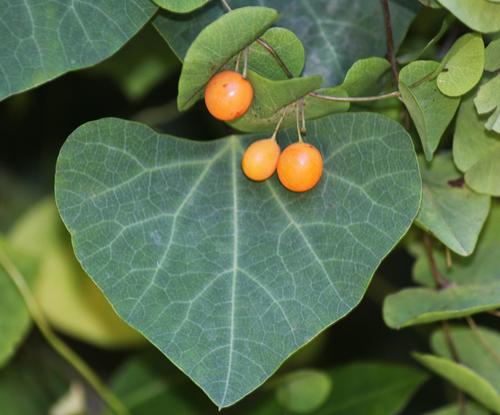
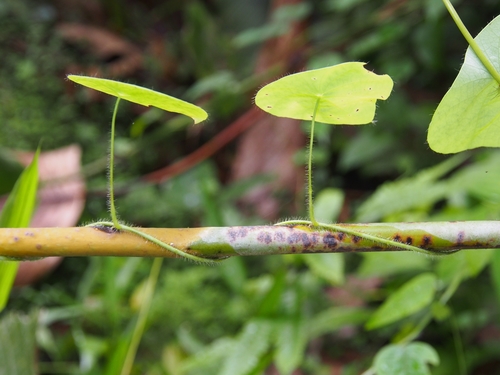
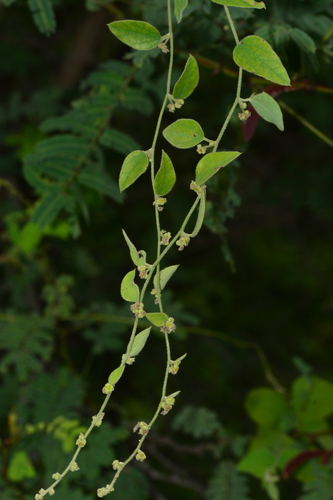
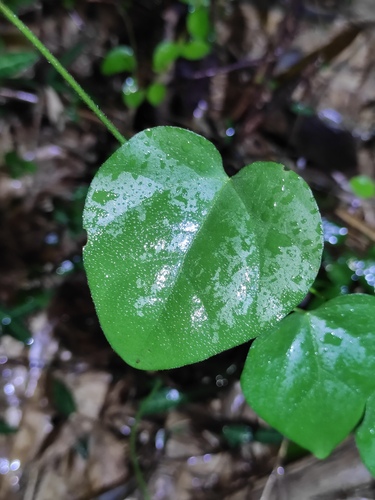
Source: WikipediaTiliacora triandra is a species of flowering plant native to mainland Southeast Asia and used particularly in the cuisines of northeast Thailand and Laos. In the Isan dialect of Lao, the language of northeastern Thailand, it is called bai yanang or bai ya nang (ใบย่านาง, literally "yanang leaf"), or simply yanang or ya nang (ย่านาง). In Laos, it is also called bai yanang (ໃບຢານາງ). In Khmer, it is called voar yeav (វល្លិយាវ). It is a climbing plant with deep green leaves and yellowish flowers, tolerating only very mild frost.
Description
A slender woody climber. The flowers are yellow.
This description is brief — help expand it
Edible Uses
In the Lao Isan culture of northeastern Thailand, the leaves are used in the preparation of kaeng no mai (Thai: แกงหน่อไม้, sometimes called kaeng Lao (Thai: แกงลาว)),photo, after the ethnic Lao majority of northeastern Thailand, is a chili-hot tasting soup containing bamboo shoots, chilis, salt, and sometimes also oyster mushrooms, straw mushrooms, cha-om, or other ingredients. Generally the leaves are not used whole, but rather a juice (or extract) made from the leaves is used to make the broth, primarily as a thickening agent rather than for its flavor. This juice may be prepared from scratch, from fresh leaves, or purchased in canned form.photo In Vietnam, the plant is called dây sương sâm, and can be made into a kind of jelly called: "sương sâm", sometimes combined with other ingredients as a beverage and desserts. In Cambodia, it is used as an ingredient in sour soups called samlor machu. In Laos and Thailand, the leaves are extracted with water using both hands rubbing on the leaves back and forth until all the green part in the leaves is out in the water, this is called nam yanang (Lao: ນໍ້າຢານາງ; Thai: น้ำย่านาง), meaning "yanang water". The yanang water is used to make bamboo soup. Some street vendors also sell bottled yanang water marketing it as a chlorophyll drink.
Traditional Uses
The leaves are pureed then used to get rid of the bitterness of some spicy bamboo shoots. This is eaten with rice. It is used in soups and as a food colouring. The leaf spine is filtered out.
Medicinal Uses
In many Southeast Asian countries, the leaves and the roots of T. triandra plants are used for medicinal purposes. Reports have indicated that the native populations have used the roots and the leaves of this plant as a detoxification agent, anti-cancer, antibacterial, and anti-inflammatory agent, amongst other uses.
Distribution
A tropical plant. It grows in limestone areas.
Where It Grows
Asia, Cambodia, Indochina, Laos, Malaysia, SE Asia, Thailand, Vietnam,
Cultivation
A dioecious species, both male and female forms need to be grown if fruit and seed are required.
Other Uses
A fibre obtained from the stems is used for cordage.
Other Information
It is available in markets fresh, frozen or canned.
Notes
It has antioxidant activity.
Synonyms
Also Known As
Akar kunyit-kunyit, Akar kusin, Bai yaa nang, Bekunyit, Tao ya nang, Thao yaanaang, Vor yeav, Yaa nang, Yaanang, Yanang
References (19)
- Burkill, I.H., 1966, A Dictionary of the Economic Products of the Malay Peninsula. Ministry of Agriculture and Cooperatives, Kuala Lumpur, Malaysia. Vol 2 (I-Z) p 2200
- Cruz-Garcia, G. S., & Price, L. L., 2011, Ethnobotanical investigation of 'wild' food plants used by rice farmers in Kalasin, Northeast Thailand. Journal of Ethnobiology and Ethnomedicine 7:33
- Eiadthong, W., et al, 2010, Management of the Emerald Triangle Protected Forests Complex. Botanical Consultant Technical Report. p 52
- Facciola, S., 1998, Cornucopia 2: a Source Book of Edible Plants. Kampong Publications, p 150
- Ferns, Useful Tropical Plants
Show all 19 references Hide references
- Forman, L.L., 1984, Menispermaceae in Flora Malesiana Series 1 Vol 10 (2) p166,
- Jacquat, C., 1990, Plants from the Markets of Thailand. D.K. Book House p 35
- Jiwajinda, S., et al, 2002, Suppressive Effects of Edible Thai Plants on Superoxide and Nitric Oxide Generation. Asian Pacific Journal of Cancer Prevention, Vol 3, 2002
- Kachenchart, B., et al, 2008, Phenology of Edible Plants at Sakaerat Forest. In Proceedings of the FORTROP II: Tropical Forestry Change in a Changing World. Bangkok, Thailand.
- Khumgratok, S., Edible Plants in Cultural Forests of Northeastern Thailand. Mahasarakham University Thailand.
- Luczaj, L., et al, 2021, Wild food plants and fungi sold in the markets of Luang Prabang, Lao PDR. Journal of Ethnobiology and Ethnomedicine (2021) 17:6
- Nakahara, K. et al, 2002, Antimutagenicity of Some Edible Thai Plants, and a Bioactive Carbazole Alkaloid, Mahanine, Isolated from Micromelum minutum. Journal of Agricultural and Food Chemistry. 50: 4796-4892
- Phatlamphu, N., et al, 2021, Ethnobotany of edible plants in Muang District, Kalasin Province, Thailand, Biodiversitas Vol. 22, No. 12 pp 5432-5444
- Singthong, J., et al, 2009, Extraction and physicochemical characterisation of polysaccharide gum from Yanang (Tiliacora triandra) leaves. Food Chemistry 114: 1301-1307
- Somnasang, P., Moreno, G and Chusil K., 1998, Indigenous knowledge of wild hunting and gathering in north-east Thailand. Food and Nutrition Bulletin 19(4) p 359f
- Srichaiwong, P., et al, 2014, A Study of the Biodiversity of Natural Food Production to Support Community Upstream of Chi Basin, Thailand. Asian Social Science 10 (2):
- Suksri, S., et al, 2005, Ethnobotany in Bung Khong Long Non-Hunting Area, Northeast Thailand. Kasetsart J., (Nat. Sci) 39: 519-533
- Thitiprasert, W., et al, 2007, Country report on the State of Plant Genetic Resources for Food and Agriculture in Thailand (1997-2004). FAO p 95
- Turreira Garcia, N., et al, 2017, Ethnobotanical knowledgeof the Kuy and Khmer people in Prey Lang, Cambodia. Cambodian Journal of Natural History 2017 (1): 76-101