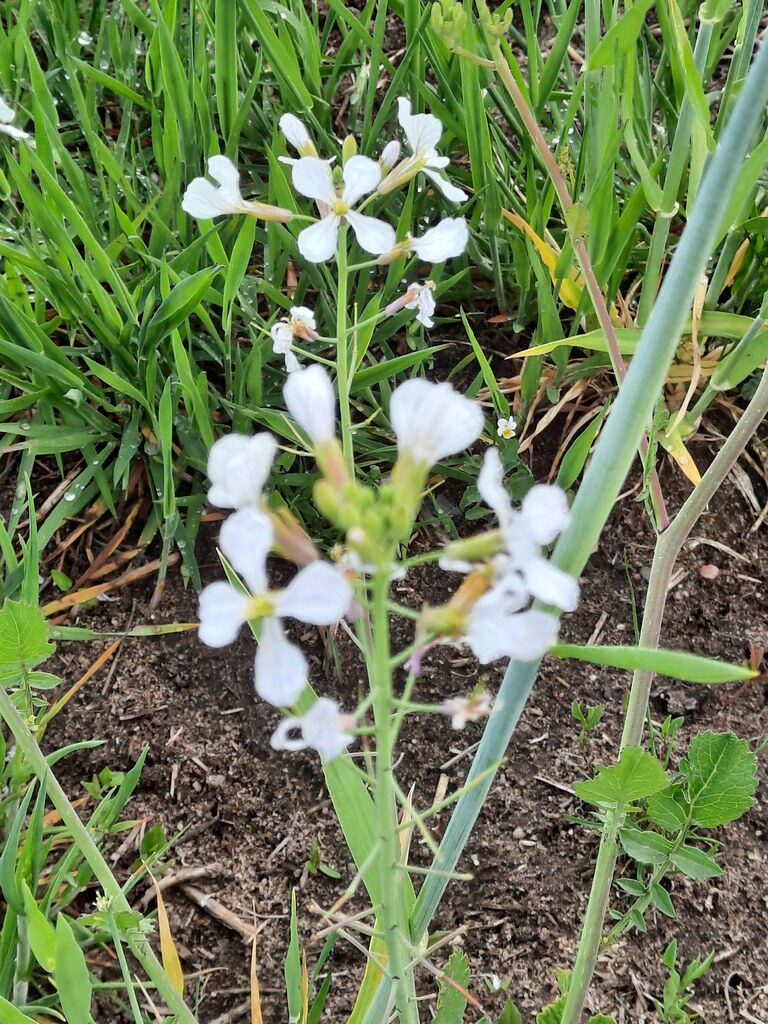
Thlaspi arvense
L.
Field Pennycress
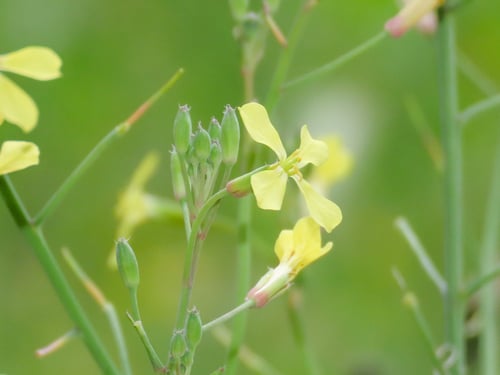
iNaturalist· cc-by-nc
(c) josefwirth, some rights reserved (CC BY-NC), uploaded by josefwirth
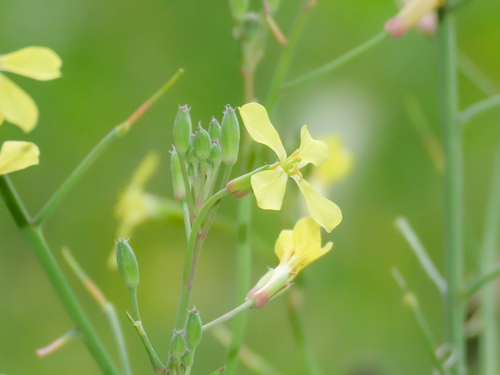
iNaturalist· cc-by-nc
(c) Rob Lang, some rights reserved (CC BY-NC)
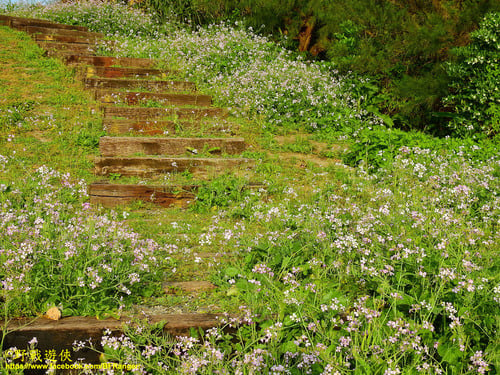
iNaturalist· cc-by-nc
(c) Rob Lang, some rights reserved (CC BY-NC)
Summary
Source: WikipediaThlaspi arvense, known by the common name field pennycress, is a flowering plant in the cabbage family Brassicaceae. It is native to Eurasia, and is a common weed throughout much of North America and its home.
Description
A cabbage family herb. It is an annual plant. It grows up to 60 cm tall and spreads 1 m wide. The stem is erect and angular. The lower leaves are oval or sword shaped with teeth. These leaves have leaf stalks. The upper leaves clasp the stem at their base. The flowers are white and small. They are in long heads. The fruit is a pod. It is flattened.
Edible Uses
Young leaves can be eaten raw or cooked, but must be harvested before the plant flowers or they become very bitter. Even at their best, the leaves have a somewhat bitter flavour and aroma that is not to everyone's taste. They can be added in small quantities to salads, cooked in soups, or used as a potherb — the flavour resembles mustard with a hint of onion. The leaves are notably high in protein for a leafy green; dried leaves contain 54.2g protein per 100g, along with 33.1g carbohydrate and a remarkable 1900mg vitamin C per 100g dry weight. The seed can be ground into a powder and used as a mustard substitute, or sprouted and added to salads.
Traditional Uses
The tender shoots are cooked as a vegetable. The water is changed 1 or 2 times. They are also cooked in stir fries and used for making pickles. The leaves are eaten with oil and salt. The seeds are used as a condiment. They are used in soups and in sausages.
Medicinal Uses
The plant is antirheumatic and diuretic. The seed is a tonic, and both seed and young shoots are considered beneficial for the eyes. In Tibetan medicine, the seeds are regarded as having an acrid taste and cooling potency; they are used as anti-inflammatory and febrifuge agents in treating pus in the lungs, renal inflammation, appendicitis, and seminal and vaginal discharges. The whole plant is used as an antidote, anti-inflammatory, blood tonic, depurative, diaphoretic, expectorant, febrifuge, and hepatic, and is applied in the treatment of carbuncles, acute appendicitis, intestinal abscess, post-partum pain, dysmenorrhoea, and endometriosis. Large doses can cause a decrease in white blood cells, nausea, and dizziness — use with caution. The plant has broad antibacterial activity, effective against staphylococci and streptococci.
Known Hazards
Use with caution as large doses can cause decreased white blood cells, nausea, and dizziness.
Distribution
It is a temperate plant. In Nepal it grows between 2100-4500 m altitude. It grows in open or shady places along riverbanks. It will grow in most soils and is best in an open, sunny position. It is resistant to drought and frost. In Sichuan. In Yunnan.
Where It Grows
Afghanistan, Africa, Argentina, Asia, Australia, Balkans, Bhutan, Bolivia, Bosnia, Britain, Canada, Central Asia, Chile, China, Colombia, Estonia, Europe*, Himalayas, India, Iraq, Ireland, Japan, Kashmir, Kazakhstan, Korea, Kyrgyzstan, Luxembourg, Middle East, Mongolia, Nepal, New Zealand, North Africa, North America, Northeastern India, Norway, Pakistan, Russia, Scandinavia, Sikkim, Slovenia, South America, Sweden, Taiwan, Tajikistan, Tasmania, Tibet, Turkmenistan, USA, Uzbekistan, SW Asia, South America,
Cultivation
Plants are grown from seed.
Propagation
Sow seed in situ in March or April.
Other Uses
The seed contains 20–30% of a semi-drying oil, which is used for lighting.
Other Information
It is commonly eaten in Bhutan. It is a cultivated food plant.
Notes
There are about 60 Thlaspi species. It contains sinigrin, an element which reportedly gives the leaves a warm taste. It is high in vitamin C and B2.
Synonyms
Also Known As
Bhaji, Bolsa grande, Bre-ga, Carraspique, Cestika, Cheka-chumu, Common penny cress, Erba storna, Fanweed, Gekha, Jidanhuang, Jucu, Kugen, Ku gan cai, Litterhein, Manlancai, Mithridate mustard, Pengeurt, Stinkweed, Telaspo, Tite, Xi ming
References (47)
- Bodkin, F., 1991, Encyclopedia Botanica. Cornstalk publishing, p 979
- Boesi, A., 2014, Traditional knowledge of wild food plants in a few Tibetan communities. Journal of Ethnobiology and Ethnomedicine 10:75
- Cerne, M., 1992, Wild Plants from Slovenia used as Vegetables. Acta Horticulturae 318
- "Chinese Nutrition Journal", 2002, Vol 23(8) p 298
- Cormack, R. G. H., 1967, Wild Flowers of Alberta. Commercial Printers Edmonton, Canada. p 131
Show all 47 references Hide references
- Duke, J.A., 1992, Handbook of Edible Weeds. CRC Press. p 194
- Elias, T.S. & Dykeman P.A., 1990, Edible Wild Plants. A North American Field guide. Sterling, New York p 82
- Esperanca, M. J., 1988. Surviving in the wild. A glance at the wild plants and their uses. Vol. 1. p 357
- Flora of Australia, Volume 8, Lecythidales to Batales, Australian Government Publishing Service, Canberra (1982) p 288
- Flora of China @ efloras.org Volume 8
- Geng, Y., et al, 2016, Traditional knowledge and its transmission of wild edibles used by the Naxi in Baidi Village, northwest Yunnan province. Journal of Ethnobiology and Ethnomedicine. 12:10
- Girard, N. J., 2020, Sustainable Foraging of Wild Edible Plants in Norway. A Biocultural Approach. M. Sc. thesis Norwegian University. p 129
- Hedrick, U.P., 1919, (Ed.), Sturtevant's edible plants of the world. p 649
- Heywood, V.H., Brummitt, R.K., Culham, A., and Seberg, O. 2007, Flowering Plant Families of the World. Royal Botanical Gardens, Kew. p 70
- http://nordicfood lab/org/blog/2102/9/wild-edible-plants-an-overview
- Hu, Shiu-ying, 2005, Food Plants of China. The Chinese University Press. p 422
- Hwang, H., et al, 2013, A Study on the Flora of 15 Islands in the Western Sea of Jeollanamdo Province, Korea. Journal of Asia-Pacific Biodiversity Vol. 6, No. 2 281-310
- Irving, M., 2009, The Forager Handbook, A Guide to the Edible Plants of Britain. Ebury Press p 102
- Ju, Y., et al, 2013, Eating from the wild: diversity of wild edible plants used by Tibetans in Shangri-la region, Yunnan, China, Journal of Ethnobiology and Ethno medicine 9:28
- Kalle, R. & Soukand, R., 2012, Historical ethnobotanical review of wild edible plants of Estonia (1770s-1960s) Acta Societatis Botanicorum Poloniae 81(4):271-281
- Kang, Y., et al, 2012, Wild food plants and wild edible fungi in two valleys on the Qinling Mountains (Shaanxi, central China) Journal of Ethnobiology and Ethnomedicine; 9:26
- Kang, Y., et al, 2014, Wild food plants used by the Tibetans of Gongba Valley (Zouqu country, Gansu, China) Journal of Ethnobiology and Ethnomedicine 10:20
- Kang, J. et al, 2016, Wild food plants and fungi used in the mycophilous Tibetan community of Zhagana (Tewo Country, Gansu, China) Journal of Ethnobiology and Ethnomedicine. 12:21
- Kermath, B. M., et al, 2014, Food Plants in the Americas: A survey of the domesticated, cultivated and wild plants used for Human food in North, Central and South America and the Caribbean. On line draft. p 867
- Lazarides, M. & Hince, B., 1993, Handbook of Economic Plants of Australia, CSIRO. p 236
- Low, T., 1991, Wild Herbs of Australia and New Zealand. Angus & Robertson. p 57, 142
- Mabey, R., 1973, Food for Free. A Guide to the edible wild plants of Britain, Collins. p 77
- MacKinnon, A., et al, 2009, Edible & Medicinal Plants of Canada. Lone Pine. p 212
- Malezas Comestibles del Cono Sur, INTA, 2009, Buernos Aires
- Manandhar, N.P., 2002, Plants and People of Nepal. Timber Press. Portland, Oregon. p 456
- Moerman, D. F., 2010, Native American Ethnobotany. Timber Press. p 556
- Plants for a Future database, The Field, Penpol, Lostwithiel, Cornwall, PL22 0NG, UK. http://www.scs.leeds.ac.uk/pfaf/
- READ,
- Redzic, S. J., 2006, Wild Edible Plants and their Traditional Use in the Human Nutrition in Bosnia-Herzegovina. Ecology of Food and Nutrition, 45:189-232
- Redzic, S., 2010, Use of Wild and Semi-Wild Edible Plants in Nutrition and Survival of People in 1430 Days of Siege of Sarajevo during the War in Bosnia and Herzegovina (1992–1995). Coll. Antropol 34 (2010) 2:551-570
- Savita, et al, 2006, Studies on wild edible plants of ethnic people in east Sikkim. Asian J. of Bio Sci. (2006) Vol. 1 No. 2 : 117-125
- Sp. pl. 2:646. 1753 [ As arvense]
- Tasmanian Herbarium Vascular Plants list p 18
- Tsering, J., et al, 2017, Ethnobotanical appraisal on wild edible plants used by the Monpa community of Arunchal Pradesh. Indian Journal of Traditional Knowledge. Vol 16(4), October 2017, pp 626-637
- Tsherig, K., 2012, Edible Wild Plants of Bhutan and their contribution to Food and Nutrition Security. Ministry of Ag. and Forests, Bhutan. www.fao.org
- Urgamal, M., Oyuntsetseg, B., Nyambayar, D. & Dulamsuren, Ch. 2014. Conspectus of the vascular plants of Mongolia. (Editors: Sanchir, Ch. & Jamsran, Ts.). Ulaanbaatar, Mongolia. “Admon“ Press. 334pp. (p. 79-90).
- Wang, J. et al, 2013, A Study on the Utilization of Wild Plants for Food in Liangshan Yi Autonomous Prefecture. Plant Diversity and Resources. 35(4): 416-471
- Wild edible plants of Himachal Pradesh
- www.ediblewildfood.com
- Yeshi, K. et al, 2017, Taxonomical Identification of Himalayan Edible Medicinal Plants in Bhutan and the Phenolic Contents and Antioxidant Activity of Selected Plants. TBAP 7 (2) 2017 pp 89 - 106
- Zhou Taiyan, Lu Lianli, Yang Guang; Ihsan A. Al-Shehbaz, BRASSICACEAE (CRUCIFERAE), Flora of China.
- Zhang, L., et al, 2016, Ethnobotanical study of traditional edible plants used by the Naxi people during droughts. Journal of Ethnobiology and Ethnomedicine. 12:39