Terminalia prunioides
M. A. Lawson
Lowveld terminalia, Purple-pod terminalia
iNaturalist· cc-by-nc
(c) Lukas Lindenthal, some rights reserved (CC BY-NC), uploaded by Lukas Lindenthal
iNaturalist· cc-by
(c) Eric Knight, some rights reserved (CC BY)
Summary
Source: WikipediaTerminalia prunioides, the purple-pod cluster-leaf or purple-pod terminalia, is a small African tree in the family Combretaceae. It is native to the eastern and south-central parts of the continent.
Description
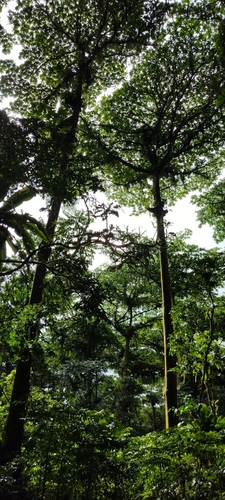
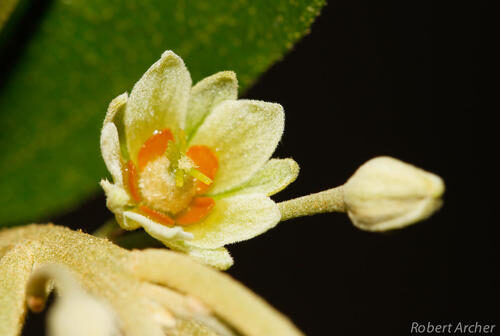
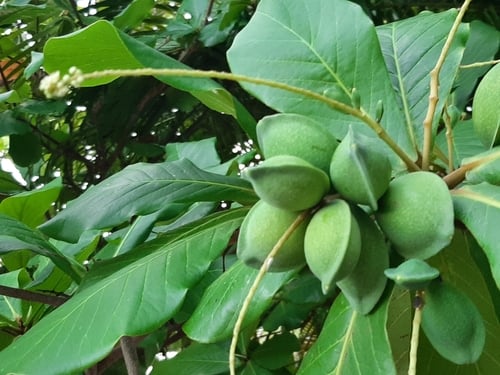
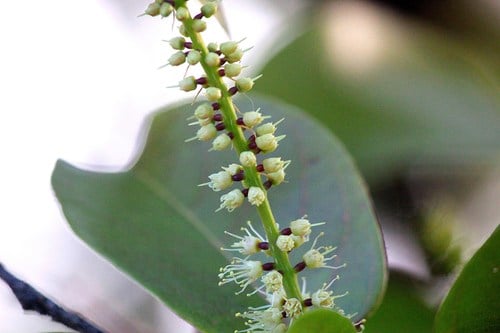
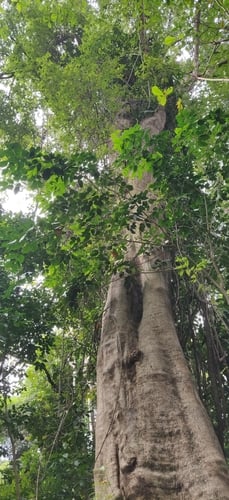
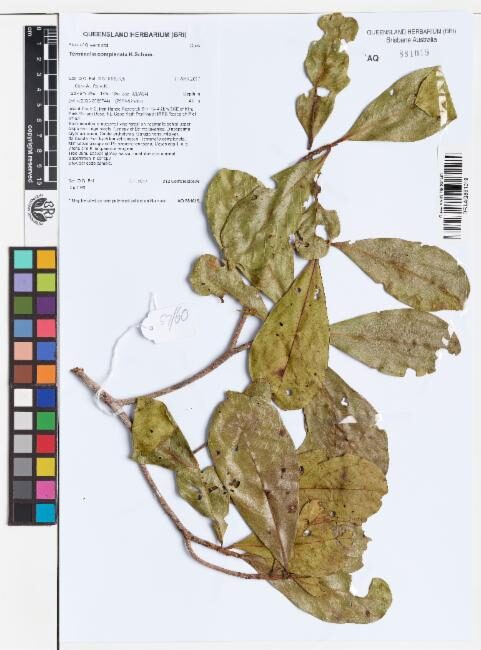
A bushy shrub and also a medium sized tree. It grows 5-15 m tall. It can have a girth of 1.5 m. It can have one or many stems. The bark is light grey and ribbed along its length. The branches hang over. The short twigs point upwards and at right angles to the branches. The leaves and flowers are crowded at the ends of the small branches. The bark on the twigs strips off in short lengths. The leaves are small. They are 1.3-5 cm long by 2.5 cm across. They are oval and often widest in the upper half and taper to the base. The leaves are dark green on the upper surface and lighter green and hairy underneath. The flowers are small and starry. They are white with a puff of yellow stamens. They are in lax spikes at the ends of short branches. They have a strong scent. The fruit are 3.5-5 cm long and oval. The seed in the thickened centre is surrounded by a tough flat wing. They turn deep wine red when ripe.
Edible Uses
The gum exuded from the tree is edible. The fresh leaves and young twigs are used for tea. The seeds are eaten raw, ground for coffee (boiled with milk and sugar), or used whole. The ripe fruit are eaten as a dessert fruit or brewed as tea.
Traditional Uses
The gum exuded from the tree is edible. The young twigs are boiled in water to make tea. The fresh leaves are used for tea. The seeds are used for coffee. They are ground and boiled with milk and sugar. The seeds are eaten raw. The fruit are eaten as a desert fruit. They are also used as a tea.
Medicinal Uses
The plant is used in traditional medicine across its range. In Somalia, a decoction is taken to relieve postnatal abdominal pains. The bark is chewed to treat coughs, sore throats, and stomach-aches, while the roots are chewed to treat colds. Research has shown that leaf extracts of T. prunioides possess significant antifungal activity against pathogens such as Microsporum canis, which causes ringworm and other dermatophyte infections.
Distribution
A tropical plant. It grows in frost free areas. It likes shade. It can grow on sandy or stony soils. It grows naturally in low altitude open woodland and scrub. It occurs on rocky slopes and deep alluvial soils of low altitude rivers. It is very drought resistant. It grows between 30-1,400 m above sea level. It can grow in arid places. In Brisbane Botanical Gardens.
Where It Grows
Africa, Angola, Australia, Botswana, Central Africa, Djibouti, East Africa, Eritrea, Eswatini, Ethiopia, Kenya, Lesotho, Malawi, Mozambique, Namibia, Somalia, South Africa, Southern Africa, Swaziland, Tanzania, Uganda, Zambia, Zimbabwe,
Cultivation
Plants can be grown from seeds. The seeds germinate easily. It is best to remove the wings and then soak the seeds for a few hours before sowing. Seeds germinate in about 3 weeks.
Propagation
Seed - viability can be maintained for at least 1 year in hermetic storage at 3°c.
Other Uses
The rotten heartwood is sometimes pulverized and used as a fragrance for cosmetic purposes. The yellow wood is heavy, very hard, tough and exceptionally durable, even in salty water where it resists borers. It is used to make tool handles, fence posts, house building, dhow keels and wagon axles. The wood makes a good fuel and an excellent charcoal. The leaves are used as a green manure.
Production
It can grow to about 6 m in 15 years. They flower in spring and summer.
Notes
There are about 200-250 Terminalia species. They are tropical.
Synonyms
Also Known As
Blutfruchtbaum, Chachandau, Codoni, Hareeri, Lowveld cluster-leaf, Mochara, Ohama, Omuhama, Sterkbos, Tiyeeg, Tsamanate
References (16)
- Fowler, D. G., 2007, Zambian Plants: Their Vernacular Names and Uses. Kew. p 20
- Lee, 1979,
- Mahony, D., 1991, Trees of Somalia. A Field Guide for Development Workers. Oxfam Research Paper 3. p 9
- Magwede, K., van Wyk, B.-E., & van Wyk, A. E., 2019, An inventory of Vhavenḓa useful plants. South African Journal of Botany 122 (2019) 57–89
- D. Oliver, Fl. trop. Afr. 2:415. 1871
Show all 16 references Hide references
- Palgrave, K.C., 1996, Trees of Southern Africa. Struik Publishers. p 682
- Palmer, E and Pitman, N., 1972, Trees of Southern Africa. Vol. 3. A.A. Balkema, Cape Town p 1657
- Peters, C. R., O'Brien, E. M., and Drummond, R.B., 1992, Edible Wild plants of Sub-saharan Africa. Kew. p 87
- Roodt, V., 1998, Trees & Shrubs of the Okavango Delta. Medicinal Uses and Nutritional value. The Shell Field Guide Series: Part 1. Shell Botswana. p 63
- Royal Botanic Gardens, Kew (1999). Survey of Economic Plants for Arid and Semi-Arid Lands (SEPASAL) database. Published on the Internet; http://www.rbgkew.org.uk/ceb/sepasal/internet [Accessed 10th April 2011]
- Ruiters-Welcome, A. K., 2019, Food plants of southern Africa. Ph.D. thesis. Univ. of Johannesburg p 45
- Sullivan, S., 1998, People plants and practice in drylands: Socio-political and ecological dimensions of resource-use by Damara farmers in north-west Namibia. Ph.D. Univ. College London. p 31
- van Wyk, B, van Wyk, P, and van Wyk B., 2000, Photographic guide to Trees of Southern Africa. Briza. p 306
- Welcome, A. K. & Van Wyk, B.-E., 2019, An inventory and analysis of the food plants of southern Africa. South African Journal of Botany 122 (2019) 136–179
- World Checklist of Useful Plant Species 2020. Royal Botanic Gardens, Kew
- www.worldagroforestrycentre.org/treedb/