Terminalia kaernbachii
Warb.
Okari
iNaturalist· cc-by
(c) coenobita, some rights reserved (CC BY), uploaded by coenobita
wikimedia· cc-by
Wikimedia Commons - Forest and Kim Starr
wikimedia· cc-by
Wikimedia Commons - Forest and Kim Starr
Summary
A deciduous tree reaching 20m tall and wide at a fast growth rate, Terminalia kaernbachii thrives in full sun on light sandy, medium loamy, and heavy clay well-drained soils. It adapts to mildly acidic to basic pH levels and prefers moist soil. Hardy to UK zone 10.
Description
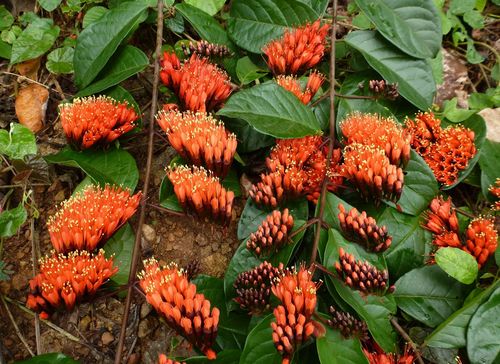
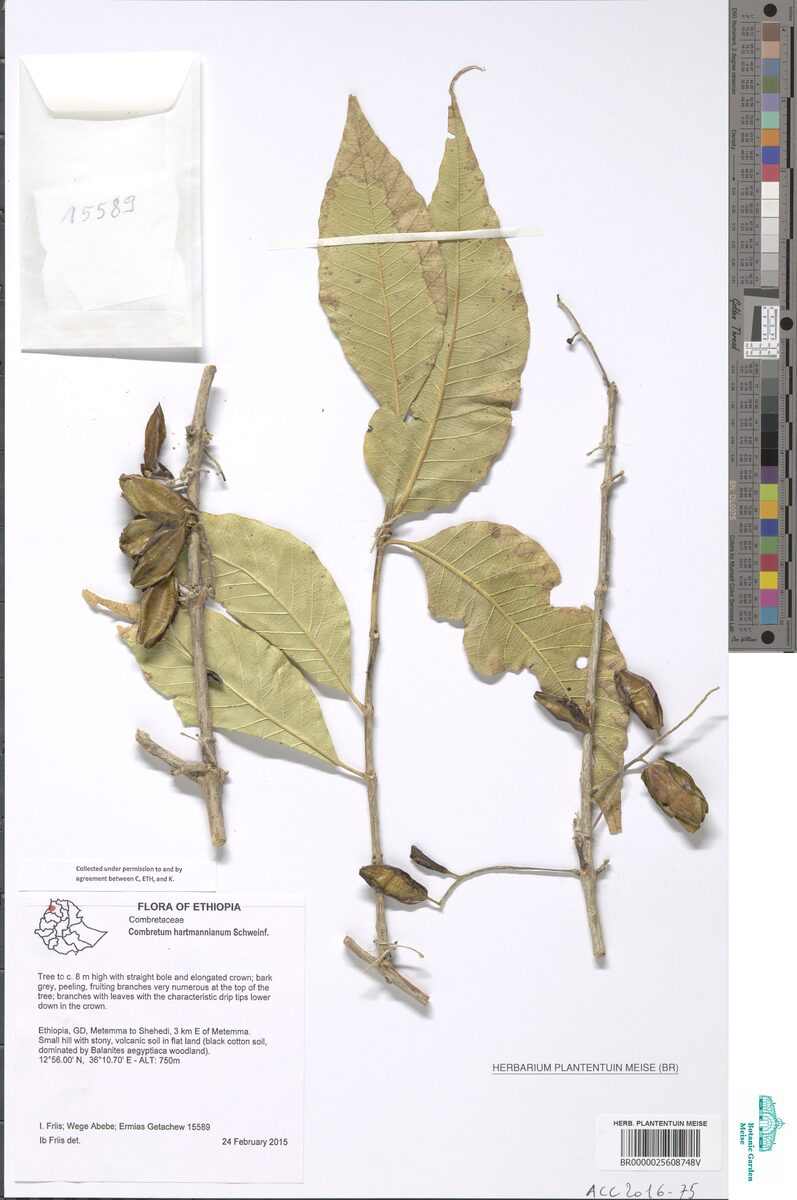
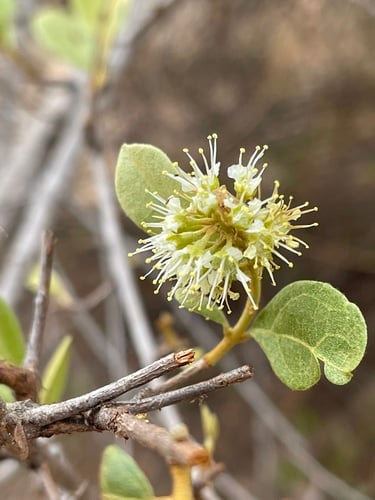
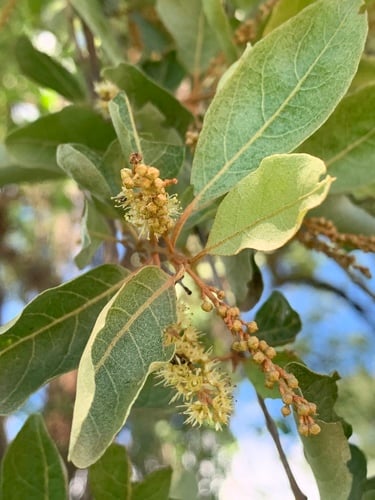
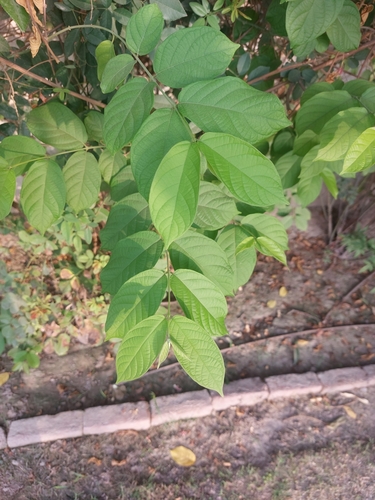
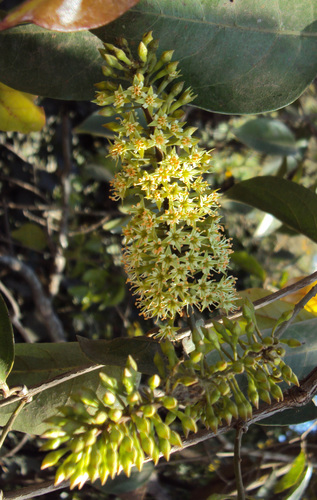
A large tree. It can be 20-30 m tall. It usually has buttresses. The branches are in layers and the leaves are mostly near the ends of the thick twigs. The twigs are hairy when young. The young leaves are yellow-green. The leaves are large, hairy and reddish brown. The leaf stalks are 2 cm long. The leaves can be 15-28 cm long by 6-13 cm wide. They are thick and with a tip at the end. They taper towards the base. The veins often stick out underneath the leaf and are depressed on the upper surface of the leaf. The flowers occur on spikes which stick upwards. The buds are usually hairy. The flower stalks are shorter then T. impediens. The fruit is very large, up to 11 cm x 8 cm and slightly flattened. They are red and smooth when ripe. The fruit have reddish brown hairs when young. The fruit has a large woody stone inside. The stone inside the fruit splits into 2 more or less equal parts. The seedling leaves are 3-4 and thin.
Edible Uses
The seed can be eaten raw, roasted, or baked, and has an excellent mild, almond-like flavour that improves with light roasting and a little salt. The palatable kernels are the largest known in this plant family, measuring up to 7–8cm long and 3–4cm wide, and weighing between 1.5–10g each. The seed contains up to 50% of a sweet, colourless, non-drying oil and is also a source of vegetable butter. The red, fleshy, ellipsoid fruit grows to 60–175mm long, 40–80mm wide, and 35–60mm thick.
Traditional Uses
The kernel inside the stone of the fruit is edible. It is eaten raw and also roasted or baked. The seed can be pressed to extract oil.
This uses section is brief — help expand it
Medicinal Uses
None known
Distribution
It is a tropical plant. It occurs in lowland areas. They will grow up to 1300 m altitude but do not produce well at this altitude. At Botanical Ark Mossman.
Where It Grows
Asia, Australia, Hawaii, Indonesia, Marquesas, North America, Pacific, Papua New Guinea*, PNG, Philippines, Pohnpei, SE Asia, Singapore, Solomon Islands*, Sri Lanka, USA,
Cultivation
Okari nut trees are normally grown from seeds. Seeds grow easily but rapidly lose their viability. The trees grow very fast and they can increase in height by up to 2 metres in one year. But trees need to be fairly old before they produce many nuts. Twenty year old trees often only produce a few nuts. Fruit are normally harvested after falling.
Propagation
Seed germinates freely when fresh but loses viability quickly.
Other Uses
The wood is moderately hard but tends toward brittleness. It is occasionally used in furniture construction, though it is rarely logged commercially because the value of the seed takes precedence. Special uses include carbon farming and food forest applications.
Production
Trees grow quickly but nut production may not start for 20 years. The kernel can be 7-8 cm long and 3-4 cm wide. The kernel is made up of coiled leaves which make up the seed. A kernel can weigh up to 10 grams in weight.
Other Information
A very popular and very important nut in Papua New Guinea. It is a cultivated food plant.
Notes
There are about 200-250 Terminalia species. They are tropical.
Synonyms
Also Known As
Alita fasia, Favie, Ghaghimanga, Hogolo, Iuwa, Manavasa, Naklise, Nyiga, Pohon ketapang okari, Sai, Saido, Sarigi, Talia lavata, Talise, Tatalise, Topo, Tukai'o, Uka, Yumu
References (31)
- Altschul, S.V.R., 1973, Drugs and Foods from Little-known Plants. Notes in Harvard University Herbaria. Harvard Univ. Press. Massachusetts. no. 3044
- Arora, R. K., 2014, Diversity in Underutilized Plant Species - An Asia-Pacific Perspective. Bioversity International. p 96
- Barwick, M., 2004, Tropical and Subtropical Trees. A Worldwide Encyclopedic Guide. Thames and Hudson p 410
- Blench, R., 2004, Fruits and Arboriculture in the Indo-Pacific Region. Indo-Pacific Prehistory Association Bulletin 24. (Taipei Papers Volume 2) p 40
- Borrell, O.W., 1989, An Annotated Checklist of the Flora of Kairiru Island, New Guinea. Marcellin College, Victoria Australia. p 62
Show all 31 references Hide references
- Bot. Jahrb. Syst. 18:201. 1893
- Bourke, M., 1995, Edible Indigenous Nuts in Papua New Guinea. In South Pacific Indigenous Nuts. ACIAR Proceedings No 69, Canberra. p 46
- Coode, M.J.E., in Womersley, J.S., (Ed), 1978, Handbooks of the Flora of Papua New Guinea. Melbourne University Press. Vol 1. p 82
- Coronel, R.E., 1982, Fruit Collections in the Philippines. IBPGR Newsletter p 10
- Darley, J.J., 1993, Know and Enjoy Tropical Fruit. P & S Publishers. p 77
- Evans, B. R, 1999, Edible nut Trees in Solomon Islands. A variety collection of Canarium, Terminalia and Barringtonia. ACIAR Technical Report No. 44 96pp
- Facciola, S., 1998, Cornucopia 2: a Source Book of Edible Plants. Kampong Publications, p 80
- Flavelle, A. J., 1991, A Traditional Agroforestry Landscape on Fergusson Island, Papua New Guinea. M. Sc. Univ. of British Columia. p 160
- French, B.R., 1986, Food Plants of Papua New Guinea, A Compendium. Asia Pacific Science Foundation p 171
- French, B.R., 2010, Food Plants of Solomon Islands. A Compendium. Food Plants International Inc. p 186
- Henderson, C.P. and I.R.Hancock, 1988, A Guide to the Useful Plants of the Solomon Islands. Res. Dept. Min of Ag. & Lands. Honiara, Solomon Islands. p 74
- Henning, B. M., 2014, The Diversity of Conservation: Exploring Narratives, Relationships and Ecosystem Services in Melanesian Market-based Biodiversity Conservation. Ph D dissertation, Uni of Minnesota. p 216
- Kiple, K.F. & Ornelas, K.C., (eds), 2000, The Cambridge World History of Food. CUP p 1824 (As Terminalia okari)
- Lepofsky, D., 1992, Arboriculture in the Mussau Islands, Bismarck Archipelago. Economic Botany, Vol 46, No. 2, pp. 192-211 (As Pandanus kaernbachii)
- Macmillan, H.F. (Revised Barlow, H.S., et al) 1991, Tropical Planting and Gardening. Sixth edition. Malayan Nature Society. Kuala Lumpur. p 310
- Martin, F. W., et al, 1987, Perennial Edible Fruits of the Tropics. USDA Handbook 642 p 25
- Massal, E. and Barrau, J., 1973, Food Plants of the South Sea Islands. SPC Technical Paper No 94. Nounea, New Caledonia. p 32
- Menninger, E.A., 1977, Edible Nuts of the World. Horticultural Books. Florida p 61
- Peekel, P.G., 1984, (Translation E.E.Henty), Flora of the Bismarck Archipelago for Naturalists, Division of Botany, Lae, PNG. p 403, 402, 404
- Solomon, C., 2001, Encyclopedia of Asian Food. New Holland. p 390
- Sukarya, D. G., (Ed.) 2013, 3,500 Plant Species of the Botanic Gardens of Indonesia. LIPI p 548
- Walter, A. & Sam C., 2002, Fruits of Oceania. ACIAR Monograph No. 85. Canberra. p 259
- Wickens, G.E., 1995, Edible Nuts. FAO Non-wood forest products. FAO, Rome. p 65, 117
- Wiersema, J. H. & Leon, B., 2013, World Economic Plants. A Standard Reference CRC Press. 2nd Ed. p 680
- Womersley, J.S., (Ed.) Handbooks of the Flora of Papua New Guinea. Vol. 1. P 82
- World Checklist of Useful Plant Species 2020. Royal Botanic Gardens, Kew