Tasmannia lanceolata
(Poiret) A. C. Smith
Mountain pepper
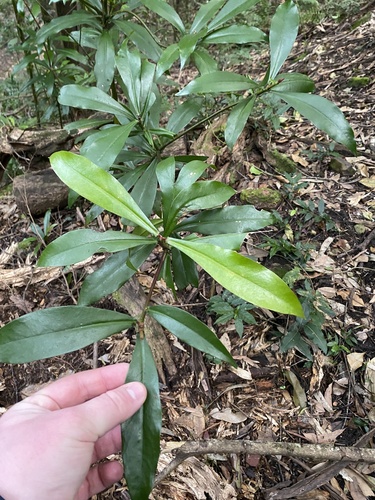
iNaturalist· cc-by-nc-nd
(c) James Gaither, some rights reserved (CC BY-NC-ND)
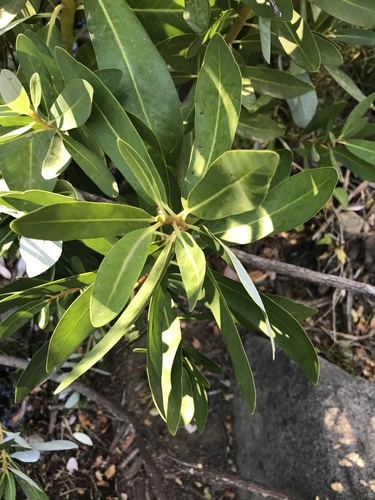
iNaturalist· cc-by-nc
(c) Alex Martine, some rights reserved (CC BY-NC)
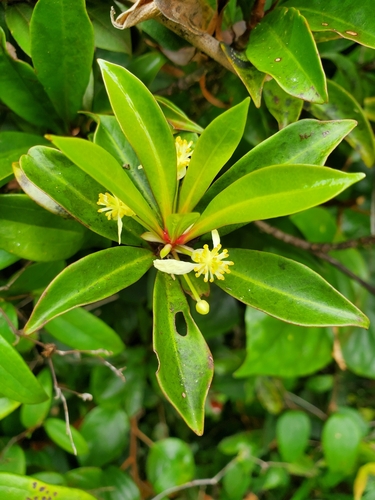
iNaturalist· cc-by-nc
(c) Alex Martine, some rights reserved (CC BY-NC)
Summary
Source: WikipediaTasmannia lanceolata, commonly known as pepper tree, native pepper, mountain pepper or mountain pepperbush, is a species of flowering plant in the family Winteraceae, and is endemic to south-eastern Australia. It is a dioecious bushy shrub to small tree with lance-shaped or narrowly ellipic leaves, male and female flowers on separate plants, the flowers with 3 to 9 petals, and the fruit a deep maroon to glossy black berry.
Description
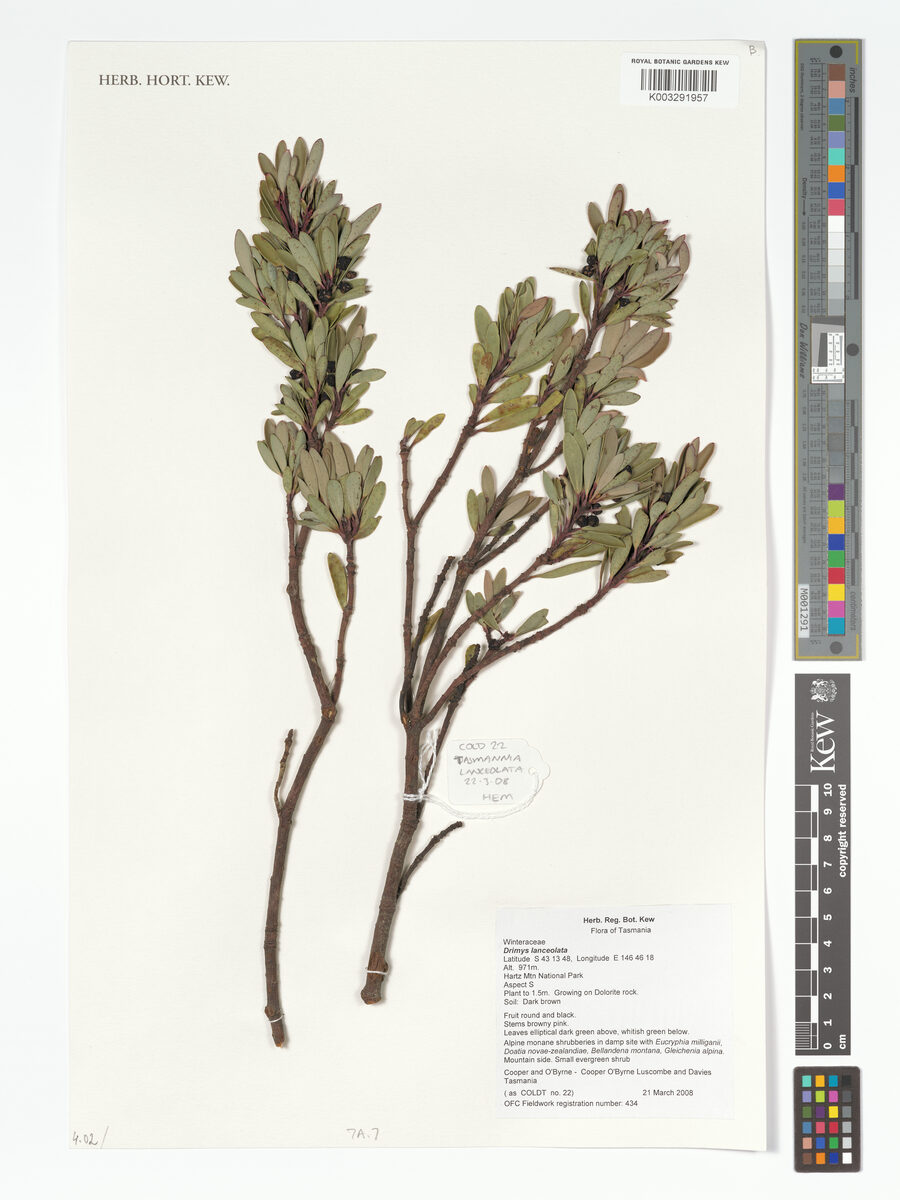
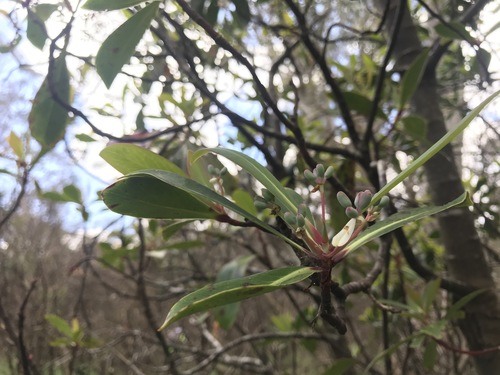
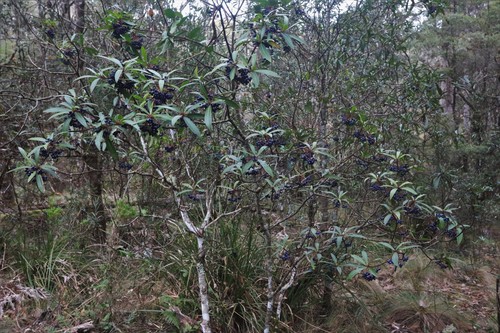
An attractive shrub that grows to 5 m tall. It can grow to 15 m tall in cool rainforest locations. It has dark green leaves and distinctive red young stems. Leaves are narrow and vary in shape. They are often oblong and 1.5-13 cm long. They are larger in lowland areas and smaller in mountains. They often have a broad base and taper. Male and female flowers are on separate plants. The flowers are at the base of new growth. The flowers are cream. The number of petals varies. The ripe fruit are black like peppercorns. They have 2 lobes and are shiny. They are 5 mm across. They have several black seeds inside. The leaves, bark and berries have an aromatic peppery taste.
Edible Uses
The leaves, seeds, and berries are used as a peppery spice and pepper substitute, fresh or dried. The ripe berries are used like peppercorns. Flower buds are added to salads or pickled like capers. The bark is used to make herbal tea and is the source of essential oil for flavoring confectionery.
Traditional Uses
The leaves, seeds and berries are used to add a spicy flavour to food. The berries are used fresh and dried. They are a pepper substitute. The flower buds are added to salads or pickled like capers. The bark can be used to make a herbal tea. It is also the source of an essential oil used to flavour confectionery.
Medicinal Uses
The bark is used to make herbal tea.
Known Hazards
Polygodial has been identified as the primary active compound in Tasmannia lanceolata, and is also responsible for its peppery taste. The fruits also contain benzoic acids, flavanols, and flavanones, as well as eugenol, methyl eugenol, and gallic acid, and also the glycosides quercetin, rutin, and possibly vitamin D. The leaf and berry have long been used as a spice, typically dried. The 1889 book The Useful Native Plants of Australia records that common names included "Pepper Tree" and that "the drupe is used as a condiment, being a fair substitute for pepper, or rather allspice [...] The leaves and bark also have a hot, biting, cinnamon-like taste." More recently, it has become popularised as a bushfood condiment. It can be added to curries, cheeses, and alcoholic beverages. It is exported to Japan to flavour wasabi. The berries are sweet and fruity at first with a lingering peppery aftertaste. Dried T. lanceolata berries and leaves have strong antimicrobial activity against food spoilage organisms. It also has high antioxidant activity. Low safrole clonal selections are grown in plantations for commercial use, as safrole is considered a low-risk toxin. Used in colonial medicine as a substitute for Winter's bark, a stomachic, it was also used for treating scurvy. Tasmanian pepper is one of a number of native Australian herbs and food species being supported by the Australian Native Food Industry Ltd, which brings together producers of food species from all parts of Australia. The pepperberry can be used as a fish poison. It can be grown as an ornamental garden plant. Its berries attract birds, including currawongs, that feed on them. It can be propagated from cuttings or seed, and can grow in a well-drained acidic soil with some shade, but is sensitive to Phytophthora cinnamomi. Garden cultivars include 'Mt. Wellington', a compact plant with coppery new growth, and 'Suzette', a variegated cultivar.
Distribution
It grows in cool wet places in Tasmania and Victoria in Australia. It does best in well drained moist soils with a rainfall of over 1,000 mm. It does best with plenty of light. It can grow up to 1200 m altitude. It is grown in Ireland as a hedge plant. Arboretum Tasmania.
Where It Grows
Australia*, Britain, Europe, Tasmania*,
Cultivation
Rooted cuttings will grow to 1 m in 2 to 3 years. Bottom heating helps cuttings form roots. It can be grown from seed which germinate in 6-8 weeks.
Production
Fruit production can be 10 to 15 kg per tree. The leaves are dried in a dark, well-aired place.
Other Information
It is cultivated.
Notes
The burning peppery taste is due to enzymes which are activated by saliva.
Synonyms
References (35)
- Alice, L. & O'Quinn, T., Australian Bush Superfoods. Explore Australia p 106
- Bodkin, F., 1991, Encyclopedia Botanica. Cornstalk publishing, p 967
- Bodkin, F., 1991, Encyclopedia Botanica. Cornstalk publishing, p 359 (As Drimus aromatica)
- Bonney, N., 1997, Economic Native Trees and Shrubs for South Australia. Greening Australia (SA) inc. Campbelltown SA 5074 p 163
- Bonney, N., 2012, Edible Wild Native Plants for Southern Australia. p 80
Show all 35 references Hide references
- Cameron, M., (Ed.) 1981, A Guide to Flowers & Plants of Tasmania. Reed p 46
- Caton, J.M. & Hardwick, R. J., 2016, Field Guide to Useful Native Plants from Temperate Australia. Harbour Publishing House. p 220
- Cherikoff V. & Isaacs, J., The Bush Food Handbook. How to gather, grow, process and cook Australian Wild Foods. Ti Tree Press, Australia p 197
- Collier, P., 1992, Rainforest Plants of Tasmania. Plant Identikit. Society for growing Australian Plants. Tasmania. p 31
- Collier, P., 1995, Alpine Wildflowers of Tasmania. Plant Identikit. Society for growing Australian Plants. Tasmania. p 36
- Cribb, A.B. & J.W., 1976, Wild Food in Australia, Fontana. p 60
- Cronin, L., 1989, The Concise Australian Flora. Reed. p 125
- Facciola, S., 1998, Cornucopia 2: a Source Book of Edible Plants. Kampong Publications, p 246 (As Drimys lanceolata)
- Ferns, Plants for the Future. (As Drimys lanceolata)
- Hastings Advance Community College, 2017, Uses for Native Plants of the Mornington Peninsula. 86pp. p 73
- Hedrick, U.P., 1919, (Ed.), Sturtevant's edible plants of the world. p 282 (As Drimys aromatica)
- Hemphill, I, 2002, Spice Notes. Macmillan. p 289
- Hibbert, M., 2002, The Aussie Plant Finder 2002, Florilegium. p 89, 297 (As Drimys)
- Kirkpatrick, J., 1997, Alpine Tasmania, An Illustrated guide to the flora and vegetation. Oxford, p 51
- Lord, E.E., & Willis, J.H., 1999, Shrubs and Trees for Australian gardens. Lothian. p 161 (As Drimys lanceolata)
- Low, T., 1991, Wild Food Plants of Australia. Australian Nature FieldGuide, Angus & Robertson. p 73
- Morley, B.D., & Toelken, H.R., (Eds), 1983, Flowering Plants in Australia. Rigby. p 37 (As Drimys)
- Nicholson, N & H., 1994, Australian Rainforest Plants 4, Terania Rainforest Publishing. NSW. p 68
- Phillips, R. & Rix, M., 2002, The Botanical Garden Vol. 1. Trees and Shrubs. MacMillan. p 60 (As Drimys)
- Ratcliffe D & P., 1987, Australian Native Plants for Indoors. Little Hills press. p 136
- Robins, J., 1996, Wild Lime. Cooking from the Bush food garden. Allen & Unwin p 131
- Seidemann J., 2005, World Spice Plants. Economic Usage, Botany, Taxonomy. Springer. p 140 (As Drimys)
- Smith, K & I., 199, Grow your own bushfoods. New Holland. Australia. p 7
- Taxon 18:287. 1969
- Uphof,
- Whiting, J. et al, 2004, Tasmania's Natural Flora. Tasmania's Natural Flora Editorial Committee PO Box 194, Ulverstone, Tasmania, Australia 7315 p 341
- Wiersema, J. H. & Leon, B., 2013, World Economic Plants. A Standard Reference CRC Press. 2nd Ed. p 677
- Williams, J.B., Harden, G.J., and McDonald, W.J.F., 1984, Trees and shrubs in rainforests of New South Wales and Southern Queensland. Univ. of New England, Armidale. p 52, 77
- Woolmore, E et al, 2002, King Island Flora: A Field Guide. p 79
- World Checklist of Useful Plant Species 2020. Royal Botanic Gardens, Kew