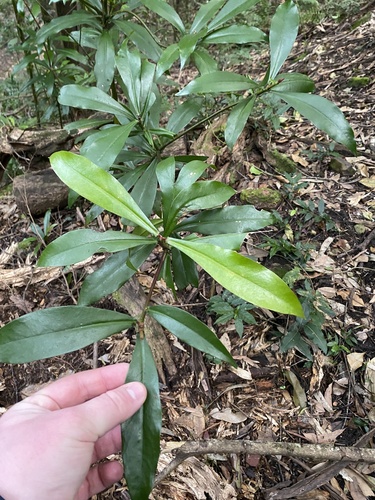
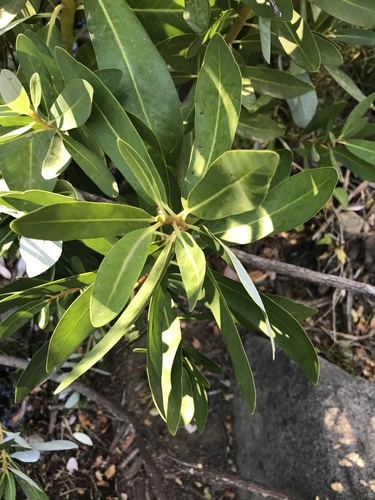
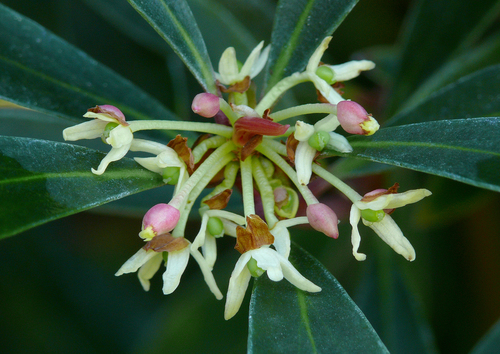
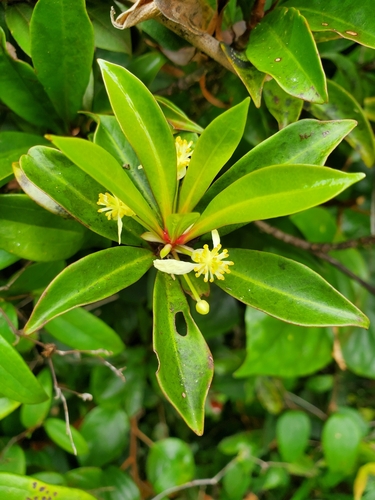
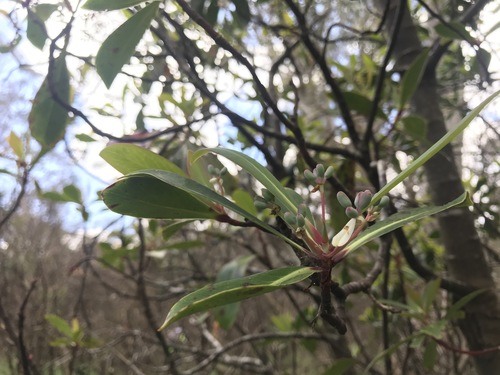
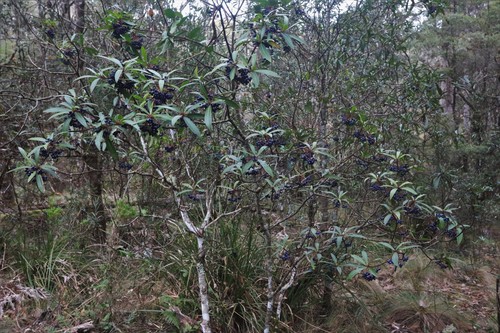
Drimys lanceolata - (Poir.)Baill.
(Poir.)Baill.
Mountain Pepper
gbif· cc-by
Royal Botanic Gardens, Kew
gbif· cc-by
Royal Botanic Gardens, Kew
gbif· cc-by
Royal Botanic Gardens, Kew
Description
Drimys lanceolata is an evergreen Shrub growing to 4.5 m (14ft) by 2.5 m (8ft) at a slow rate. See above for USDA hardiness. It is hardy to UK zone 8. It is in leaf all year, in flower from April to May, and the seeds ripen from September to October. The species is dioecious (individual flowers are either male or female, but only one sex is to be found on any one plant so both male and female plants must be grown if seed is required). . The plant is not self-fertile. Suitable for: light (sandy) and medium (loamy) soils and prefers well-drained soil. Suitable pH: mildly acid and neutral soils. It can grow in semi-shade (light woodland). It prefers moist soil. The plant can tolerates strong winds but not maritime exposure.
Edible Uses
Condiment. The fruit and seed are used as a pepper and allspice substitute[1, 2, 11, 46, 61, 105, 183]. A pungent flavour. The aromatic berries are edible according to one report, whilst another says that they taste somewhat like cinnamon.
Medicinal Uses
Antiscorbutic Stomachic. Antiscorbutic, stomachic.
Distribution
Australia - New South Wales, Tasmania and Victoria.
Where It Grows
AUSTRALASIA: Australia, Tasmania, New South Wales (southeast), Victoria,
Cultivation
Requires a light lime-free soil in semi-shade. Prefers a fertile moist but well-drained soil. A fairly hardy species, surviving very cold winters in various parts of the country so long as it is in a suitable position. It tolerates temperatures down to about -15°c, but plants are liable to be damaged in cold winters. This species is hardier than D. winteri according to one report whilst another says that it is less hardy than D. winteri. All parts of the plant are very aromatic and pungent. Plants in this genus are notably resistant to honey fungus. Plants are usually dioecious though monoecious and hermaphrodite forms are known. Male and female plants must usually be grown if seed is required.
Propagation
Seed - best sown as soon as it is ripe in the autumn in a greenhouse. When they are large enough to handle, prick the seedlings out into individual pots and grow them on in the greenhouse for at least their first winter. Plant them out into their permanent positions in late spring or early summer, after the last expected frosts. Cuttings of half-ripe wood, 10 - 15 cm with a heel, July/August in a frame. Approximately 60% take. Layering in March/April. Takes 12 months. Cuttings of mature wood of the current year's growth with a heel of older wood, November in a cold frame.
Other Uses
Hedge Hedge Wood. This species makes an excellent windbreak in woodland, it is widely grown as a hedge in mild temperate regions. Wood - soft, only moderate strength.