Taraxacum officinale
(L.) Weber in Wiggers
Dandelion
iNaturalist· cc-by-nc-sa
(c) Paul Reeves, some rights reserved (CC BY-NC-SA), uploaded by Paul Reeves
iNaturalist· cc-by-nc
(c) jonathan_mack, some rights reserved (CC BY-NC)
iNaturalist· cc-by
(c) Daughter Dad, some rights reserved (CC BY)
Summary
Source: WikipediaTaraxacum officinale, the dandelion or common dandelion, is a herbaceous perennial flowering plant in the daisy family, Asteraceae. The common dandelion is well-known for its yellow flower heads that turn into round balls of many silver-tufted fruit, which disperse in the wind. These balls are sometimes called "clocks" or "blowballs". Originally native to Eurasia, as a result of its hardiness and easy propagation, the dandelion has become widely established across several continents. It has been introduced to southern Africa, the Americas, Australia, and New Zealand. It grows in temperate regions of the world in areas with moist soils. They are able to grow in a variety of environments and are tolerant of crowding, extreme temperatures, and low moisture. The dandelion is often considered a weed, especially in lawns, but it is increasingly being recognised in its native regions as useful for attracting birds and pollinating insects. In one study, it ranked as the fourth most important source of pollen. Although dandelion pollen is considered to be an early food resource for some emerging pollinators in spring, it has also been found to lack certain essential nutrients and can lead to declining brood health for bees. The leaves, flowers, and roots are sometimes used as food and in herbal medicine.
Description
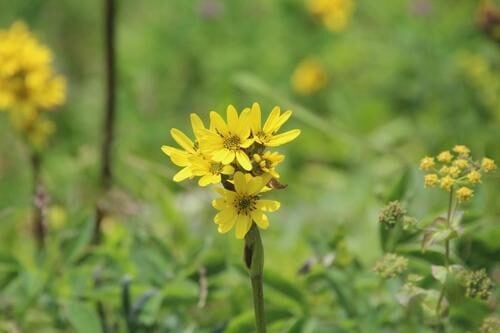
A herb. It keeps growing from year to year. It grows to 10 cm high. The leaves are at the base. They grow in a ring. The leaves vary in shape. They are narrowly oblong but divided into irregular leaflets along the stalk. They have teeth along the edge. The lobes point backwards towards the leaf bases. The flower heads are yellow. They occur singly. They are on a hollow leafless stalk. It is unbranched. The fruit is dry.
Edible Uses
Leaves can be eaten raw or cooked. They are somewhat bitter in salads, though less so in winter, and tender young leaves are considerably milder than older ones. Blanching the growing plant by excluding light reduces bitterness further, though it also lowers vitamin and mineral content. The leaves are highly nutritious: 100g raw contains approximately 2.7g protein, 9.2g carbohydrate, 187mg calcium, 66mg phosphorus, 3.1mg iron, 76mg sodium, 397mg potassium, 36mg magnesium, 14,000 IU vitamin A, 0.19mg vitamin B1, 0.26mg vitamin B2, and 35mg vitamin C. The root is edible raw or cooked, with a bitter, turnip-like flavour. Flowers can be eaten raw or cooked; their flavour is rather bitter, but unopened buds work well in fritters and can also be preserved in vinegar as a caper substitute. Both leaves and roots are used to flavour herbal beers and soft drinks such as dandelion and burdock. Roots from two-year-old plants, harvested in autumn, dried and roasted, make an excellent caffeine-free coffee substitute. Flowers brew a pleasant tea and can be made into wine — all green parts should be removed during wine-making to avoid bitterness. Leaves and roots are also suitable for tea on their own.
Traditional Uses
The tender leaves and enjoyed as a potherb. They can be eaten raw in salads or cooked. They are fried in oil. The leaves are used in a fermented Korean dish called Kimchi. The roots can be baked in a slow oven until brown, and brittle. They are then ground up and then perked like coffee. They can also be boiled and eaten. They are used in soups. The flowers can be dipped in batter and fried. They have also be used for wine. They are also used to flavour drinks. CAUTION: The drug taraxacum is a mild laxative. Sprouted seeds can be eaten. The pollen is used as a food colouring.
Medicinal Uses
Dandelion is a widely used herbal remedy, particularly valued as a diuretic because its high potassium content replaces the potassium lost when diuretics are taken. All parts of the plant, especially the root, are mildly aperient, cholagogue, depurative, strongly diuretic, hepatic, laxative, stomachic, and tonic. The root is also experimentally cholagogue, hypoglycaemic, and a weak antibiotic against yeast infections; the dried root has a weaker action overall. Roots should be harvested in autumn from two-year-old plants and can be used fresh or dried. Leaves are best harvested in spring when the plant is flowering and can be dried for later use. Tea can be made from the leaves or, more commonly, from the roots. The plant is used internally for gall bladder and urinary disorders, gallstones, jaundice, cirrhosis, dyspepsia with constipation, oedema linked to high blood pressure and heart weakness, chronic joint and skin complaints, gout, eczema, and acne. It has an antibacterial action, inhibiting Staphylococcus aureus, Pneumococci, Meningococci, Bacillus dysenteriae, B. typhi, C. diphtheriae, and Proteus, among others. The latex from the plant sap can be applied to corns, warts, and verrucae, and has a specific action on gall bladder inflammation; it is also believed to help dissolve stones in the liver. A tea made from the leaves is laxative. The German Commission E Monographs approve Taraxacum officinale for dyspepsia, urinary tract infections, liver and gallbladder complaints, and appetite loss.
Known Hazards
This plant has been mentioned in various books on poisonous plants but any possible toxins will be of very low concentration and toxicity. There are reports that some people have suffered dermatitis as a result of touching the plant, this is probably caused by the latex in the leaves and stems.
Distribution
It grows in temperate places. It grows in lawns and on roadsides. It grows in damp cool sites. In Java it grows between 1,200-1,500 m above sea level. In Argentina it grows below 500 m above sea level. In the Himalayas it grows between 3,200-4,600 m above sea level. In Hobart Botanical gardens. It suits hardiness zones 3-10. Tasmania Herbarium. In Sichuan.
Where It Grows
Africa, Alaska, Albania, Algeria, Andes, Andorra, Argentina, Armenia, Asia, Australia, Austria, Bahamas, Balkans, Belarus, Bolivia, Bosnia, Botswana, Brazil, Britain, Bulgaria, Cameroon, Canada, Caucasus, Central Africa, Central America, Central Asia, Chile, China, Congo DR, Croatia, Cuba, Cyprus, Dominican Republic, East Africa, Easter Island, Ecuador, Estonia, Eswatini, Europe, Falklands, Fiji, Finland, France, Georgia, Guatemala, Haiti, Hawaii, Himalayas, Hungary, Iceland, India, Indochina, Indonesia, Ireland, Italy, Jamaica, Japan, Kazakhstan, Korea, Kyrgyzstan, Latvia, Lesotho, Libya, Lithuania, Luxembourg, Macedonia, Madagascar, Mediterranean, Mexico, Middle East, Moldova, Mongolia, Mozambique, Nepal, Netherlands, New Caledonia, New Zealand, Norfolk Island, North Africa, North America*, Northeastern India, Norway, NW India, Pacific, Pakistan, Palestine, Paraguay, Poland, Portugal, Puerto Rico, Romania, Russia, Scandinavia, SE Asia, Serbia, Sicily, Sikkim, Slovenia, South Africa, Southern Africa, South America, Spain, Sweden, Swaziland, Switzerland, Tasmania, Tibet, Tonga, Turkey, Türkiye, Ukraine, Uruguay, USA, Uzbekistan, Vietnam, West Africa, West Indies,
Cultivation
A very easily grown plant, it succeeds in most soils, though it prefers a well-drained humus-rich neutral to alkaline soil in full sun or light shade. A very hardy plant, tolerating temperatures down to at least -29°c. The dandelion is a common weed of lawns and grassy places. Though it has a bitter flavour, the plant is often cultivated as a salad crop and as a medicinal plant, especially in parts of Europe. There are some named varieties with larger, more tender and less bitter leaves. Dandelions can provide edible leaves all year round, especially if they are given a small amount of protection in the winter. A valuable bee plant and an important food plant for the caterpillars of many butterfly and moth species, it grows well in a spring meadow. A deep rooting plant, it has roots up to 1 metre long and brings up nutrients from lower levels of the soil. An excellent plant to grow in lawns, if the lawn is cut no more than fortnightly then the dandelions will provide a good quantity of edible leaves. Grows well with alfalfa. Another report says that it inhibits the growth of nearby plants. This is probably a reference to the fact that the plant gives off ethylene gas, this gas is a hormone that promotes the premature ripening of fruits and also induces the premature fruiting of plants, thereby stunting their growth. T. officinale is not a valid name for this species, but no valid name has as yet been ascribed to it. This is actually an aggregate species of many hundreds of slightly differing species. Most seed production is apomictic which means that plants produce seed non-sexually and all seedlings are clones of the parent, thus small differences are maintained. The leaves can be harvested in early spring to late autumn (March to November, Northern Hemisphere), while the roots are typically harvested in late autumn (September to November). Dandelions typically flower from early spring to early summer (April to June, Northern Hemisphere). Dandelions grow rapidly and can establish themselves within a few weeks, often appearing shortly after the last frost in spring.
Propagation
Sow seed in spring in a cold frame, either surface-sowing or covering only very lightly; keep the compost consistently moist. Germination typically occurs within two weeks, though two weeks of cold stratification may improve results. Prick seedlings into individual pots deep enough to accommodate the taproot, then plant out in early summer. The plant can also be propagated by division in early spring as growth resumes.
Other Uses
Dandelions are useful in agroforestry settings: their deep taproots help aerate the soil, they attract pollinators and beneficial insects, and they can serve as ground cover contributing to soil improvement. The flowers are an ingredient in the 'QR' herbal compost activator — a dried, powdered herbal mixture added to compost heaps to boost bacterial activity and shorten composting time. A liquid plant feed can be made from the roots and leaves. A low-quality latex suitable for rubber production can be obtained from the roots. A magenta-brown dye is obtained from the root. The plant releases ethylene gas, which stunts nearby plant growth and causes premature fruit ripening. A distilled water made from the ligules is used cosmetically to clear the skin and is particularly effective at fading freckles. The plant acts as a dynamic accumulator, drawing minerals and nutrients from the soil and storing them in a more bioavailable form for use as fertiliser or mulch. Dandelion flowers are rich in nectar and pollen, making them an excellent food source for bees and other pollinators. Wildlife benefits from the leaves, flowers, and seeds — the last of which can feed birds — and leaf litter offers some shelter for small insects and overwintering invertebrates.
Other Information
The leaves and flowers are foraged and used in restaurants in Sweden. It is cultivated.
Notes
There are 50-60 Taraxacum species. Contains sugars, organic acids, fatty acids and tocopherols. The flowers are rich in sugars, tocopherols and flavonoids (mainly luteolin, oxhezide and luteolin). Source of calcium, phosphorus, iron, sodium, potassium, magnesium, vitamin A, vitamin B1, vitamin B2, vitamin C.
Nutrition
| Part | Moisture | kJ | kcal | Protein | Vit A | Vit C | Iron | Zinc |
|---|---|---|---|---|---|---|---|---|
| Leaves - raw | 85.7 | 217 | 52 | 2.7 | 1400 | 35 | 3.1 | 1.2 |
| Leaves - boiled | 89.5 | 138 | 33 | 2 | 1170 | 18 | 1.8 | 0.3 |
Synonyms
Also Known As
Achicoria, Amargon, Amargosa, Angelets, Arvirasu, Baran, Barau, Beroberoka, Bo cong anh, Chicoria, Cow-parsnip, Diente di leone, Dia dinh, Diente de leon, Dudh-batthal, Dudhla, Dudli, Dulal, Foun, Gingseng jawa, Girasole, Girasu, Gluharche, Gluvarche, Hand, Huentrai, Jungali copi, Kaadu seventhi, Kanphul, Karabindiba, Khatutik, Koki, Kutwane, Leche leche, Lechuguila, Lion's tooth, Lowenzahn, Marpourcin, Maslacak, Mlecz, Oduvanchik, Paardenbloem, Pathardi, Pathri, Piene, Pienenes, Piscialletto, Pissenlit, Pitachumki, Poupa, Qumstore, Radam, Radicchiello, Radicha, Radicheta, Radika, Rasuke, Saghvidzla, Seaoitsed, Secorio, Seoyangmindeulre, Shamukei, Shershi, Su nha, Tarassaco, Taraxaco, Tawao, Thuki phool, Troyache, Umashwababa, Undarkani, Uqudalele, Virasoulei, Voilill, Yamaghi kha, Zicoria burda
References (180)
- Abbet, C., et al, 2014, Ethnobotanical survey on wild alpine food plants in Lower and Central Valais (Switzerland). Journal of Ethnopharmacology 151 (2014) 624–634
- Agarwal, R. & Chandra, V., 2019, Diversity of wild edible plants in the Mandal-Chopta forest, Uttarakhand. Journal of Medicinal Plants Studies 2019; 7(1): 89-92
- Aipeisova S.A., et al, 2019, Wild useful herbs of Aktobe Region (Western Kazakhstan). Ukrainian Journal of Ecology, 9(3), 329-331
- Ambasta, S.P. (Ed.), 2000, The Useful Plants of India. CSIR India. p 621
- Arora, R. K., 2014, Diversity in Underutilized Plant Species - An Asia-Pacific Perspective. Bioversity International. p 46
Show all 180 references Hide references
- Awan, M. R., et al, 2011, Studies on traditional knowledge of economically important plants of Kaghan Valley, Mansehra District, Pakistan. Journal of Medicinal Plants Research Vol. 5(16), pp. 3958-3967
- Barreau, A., et al, 2016, How Can We Teach Our Children if We Cannot Access the Forest? Generational Change in Mapuche Knowledge of Wild Edible Plants in Andean Temperate Ecosystems of Chile. Journal of Ethnobiology 36(2): 412–432
- Bentley, J., Nina, S & Perez, S., 2001, Ethnobotany of Weeds in Cochabamba.
- Benvenuti, S. & Mazzoncini, M., 2021, The Biodiversity of Edible Flowers: Discovering New Tastes and New Health Benefits. Frontiers in Plant Science Article 569499.
- Bodkin, F., 1991, Encyclopedia Botanica. Cornstalk publishing, p 967
- Boesi, A., 2014, Traditional knowledge of wild food plants in a few Tibetan communities. Journal of Ethnobiology and Ethnomedicine 10:75
- Bonet, M. A. & Valles, J., 2002, Use of non-crop food vascular plants in Montseny biosphere reserve (Catalonia, Iberian Peninsula). International Journal of Food Sciences and Nutrition (2002) 53, 225–248
- Bowser, M., 2017, Handout on Edible Plants of the Kenai Peninsula. USFWS Kenai National Wildlife Refuge p 10
- Burnie, G & Fenton-Smith, J., 1999, A Grower's Guide to Herbs. Murdoch Books. p 29
- Bussman, R. W., et al, 2016, A comparative ethnobotany of Khevsureti, Samtskhe-Javakheti, Tusheti, Svaneti, and Racha-Lechkhumi, Republic of Georgia (Sakartvelo), Caucasus. Journal of Ethnobiology and Ethnomedicine (2016) 12:4
- Bussman, R. W. et al, 2017, Ethnobotany of Samtskhe-Javakheti, Sakartvelo (Republic of Georgia), Caucasus. Indian Journal of Traditional Knowledge Vol. 16(1) pp 7-24
- Bussman, R. W., et al, 2021, Unity in diversity—food plants and fungi of Sakartvelo (Republic of Georgia), Caucasus. Journal of Ethnobiology and Ethnomedicine (2021) 17:72 p 7
- Cerne, M., 1992, Wild Plants from Slovenia used as Vegetables. Acta Horticulturae 318
- Ciftcioglu, C. G., 2015, Sustainable wild-collection of medicinal and edible plants in Lefke region of North Cyprus. Agroforest Syst. Springer
- Cordero, S. E., Abello, L. A., & Galvez, F. L., 2017, Plantas silvestres comestibles y medicinales de Chile y otras partes del mundo. CORMA p 244
- Crawford, M., 2012, How to grow Perennial Vegetables. Green Books. p 95
- Chen, B. & Qiu, Z., Consumer's Attitudes towards Edible Wild Plants, Ishikawa Prefecture, Japan. p 26 www.hindawi.com/journals/ijfr/aip/872413.pdf
- Cheifetz, A., (ed), 1999, 500 popular vegetables, herbs, fruits and nuts for Australian Gardeners. Random House p 102
- Ciocarlan, N. & Ghendov, V., 2015, Ethnobotanical and Ecological Studies of Wild Edible Plants from Bugeac Steppe, Republic of Moldova. Journal of EcoAgriTourism. Cailta terra Vol. 11(2):
- Cormack, R. G. H., 1967, Wild Flowers of Alberta. Commercial Printers Edmonton, Canada. p 399
- Cribb, A.B. & J.W., 1976, Wild Food in Australia, Fontana. p 131, 154, 179
- Crowe, A., 1997, A Field Guide to the Native Edible Plants of New Zealand. Penguin. p 77
- Cundall, P., (ed.), 2004, Gardening Australia: flora: the gardener's bible. ABC Books. p 1400
- Curtis, W.M., 1963, The Students Flora of Tasmania Vol 2 p 387
- Daly, A. B., 20014, Narrating changing foodways: wild edible plant knowledge and traditional food systems in Mapuche lands of the Andean Temperate Forests, Chile. Masters Thesis Vancouver. p 45
- Dashorst, G.R.M., and Jessop, J.P., 1998, Plants of the Adelaide Plains & Hills. Botanic Gardens of Adelaide and State Herbarium. p 152
- Denes, A., et al, 2012, Wild plants used for food by Hungarian ethnic groups living in the Carpathian Basin. Acta Societatis Botanicorum Poloniae 81 (4): 381-396
- de Polle, E., Plantas Silvestres Comestible de Guatemala. 1(1) Universidad de San Carlos de Guatemala.
- Diaz-Betancourt, M., et al, 1999, Weeds as a future source for human consumption. Rev. Biol. Trop. 47(3):329-338
- Dobriyal, M. J. R. & Dobriyal, R., 2014, Non Wood Forest Produce an Option for Ethnic Food and Nutritional Security in India. Int. J. of Usuf. Mngt. 15(1):17-37
- Dogan, Y., et al, 2004, The Use of Wild Edible Plants in Western and Central Anatolia (Turkey). Economic Botany 58(4) pp. 684-690
- Dolina, K. & Luczaj, L., 2014, Wild food plants used on the Dubrovnik coast (south-eastern Croatia) Acta Soc Bot Pol 83(3):175–181
- Duke, J.A., 1992, Handbook of Edible Weeds. CRC Press. p 192
- Elias, T.S. & Dykeman P.A., 1990, Edible Wild Plants. A North American Field guide. Sterling, New York p 104
- Ertug, F., 2004, Wild Edible Plants of the Bodrum Area. (Mugla, Turkey). Turk. J. Bot. 28 (2004): 161-174
- Ertug, F, Yenen Bitkiler. Resimli Türkiye Florası -I- Flora of Turkey - Ethnobotany supplement
- Esperanca, M. J., 1988. Surviving in the wild. A glance at the wild plants and their uses. Vol. 1. p 300
- Estrada-Castillon, E., et al, 2014, Ethnobotany in Rayones, Nuevo Leon, Mexico. Journal of Ethnobiology and Ethnomedicine, 10:62
- Facciola, S., 1998, Cornucopia 2: a Source Book of Edible Plants. Kampong Publications, p 43
- Flora of Australia Volume 49, Oceanic Islands 1, Australian Government Publishing Service, Canberra. (1994) p 371
- Flyman, M. V. & Afolayan, A. J., 2006, A Survey of plants used as wild vegetables in four districts of Botswana. Ecology of Food and Nutrition, 45:405-415
- Food Composition Tables for use in East Asia FAO http://www.fao.org/infoods/directory No. 491
- Food Composition Tables for the Near East. http://www/fao.org/docrep No. 312
- Fox, F. W. & Young, M. E. N., 1982, Food from the Veld. Delta Books. p 129
- Girard, N. J., 2020, Sustainable Foraging of Wild Edible Plants in Norway. A Biocultural Approach. M. Sc. thesis Norwegian University. p 128
- Gonzalez, J. A., et al, 2011, The consumption of wild and semi-domesticated edible plants in the Arribes del Duero (Salamanca-Zamora, Spain): an analysis of traditional knowledge. Genetic. Resour Crop Evolution 58:991-1006
- Grubben, G. J. H. and Denton, O. A. (eds), 2004, Plant Resources of Tropical Africa 2. Vegetables. PROTA, Wageningen, Netherlands. p 565
- Guil-Guerrero, J. L., et al, 2001, Edible Wild Plants. in Recent Progress in Medicinal Plants Vol. 8 Sci. Tech publishing, Texas
- Haj, F., et al, 2012, Species Diversity and Ethno Botanical Classes of the Flora of Allai Valley District Battagram Pakistan. International Journal of Plant Research 2012, 2(4): 111-123
- Hensen, I., 1992, La Flora de la Comunidad Chorojo, Su uso, taxonomía científica y vernacular. Agroecología Universidad Cochabamba p 23
- Hinnawi, N. S. A., 2010, An ethnobotanical study of wild edible plants in the Northern West Bank "Palestine". An-Najah National University. p 92
- Holloway, P. S. & Alexander, G., 1990, Ethnobotany of the Fort Yukon Region, Alaska. Economic Botany, Vol. 44, No. 2 pp. 214-225
- Hibbert, M., 2002, The Aussie Plant Finder 2002, Florilegium. p 297
- http://nordicfood lab/org/blog/2102/9/wild-edible-plants-an-overview
- https://www.fireflyforest.com/flowers/category/edible-plants/ Edible Plants – Southeastern Arizona Wildflowers and Plants
- Hussey, B.M.J., Keighery, G.J., Cousens, R.D., Dodd, J., Lloyd, S.G., 1997, Western Weeds. A guide to the weeds of Western Australia. Plant Protection Society of Western Australia. p 106
- Hu, Shiu-ying, 2005, Food Plants of China. The Chinese University Press. p 748
- Huxley, A. (Ed.), 1977, The Encyclopedia of the Plant Kingdom. Chartweil Bookaly. Economic Botany 49(1) pp 26-30
- Jackes, D. A., 2007, Edible Forest Gardens
- Kalle, R. & Soukand, R., 2012, Historical ethnobotanical review of wild edible plants of Estonia (1770s-1960s) Acta Societatis Botanicorum Poloniae 81(4):271-281
- Karhagomba, I. B., et al, 2013, The cultivation of wild food and medicinal plants for improving community livelihood: The case of the Buhozi site, DR Congo. Nutrition Research and Practice (Nutr Res Pract) 2013;7(6):510-518
- Kermath, B. M., et al, 2014, Food Plants in the Americas: A survey of the domesticated, cultivated and wild plants used for Human food in North, Central and South America and the Caribbean. On line draft. p 857
- Khojimatov, O. K. et al, 2015, Some wild growing plants in traditional foods of Uzbekistan. Journal of Ethnic Foods. 2 (2015) 25-28
- Kolosova, V., et al, 2020, Foraging in Boreal Forest: Wild Food Plants of the Republic of Karelia, NW Russia. Foods 2020, 9, 1015; p 8
- Ladio, A. H. and Lozada, M., 2003, Comparison of wild edible plant diversity and foraging strategies in two aboriginal communities of northwestern Patagonia. Biodiversity and Conservation 12: 937–951
- Ladio, A. H. and Lozada, M., 2004, Patterns of use and knowledge of wild edible plants in distinct ecological environments: a case study of a Mapuche community from northwestern Patagonia. Biodiversity and Conservation 13:1153-1173
- Ladio, A., Lozada, M. & M. Weigandt, 2007, Comparison of traditional wild plant knowledge between aboriginal communities inhabiting arid and forest environments in Patagonia, Argentina. Journal of Arid Environments 69 (2007) 695–715
- Lim, T. K., 2015, Edible Medicinal and Non Medicinal Plants. Volume 9, Modified Stems, Roots, Bulbs. Springer p 81
- Luczaj, L. et al, 2012, Wild food plant use in 21st century Europe: the disappearance of old traditions and the search for new cuisines involving wild edibles. Acta Soc Bot Pol 81(4):359–370
- Luczaj, L. et al, 2014, Wild Food Plants of Dalmatia (Croatia). in A. Pieroni, C. L. Quave (eds.), Ethnobotany and Biocultural Diversities in the Balkans, p 138
- Lukasz, L., 2016, Wild Edible Plants Traditionally Used in Poland.
- Malezas Comestibles del Cono Sur, INTA, 2009, Buernos Aires
- Masoodi, H. U. R. & Sundriyal, R. C., 2020, Richness of non-timber forest products in Himalayan communities—diversity, distribution, use pattern and conservation status. Journal of Ethnobiology and Ethnomedicine 16:56
- Mattalia, G., et al, 2012, Traditional uses of wild food and medicinal plants among Brigasc, Kye ́, and Provenc ̧al communities on the Western Italian Alps. Genet Resour Crop Evol. Springer
- Menendez-Baceta, G., et al, 2012, Wild edible plants traditionally gathered in Gorbeialdea (Biscay, Basque Country) Genetic Resources and Crop Evolution 59:1329-1347
- Mercy, N. A., et al, 2016, Survey of Wild Vegetables in the Lebialem Highlands of South Western Cameroon. Journal of Plant Sciences 4(6): 172-184
- Miguel, E., et al, 1989, A checklist of the cultivated plants of Cuba. Kulturpflanze 37. 1989, 211-357
- Mir, M. Y., 2014, Documentation and ethnobotanical survey of wild edible plants used by the tribals of Kupwara, J & K, India. International Journal of Herbal Medicine. 2(4): 11-18
- Miskoska-Milevska, E. et al, 2020, Traditional uses of wild edible plants in the Republic of North Macedonia. PHYTOLOGIA BALCANICA 26(1): 155–162, Sofia, 2020 p 158
- Moerman, D. F., 2010, Native American Ethnobotany. Timber Press. p 550
- Nanagulyan, S., et al, 2020, Wild plants and fungi sold in the markets of Yerevan (Armenia). Journal of Ethnobiology and Ethnomedicine 16:26
- Nedelcheva A., 2013, An ethnobotanical study of wild edible plants in Bulgaria. EurAsian Journal of BioSciences 7, 77-94
- Ochse, J.J. et al, 1931, Vegetables of the Dutch East Indies. Asher reprint. p 150
- Palmeiri, V. S., & Geisa, M. G., 2019, Las plantas comestibles empleadas por las comunidades comechingonas de San Marcos Sierras (Córdoba, Argentina). Primeras aproximaciones. Bol. Soc. Argent. Bot. 54: 295-309.
- Palmieri, V. S., et al, 2022, Wild edible plants of the Central Mountains in Argentina. Comparing subregions to understand the complexity of local botanical knowledge. Rodriguésia 73: e01092021. 2022
- Pardo-de-Santayana, M., et al, 2005, The gathering and consumption of wild edible plants in the Campoo (Cantabria, Spain). International Journal of Food Sciences and Nutrition. 56(7): 529-542
- Pardo-de-Santayana, M., et al, 2007, Traditional knowledge of wild edible plants used in the northwest of the Iberian Peninsula (Spain and Portugal): a comparative study. Journal of Ethnobiology and Ethnomedicine 2007, 3:27
- Pasta, S., et al, 2020, An Updated Checklist of the Sicilian Native Edible Plants: Preserving the Traditional Ecological Knowledge of Century-Old Agro-Pastoral Landscapes. Frontiers in Plant Science. Volume 11|Article 388
- Pieroni, A., 1999, Gathered wild food plants in the Upper Valley of the Serchio River (Garfagnana), Central Italy. Economic Botany 53(3) pp 327-341
- Pieroni, A., 2001, Evaluation of the Cultural Significance of Wild Food Botanicals traditionally Consumed in Northwestern Tuscany, Italy, Journal of Ethnobiology 21(1):89-104
- Pieroni, A., et al, 2005, Food for two seasons: Culinary uses of non-cultivated local vegetables and mushrooms in a south Italian village. International Journal of Food Sciences and Nutrition, 56(4): 245-272
- Pieroni, A. et al, 2014, Resilience at the border: traditional botanical knowledge among Macedonians and Albanian living in Gollobordo, Eastern Albania. Journal of Ethnobiology and Ethnomedicine. 10:31
- Pieroni, A., et al, 2012, "We are Italians!": The Hybrid Ethnobotany of a Venetian Diaspora in Eastern Romania. Human Ecology 40:435-451
- Pieroni, A. & Soukand, R., 2017, Are Borders more Important than Geographical Distance? The Wild Food Ethnobotany of the Boykos and its Overlap with that of the Bukovinian Hutsuls in Western Ukraine. Journal of Ethnobiology 37(2): 326–345
- Pieroni, A. & Soukand, R., 2017, The disappearing wild food and medicinal plant knowledge in a few mountain villages of North-Eastern Albania. Journal of Applied Botany and Food Quality 90, 58 - 67
- Pieroni, A. & Soukand, R., 2018, Forest as Stronghold of Local Ecological Practice: Currently Used Wild Food Plants in Polesia, Northern Ukraine. Economic Botany, XX(X) pp. 1-21
- Plants for a Future database, The Field, Penpol, Lostwithiel, Cornwall, PL22 0NG, UK. http://www.scs.leeds.ac.uk/pfaf/
- Plants of Haiti Smithsonian Institute http://botany.si.edu
- Prakofjewa, J., et al, 2023, Boundaries Are Blurred: Wild Food Plant Knowledge Circulation across the Polish-Lithuanian-Belarusian Borderland. Biology 2023, 12, 571.
- PROSEA handbook Volume 13 Spices. p 280
- Pruse, B., et al, 2021, Active Wild Food Practices among Culturally Diverse Groups in the 21st Century across Latgale, Latvia. Biology 2021, 10, 551.
- Rana, J.C. et al, 2011, Genetic resources of wild edible plants and their uses among tribal communities of cold arid regions of India. Genetic Resources and Crop Evolution. 59:135-149
- Rashid, A., Anand, V.K. & Serwar, J., 2008, Less Known Wild Plants Used by the Gujjar Tribe of District Rajouri, Jammu and Kashmir State. International Journal of Botany 4(2):219-244
- Razanameharizaka, J., et al, 2022, Catalogue Legumes Traditionnels de Madagascar. Université d’Antananarivo, Antananarivo (101), Madagascar. Vol. 1. p 27
- Redzic, S. J., 2006, Wild Edible Plants and their Traditional Use in the Human Nutrition in Bosnia-Herzegovina. Ecology of Food and Nutrition, 45:189-232
- Redzic, S., 2010, Use of Wild and Semi-Wild Edible Plants in Nutrition and Survival of People in 1430 Days of Siege of Sarajevo during the War in Bosnia and Herzegovina (1992–1995). Coll. Antropol 34 (2010) 2:551-570
- Rexhepi, B., et al, 2018, Ethnobotanical Study of Wild Edible Plants in Pelagonia Region (Southwestern Macedonia) International Journal of Advances in Science Engineering and Technology, Vol. 6 (1) p 57
- Rivera, C., et al, 2005, The Ethnobotanical Study of Local Mediterranean Food Plants as Medicinal Resources in Southern Spain. Journal of Physiologyand Pharmacology. 56, Suppl. 1, 97-114 (As Taraxacum vulgare)
- Ruiters-Welcome, A. K., 2019, Food plants of southern Africa. Ph.D. thesis. Univ. of Johannesburg p 37
- Sansanelli, S., et al, 2014, Wild food plants traditionall consumed in the area of Bologna (Emilia Romagna region, Italy). Journal of Ethnobiology and Ethnomedicine 10:69
- Sansanelli, S., et al, 2017, Ethnobotanical survey of wild food plants traditionally collected and consumed in the Middle Agri Valley (Basilicata region, southern Italy). Journal of Ethnobiology and Ethnomedicine (2017) 13:50
- Savita, et al, 2006, Studies on wild edible plants of ethnic people in east Sikkim. Asian J. of Bio Sci. (2006) Vol. 1 No. 2 : 117-125
- Schneider, E., 2001, Vegetables from Amaranth to Zucchini: The essential reference. HarperCollins. p 246
- Schunko, C., et al, 2012, Intracultural variation of knowledge about wild plant uses in the Biosphere Reserve Grosses Walsertal (Austria). Journal or Ethnobiology and Ethnomedicine, 8:23
- Shava, S., 2000, The Use of Indigenous Plants as Food by a Rural Community in the Eastern Cape: an Educational Exploration. Masters Thesis Rhodes University. p 67
- Signorini, M. A., et al, 2009, Plants and traditional knowledge: An ethnobotanical investigation on Monte Ortobene (Nuoro, Sardinia). Journal or Ethnobiology and Ethnomedicine, 5:6
- Siminiuc, R. & Turcanu, D., 2021, Study of Edible Spontaneous Herbs in the Republic of Moldova for Ensuring a Sustainable Food System. Food and Nutrition Sciences, 2021, 12, 703-718 p 709
- Singh, H.B., Arora R.K.,1978, Wild edible Plants of India. Indian Council of Agricultural Research, New Delhi. p 38
- Skinner, G. & Brown, C., 1981, Simply Living. A gatherer's guide to New Zealand's fields, forests and shores. Reed. p 45
- Smith, K., 1998. Growing Uncommon Fruits and Vegetables. New Holland. p 111
- Song, M., et al, 2013, Traditional knowledge of wild edible plants in Jeju Island, Korea. Indian Journal of Traditional Knowledge. 12(2) pp 177-194
- Soukand, R., et al, 2017, Multi-functionality of the few: current and past uses of wild plants for food and healing in Liubań region, Belarus. Journal of Ethnobiology and Ethnomedicine (2017) 13:10
- Staples, G.W. and Herbst, D.R., 2005, A tropical Garden Flora. Bishop Museum Press, Honolulu, Hawaii. p 170
- Stern, G., 1986, Australian Weeds. A Source of Food and Medicine. Harper & Row. p 59
- Stryamets, N., et al, 2015, From economic survival to recreation: contemporary uses of wild food and medicine in rural Sweden, Ukraine and NW Russia. Journal of Ethnobiology and Ethnomedicine 11:53
- Sukarya, D. G., (Ed.) 2013, 3,500 Plant Species of the Botanic Gardens of Indonesia. LIPI p 1138
- Tanaka, Y. & Van Ke, N., 2007, Edible Wild Plants of Vietnam: The bountiful garden. Orchid books. p 55
- Tasmanian Herbarium Vascular Plants list p 14
- Terra, G.J.A., 1973, Tropical Vegetables. Communication 54e Royal Tropical Institute, Amsterdam, p 77
- Toledo, B. A., et al, 2007, Knowledge and Use of Edible and Medicinal Plants in two Populations from the Chaco Forest, Cordoba Province, Argentina. Journal of Ethnobiology 27(2):218-232
- Torre, de la L., et al, 2008, Enciclopedia de las Plantas Útiles del Ecuador. Herbario QCA. Pontificia Universidad Católica del Ecuador. p 236
- Tronickova, E. & Krejcova, Z., 1987, Ortaggi, Instituto Geografico de Agostini, Cecoslovacchia. p 80
- van Wyk, B., 2005, Food Plants of the World. An illustrated guide. Timber press. p 363
- Michael, P., 2007, Edible Wild Plants and Herbs. Grub Street. London. p 74
- Morley, B.D., & Toelken, H.R., (Eds), 1983, Flowering Plants in Australia. Rigby. p 311
- Paczkowska, G. & Chapman, A.R., 2000, The Western Australian Flora. A Descriptive Catalogue. Western Australian Herbarium. p 177
- Paoletti, M.G., Dreon, A.L., and Lorenzoni, G.G., 1995, Pistic, Traditional Food from Western Friuli, NE Italy. Economic Botany 49(1) pp 26-30
- Pieroni, A., 1999, Gathered wild food plants in the Upper Valley of the Serchio River (Garfagnana), Central Italy. Economic Botany 53(3) pp 327-341
- Plants for a Future database, The Field, Penpol, Lostwithiel, Cornwall, PL22 0NG, UK. http://www.scs.leeds.ac.uk/pfaf/
- Plants of Haiti Smithsonian Institute http://botany.si.edu
- PROSEA handbook Volume 13 Spices. p 280
- Rashid, A., Anand, V.K. & Serwar, J., 2008, Less Known Wild Plants Used by the Gujjar Tribe of District Rajouri, Jammu and Kashmir State. International Journal of Botany 4(2):219-244
- Redzic, S. J., 2006, Wild Edible Plants and their Traditional Use in the Human Nutrition in Bosnia-Herzegovina. Ecology of Food and Nutrition, 45:189-232
- Schneider, E., 2001, Vegetables from Amaranth to Zucchini: The essential reference. HarperCollins. p 246
- Sharma, L. et al, 2018, Diversity, distribution pattern, endemism and indigenous uses of wild edible plants in Cold Desert Biosphere Reserve of Indian Trans Himalaya. Indian Journal of Traditional Knowledge. Vol 17(1) January 2018 pp 122-131
- Singh, H.B., Arora R.K.,1978, Wild edible Plants of India. Indian Council of Agricultural Research, New Delhi. p 38
- Skinner, G. & Brown, C., 1981, Simply Living. A gatherer's guide to New Zealand's fields, forests and shores. Reed. p 45
- Smith, K., 1998. Growing Uncommon Fruits and Vegetables. New Holland. p 111
- Stanley, T. D. & Ross, E. M., 1986, Flora of south-eastern Queensland Volume 2. Queensland Government p 593
- Staples, G.W. and Herbst, D.R., 2005, A tropical Garden Flora. Bishop Museum Press, Honolulu, Hawaii. p 170
- Stern, G., 1986, Australian Weeds. A Source of Food and Medicine. Harper & Row. p 59
- Tasmanian Herbarium Vascular Plants list p 14
- Tardio, J., et al, Ethnobotanical review of wild edible plants in Spain. Botanical J. Linnean Soc. 152 (2006), 27-71
- Terra, G.J.A., 1973, Tropical Vegetables. Communication 54e Royal Tropical Institute, Amsterdam, p 77
- Thakur, D., et al, 2017, Why they eat, what they eat: patterns of wild edible plants consumption in a tribal area of Western Himalaya. Journal of Ethnobiology and Ethnomedicine (2017) 13:70
- Thomas, E., et al, 2008, The Relationship Between Plant Use and Plant Diversity in the Bolivian Andes, with Special Reference to Medicinal Plant Use. Hum Ecol (2008) 36:861–879
- Toledo, B. A. et al, 2009, Ethnobotanical knowledge in rural communities of Cordoba (Argentina): the importance of cultural and biogeographical factors. Journal of Ethnobiology and Ethnomedicine. 9:22
- Toupal, R. S. & Hollenback, K., 2009, An Ethnobotany of Indiana Dunes National Lakeshore: Plant Uses of the Ojibwa People. Bureau of Applied Research in Anthropology. University of Arizona
- Tronickova, E. & Krejcova, Z., 1987, Ortaggi, Instituto Geografico de Agostini, Cecoslovacchia. p 80
- Turner, N., et al, 2011, "Up on the Mountain": Ethnobotanical Important of Montane Sites in Pacific Coastal North America. Journal of Ethnobiology 31(1): 4-43
- Upson, R., & Lewis R., 2014, Updated Vascular Plant Checklist and Atlas for the Falkland Islands. Falklands Conservation and Kew.
- Urgamal, M., Oyuntsetseg, B., Nyambayar, D. & Dulamsuren, Ch. 2014. Conspectus of the vascular plants of Mongolia. (Editors: Sanchir, Ch. & Jamsran, Ts.). Ulaanbaatar, Mongolia. “Admon“ Press. 334pp. (p. 199-230).
- van Wyk, B., 2005, Food Plants of the World. An illustrated guide. Timber press. p 363
- Vorstenbosch, T., et al, 2017, Famine food of vegetal origin consumed in the Netherlands during World War II. Journal of Ethnobiology and Ethnomedicine (2017) 13:63
- Vari, A., et al, 2020, Berries, greens, and medicinal herbs—mapping and assessing wild plants as an ecosystem service in Transylvania (Romania). Journal of Ethnobiology and Ethnomedicine (2020) 16:13
- Weckerle, C. S., et al, 2006, Plant Knowledge of the Shuhi in the Hengduan Mountains, Southwest China. Economic Botany 60(1):2-23
- Welcome, A. K. & Van Wyk, B.-E., 2019, An inventory and analysis of the food plants of southern Africa. South African Journal of Botany 122 (2019) 136–179
- Whitney, C. W., et al, 2012, A Survey of Wild Collection and Cultivation of Indigenous Species in Iceland. Human Ecology 40:781-787
- Wiersema, J. H. & Leon, B., 2013, World Economic Plants. A Standard Reference CRC Press. 2nd Ed. p 676
- World Checklist of Useful Plant Species 2020. Royal Botanic Gardens, Kew
- www.chileflora.com
- www.ediblewildfood.com
- Yuncker, T.G., 1959, Plants of Tonga, Bernice P. Bishop Museum, Hawaii, Bulletin 220. p 270 lian College Press, Mayaguez, Puerto Rico. p 186
- Yasukawa, K., Medicinal and Edible Plants as Cancer Preventive Agents. Drug Discovery Research in Pharmacognosy. p185 www.intechopen.com
- Zizka, G., 1991, Flowering Plants of Easter Island. Palmarum Hortus Francofurtensis