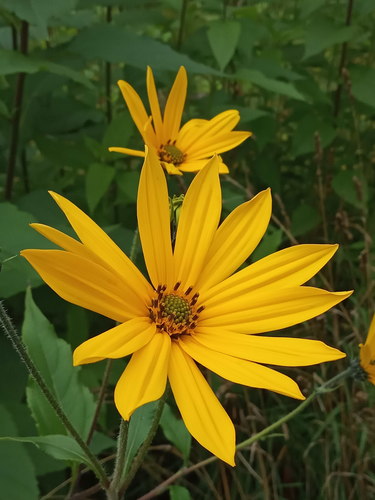
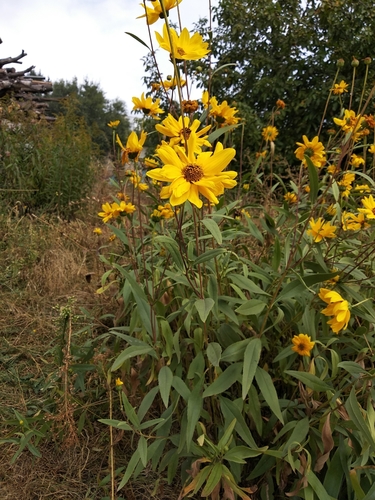
Taraxacum kok-saghyz
L. E. Rodin
Rubber dandelion, Russian dandelion
iNaturalist· cc-by-nc
(c) vladimir_epiktetov, some rights reserved (CC BY-NC)
wikimedia· cc0
Wikimedia Commons - Aron Gaister
wikimedia· cc-by
Wikimedia Commons - Brian Iaffaldano, John Cardina, Katrina Cornish
Summary
Source: WikipediaA perennial reaching 30 cm tall and wide, flowering May to June with seeds ripening June to July. Hermaphroditic and self-fertile with insect-mediated pollination. Grows well in light sandy, medium loamy, and heavy clay soils with good drainage. Tolerates mildly acidic to basic and very alkaline soil pH. Adapts to semi-shade or full sun and prefers moist conditions.
Description
A herb. It has a long taproot. It keeps growing from year to year. It grows 20 cm tall. It has 25-50 leaves arranged in one or more rings. The leaves are greyish-green and smaller than common dandelion. Flowers are on stalks about 25 cm long. A flower head can be 2.5 cm across.
Edible Uses
Edible parts include flowers, leaves, and roots. Leaves can be eaten raw or cooked. Unopened flower buds are used in fritters. The entire plant is dried for tea, with flowers alone making a pleasant brew. Roots are cooked, brewed as tea, or dried and roasted as a coffee substitute.
Traditional Uses
The leaves are eaten raw or cooked.
This uses section is brief — help expand it
Medicinal Uses
None known
Distribution
It is a temperate plant. It is best in loose well-drained soil. It grows in damp slightly salty soil. Tasmania Herbarium.
Where It Grows
Asia, Australia, Balkans, Bulgaria, Central Asia, China, Europe, Kazakhstan, Mongolia, North America, Russia, Tajikistan, Turkmenistan, Tasmania, USA, Uzbekistan,
Cultivation
Succeeds in ordinary garden soil but prefers a well-drained moisture retentive humus-rich soil in full sun or light shade. Prefers a pH between 5.5 and 8.5. Dislikes very heavy or compacted soils. Top growth of seedlings is very slow at first until the root has developed. It is advantageous to mark out the rows with a catch crop such as radishes or lettuce. This plant used to be grown commercially in Russia as a rubber producing plant. It was trialed in various countries during the second world war and was found to yield a commercial harvest in Britain, Scandinavia and Northern N. America. In a trial in N. America plants grew better in the northern U.S.A. and S. Canada than they did in the south of the USA. With the advent of cheap artificial rubber interest in this plant dwindled. Many species in this genus produce their seed apomictically. This is an asexual method of seed production where each seed is genetically identical to the parent plant. Occasionally seed is produced sexually, the resulting seedlings are somewhat different to the parent plants and if these plants are sufficiently distinct from the parents and then produce apomictic seedlings these seedlings are, in theory at least, a new species.
Propagation
Sow seeds in spring in a cold frame, surface-sown or barely covered. Keep compost moist; germination typically occurs within 2 weeks, though cold stratification for 2 weeks may improve results. Pot seedlings individually into deep containers for the tap root, transplanting in early summer. Divide plants in early spring as growth initiates.
Other Uses
The root is a latex source yielding 150–500 kilos per hectare for rubber production. Harvest roots in autumn before hard frost, then macerate to extract latex. The root's inulin content can be fermented to alcohol after latex extraction, providing fuel.
Other Information
It is cultivated.
Notes
There are 50-60 Taraxacum species. This species yields latex used as a source or rubber. Yields of 110 kg of rubber per hectare were obtained.
Synonyms
Also Known As
Khokhu, Kokof