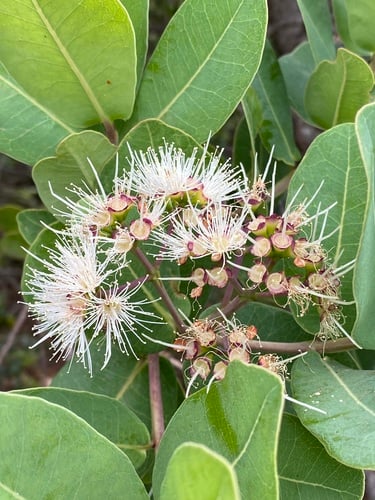
Syzygium polyanthum
(Wight) Walp.
White kelat, Indonesian bay
iNaturalist· cc-by-nc-sa
(c) Cerlin Ng, some rights reserved (CC BY-NC-SA)
iNaturalist· cc-by-nc
(c) Rafidah Abdul Rahman, some rights reserved (CC BY-NC)
iNaturalist· cc-by-nc
(c) Rafidah Abdul Rahman, some rights reserved (CC BY-NC)
Summary
Source: WikipediaSyzygium polyanthum, with common names Indonesian bay leaf or daun salam, is a species of plant in the family Myrtaceae, native to Indonesia, Indochina and Malaysia. The leaves of the plant are traditionally used as a food flavouring, and have been shown to kill the spores of Bacillus cereus.
Description
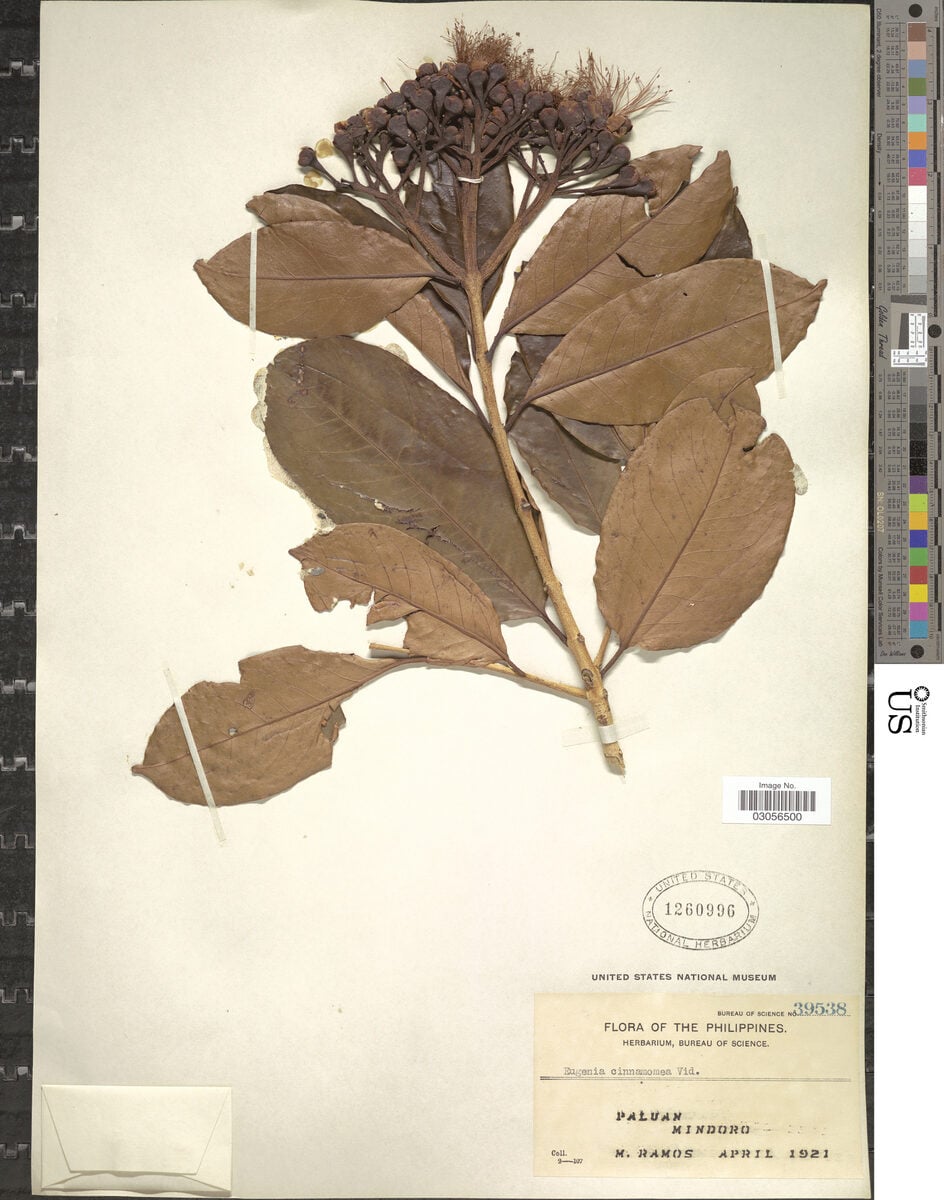
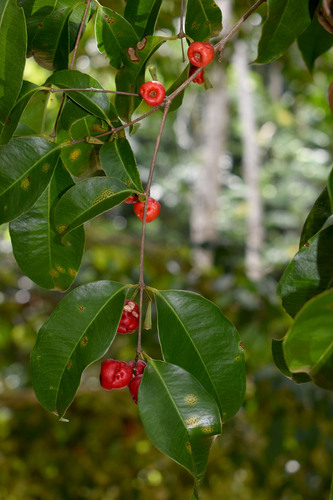
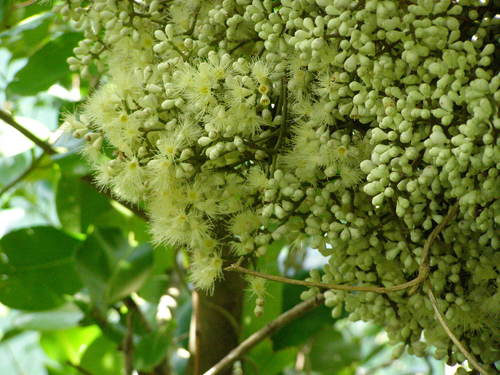
A tall tree. It grows 10-35 m tall. The trunk is straight and 60 cm across. The bark is grey with cracks along the length. The small young branches are slender and pink. The older woody twigs are greyish brown. The leaves are large, oval, dark green and shiny. The leaves grow opposite each other along the branch. The leaves taper towards the base. They are thinly leathery. They are about 10-16 cm long by 2-7 cm wide. They are broadest in the middle. There are 7-8 pairs of side veins which join near the leaf edge. The flower clusters develop where leaves have fallen off. Three flowers are grouped together. The flowering clusters occur below the leaves. Sometimes they are in the axils of leaves. They are 10 cm long. The flower stalk is 2-10 mm long. The fruit is about 1 cm across. The fruit ripen to pink or red or purple. The fruit is dark purple when ripe. There is one seed inside. The tip has a ring of enlarged calyx lobes. Young leaves are aromatic due to the presence of volatile oils.
Edible Uses
The leaves may be used dried or fresh in the cuisine of Sumatra, Java, Madura, or Bali. It is an ingredient in dishes such as sayur lodeh and nasi gurih. In Suriname it is known as 'salam blad' and widely used in Javanese cuisine, mainly in dishes such as soto soup and various stews. Because of its unique flavor it is not possible to find suitable substitutes for it.
Traditional Uses
The leaves are used to flavour cooked dishes. One leaf is used. (It has a role a little like curry leaf. ) The young leaves are commonly used as food. Pieces of meat can be boiled with the leaves and eaten together. They are used to flavour sauces, soups, cookies and vegetable dishes. The ripe fruit is eaten.
Medicinal Uses
Leaf and bark extracts are used medicinally against diarrhoea. The pounded leaves, bark and roots are applied as poultices against itches. Dried salam leaves contain about 0.17% essential oil. Eugenol and methyl chavicol are important components. Ethanolic extracts of the leaves show antifungal and antibacterial activity.
Distribution
A tropical plant. It grows in lowland forests. In Indonesia it grows up to 1,300 m altitude. It occurs in Vietnam, Laos and Cambodia. It grows in secondary forests. It needs good sunlight. It can tolerate drought. Because the fruit are eaten by animals, natural regeneration does not always occur well.
Where It Grows
Asia, Brunei, Cambodia, Indochina, Indonesia, Laos, Malaysia, Myanmar, Pacific, Philippines, Sarawak, SE Asia, Singapore, Thailand, Vietnam,
Cultivation
Plants can be grown by seeds, cuttings or air-layering. Seeds need to be sown fresh. A spacing of 6 m is suitable. Plants can be cut back and regrow.
Propagation
Seed - should be sown fresh from the fruit, on the surface of loose soil and under shade. It should not be buried, as this seriously reduces the germination percentage. Germination is rapid, starting 1 - 3 weeks after sowing, and is complete after 5 - 12 weeks. The seed loses its viability very rapidly and after 4 - 6 weeks it hardly germinates. Wildlings can be collected from under adult trees, they should be hardened off in a nursery before being planted out. Cuttings Air layering.
Other Uses
The bark is used for tanning fishing-nets and for dyeing bamboo matting brown-red (for further blackening, the matting is subsequently immersed in mud). Methanolic extracts of the leaves show strong nematicidal activity against the pine-wood nematode Bursaphelenchus xylophilus. The wood is pale brown to pinkish-brown with a purplish tinge. A medium-weight to heavy hardwood, it is used for house building and furniture. We do not have any more specific information for the wood of this species, but it belongs to a group of timbers trees collectively known as 'kelat'. The general description of kelat timber is as follows:- The heartwood is a golden brown, greyish brown or brown, with pink or purplish glints; it is not clearly demarcated from the 1 - 4cm wide band of sapwood. The texture is fine; the grain slightly interlocked, sometimes wavy or irregular; there are resin deposits. The wood is heavy; moderately hard; somewhat durable, being moderately resistant to fungi and termites, but susceptible to dry wood borers. It seasons slowly, with a high risk of checking and distortion; once dry it is moderately stable in service. It works well with ordinary tools, nailing and screwing are good so long as the wood is pre-bored; gluing is correct. The wood is used for musical instruments, tool handles, furniture components, ship building, heavy carpentry, flooring, joinery etc. The tree is often used for underplanting in forest plantations (teak, pine, kauri) in order to reduce excessive development of weeds. The leaves decay relatively slowly and provide large quantities of mulch.
Production
The younger paler leaves at the ends of stems are harvested. Fruit are produced year round. It fruits prolifically. Flowering in the northern hemisphere is October to March and fruiting from October to April a year later. Flowering and fruiting season varies.
Other Information
A popular herb in Indonesia. The ripe fruit are eaten by children.
Notes
The bark, roots and the leaves are used to relieve itchiness by the Malays.
Synonyms
Also Known As
Bungkang, Daun salam, Deng ma, Jambu hutan, Kelat merah, Kelat puteh, Kelat salam, Kelat samak, Laurel leaf, Mak, Malaga, Mantang, Manting, Mathaka, Pe, Pohon daun salam, Pokok palong, Pring sratoab, Salam leaf, Samak, San thuyen, Serai kayu, Ubar serai, Ubo serai
References (31)
- Ambasta, S.P. (Ed.), 2000, The Useful Plants of India. CSIR India. p 615
- Burkill, I.H., 1966, A Dictionary of the Economic Products of the Malay Peninsula. Ministry of Agriculture and Cooperatives, Kuala Lumpur, Malaysia. Vol 1 (A-H) p 989 (As Eugenia polyantha)
- Chai, P. P. K. (Ed), et al, 2000, A checklist of Flora, Fauna, Food and Medicinal Plants. Lanjak Entimau Wildlife Sanctuary, Sarawak. Forestry Malaysia & ITTO. p 159, 169 (As Eugenia polyantha)
- Facciola, S., 1998, Cornucopia 2: a Source Book of Edible Plants. Kampong Publications, p 161
- Foo, J.T.S.(ed), 1996, A Guide to Common Vegetables. Singapore Science Foundation. p 118
Show all 31 references Hide references
- Forest Inventory and Planning Institute, 1996, Vietnam Forest Trees. Agriculture Publishing House p 569 (As Eugenia resinosa)
- Hariyadi, B., 2008, The Entwined Tree: Traditional Natural Resource Management of Serampas, Jambi, Indonesia. Ph. D thesis. Univ. or Hawaii. p 403
- Mohd, N. G. et al, 2014, A Preliminary Flora Survey in Gunung Kajang, Pulau Tioman, Pahang Darul Makmur, Malaysia. Malays. Appl. Biol. 43(2): 17-23
- Hutton, W., 1997, Tropical Herbs and Spices of Indonesia. Periplus. p 49
- Kiple, K.F. & Ornelas, K.C., (eds), 2000, The Cambridge World History of Food. CUP p 1769
- Macmillan, H.F. (Revised Barlow, H.S., et al) 1991, Tropical Planting and Gardening. Sixth edition. Malayan Nature Society. Kuala Lumpur. p 310
- MARDI Malaysia (Also as Eugenia polyantha)
- Martin, F.W. & Ruberte, R.M., 1979, Edible Leaves of the Tropics. Antillian College Press, Mayaguez, Puerto Rico. p 98, 207
- Milow, P., et al, 2013, Malaysian species of plants with edible fruits or seeds and their evaluation. International Journal of Fruit Science. 14:1, 1-27
- Murakami, A. et al, 2014, Screening for the In Vitro Anti-tumor-promoting Activities of Edible Plants from Malaysia. Bioscience, Biotechnology, and Biochemistry, 64:1, 9-16.
- Nurfadilah, S., et al, 2017, Species richness, conservation status, and potential uses of plants in Segara Anakan Area of Sempu Island, East Java, Indonesia. BIODIVERSITAS. Volume 18, Number 4
- Ochse, J. J. et al, 1931, Vegetables of the Dutch East Indies. Asher reprint. p 536 (As Eugenia polyantha) Owen, S., 1993, Indonesian Food and Cookery, INDIRA reprints. p 82
- Phon, P., 2000, Plants used in Cambodia. © Pauline Dy Phon, Phnom Penh, Cambodia. p 580
- PROSEA
- Repert. bot. syst. 2:180. 1843
- Siong, K. H., 2003, Indigenous Fruits of Sarawak. Forest Department Sarawak. p 117 (As Eugenia)
- Solomon, C., 2001, Encyclopedia of Asian Food. New Holland. p 326
- Sukarya, D. G., (Ed.) 2013, 3,500 Plant Species of the Botanic Gardens of Indonesia. LIPI p 533
- Sukenti, K., et al, 2016, Ethnobotanical study on local cuisine of the Sasak tribe in Lombok Island, Indonesia. Journal of Ethnic Foods. 3 (2016) 189-200 p 198
- Suksri, S., et al, 2005, Ethnobotany in Bung Khong Long Non-Hunting Area, Northeast Thailand. Kasetsart J., (Nat. Sci) 39: 519-533
- Suwardi, A. B., et al, 2020, Wild edible fruits generate substantial income for local people of the Gunung Leuser National Park, Aceh Tamiang Region. Ethnobotany Research & Applications 20:11
- Terra, G.J.A., 1973, Tropical Vegetables. Communication 54e Royal Tropical Institute, Amsterdam, p 46
- Van Sam, H. et al, 2008, Uses and Conservation of Plant Species in a National Park. A case study of Ben En, Vietnam. Economic Botany 62:574-593
- van Wyk, B., 2005, Food Plants of the World. An illustrated guide. Timber press. p 360
- World Checklist of Useful Plant Species 2020. Royal Botanic Gardens, Kew
- Zawiah, N. & Othaman, H., 2012, 99 Spesies Buah di FRIM. Institut Penyelidikan Perhutanan Malaysia. p 228