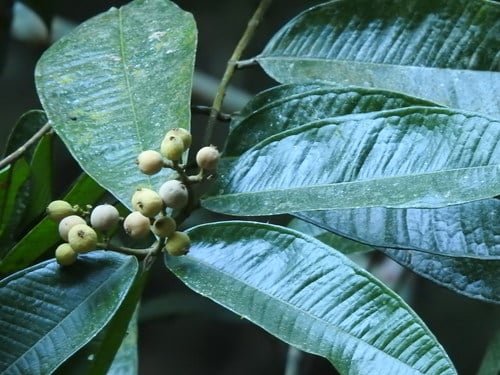
Syzygium malaccense
(L.) Merr. & L. M. Perry
Malay-apple
iNaturalist· cc-by-nc
(c) Felix, some rights reserved (CC BY-NC), uploaded by Felix
iNaturalist· cc-by-nc
(c) mariapazrr03, some rights reserved (CC BY-NC)
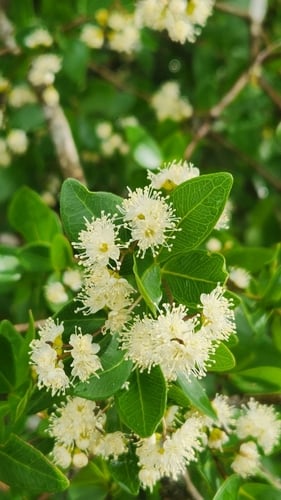
iNaturalist· cc-by-nc
(c) Wesley Torres-Pérez, some rights reserved (CC BY-NC), uploaded by Wesley Torres-Pérez
Summary
Source: WikipediaSyzygium malaccense is a species of flowering tree native to tropical Asia and Australia. It was cultivated from prehistoric times by the Austronesian peoples and introduced deliberately to remote Oceania as canoe plants. In modern times, it has been introduced throughout the tropics, including the Caribbean. The ripe fruit is edible but with little flavor.
Description
An evergreen tree 5 to 25 m tall. It spreads out to 4 m across. Trees tend to branch near the base. Leaves are simple, thick and leathery and shiny on both surfaces. They are large and oval. Leaves can be up to 25-30 cm long and 12 cm wide. The leaves have a vein around the edge of the leaf. Flowers are produced on old wood and on the trunk as well as in the angles where leaves join and at the ends of branches. Flowers are purple, crimson or white and 2.5 cm across. They mostly occur in dense clusters giving a brilliant display. The red stamens are often fallen under the tree. The fruit is rounded or oblong and 5-6 cm across by 6-8 cm long. The fruit has white flesh around a large brown seed. The seed is about 1.3 cm by 1.7 cm. Some kinds are seedless. The skin of the fruit is red or pink with darker stripes. The fruit are edible.
Edible Uses
The mountain apple is an edible fruit that can be consumed when raw and ripe. Its taste is bland but refreshing. In 1793, Captain William Bligh was commissioned to procure edible fruits from the Pacific Islands for Jamaica, including this species. He brought back this from Tahiti (called Otaheite at the time). In Puerto Rico, the Malay apple is used to make wines, in Hawaiʻi, the fruits are consumed the same way a Pacific Northwest apple is eaten. Indonesians consume the flowers of the tree in salads and in Guyana the skin of the mountain apple is cooked down to make a syrup. A mountain apple has a white fleshy fruit that has a similar texture to a pear but less sweet than an apple. Jam can be prepared by stewing the flesh with brown sugar and ginger. Coffee growers use the species to both divert birds and provide shade.
Traditional Uses
The fruit can be eaten fresh or cooked. They are also used in jam and pickles. The young leaves while still red are eaten. The flowers have also been recorded as being eaten. They are preserved in syrup or eaten in salads.
Medicinal Uses
Various parts of the tree are used in traditional medicine, the leaves and bark have in fact been shown to possess antibiotic activity, the bark is astringent, whilst the plant is also weakly hypoglycaemic. The plant contains tannins and is astringent. In particular the bark, leaves and roots of Malay apple are used against different ailments. An infusion of the bark is used to treat tuberculosis, mouth infections, stomach ache and abdominal ailments. The bark is used to cure mouth sores in children. It is also used as a purgative and to treat venereal diseases. The leaves are used to treat red eyes. A decoction of the leaves is used as a wash on skin infections. Other conditions treated with this plant include cough; yellow urine and bad appetite; as a remedy for deep bone pains, diabetes, gonorrhoea, swollen stomach after childbirth, sore throat, thrush, bronchitis and to relieve constipation.
Distribution
A tropical plant. It suits hot, wet tropical lowlands. They grow in coastal areas in the tropics and up to 1000 m altitude. It is a rainforest species. It suits humid locations. They need fertile soil, plenty of moisture, and good drainage. They are sensitive to frost. It does best in an open sunny position. It can tolerate drought but does best where there is an absence of drought. It does not grow on atolls. It will grow with soil pH of 6.1-7.4. They occur in northeast Queensland in Australia and across Malesia. They have also been introduced into other regions. In the Cairns Botanical Gardens. It suits hardiness zones 10-12.
Where It Grows
Africa, Amazon, American Samoa, Antigua and Barbuda, Asia, Australia, Bangladesh, Bougainville, Brazil, Cambodia, Cameroon, Central Africa, Central America, China, Colombia, Congo DR, Cook Islands, Costa Rica, Côte d'Ivoire, Cuba, Dominican Republic, East Africa, East Timor, Ecuador, El Salvador, Fiji, French Polynesia, FSM, Ghana, Guam, Guyana, Haiti, Hawaii, India, Indochina, Indonesia, Ivory Coast, Jamaica, Kosrae, Malaysia, Maldives, Marquesas, Micronesia, Myanmar, Nauru, New Caledonia, Nicaragua, Niue, Northeastern India, Pacific, Palau, Panama, Papua New Guinea, PNG, Peru, Philippines, Pohnpei, Puerto Rico, Rotuma, Samoa, SE Asia, Singapore, Solomon Islands, South America, Sri Lanka, St. Vincent and Grenadines, Suriname, Tahiti, Taiwan, Tanzania, Thailand, Timor-Leste, Tonga, Tuvalu, Uganda, USA, Vanuatu, Venezuela, Vietnam, Wallis and Futuna, West Africa, West Indies, Yap,
Cultivation
Trees are normally grown from seed. Seeds need to be fresh. Seeds germinate in 2-4 weeks. They can be put in a nursery and transplanted after 8 months. Where termites are a problem damaging seedlings, growing them in light shade reduces the problem. Plants can be grown by budding, grafting, layering or cuttings. Aerial layering is probably the most common method for vegetative propagation. Budding onto rootstocks of the same species have proven successful, but they are rarely successful if rootstocks of related species are used. A spacing of 10 m between trees is suitable.
Propagation
Seed - needs to be sown fresh from the fruit because it has a very limited viability. Give light shade to the seedlings when young. Air layering is the most common vegetative method of reproduction. Cuttings. Grafting or budding, but only use seedlings of the same species.
Other Uses
A reddish brown dye for making patterns on tapa bark cloth, can be processed from the bark and the root. The reddish to light brown wood is hard, tough, very heavy, but tending to warp, and difficult to work. It is used locally for construction. The wood is traditionally used in Hawaii to build beams for their hale, house and for fashioning bowls and poi-boards.
Production
Flowering and fruiting is seasonal. In the southern hemisphere flowering is about October to November. In northeastern India flowers occur in April to May and fruit occur in May to June. Fruit ripen in 2-3 months. The fruit are ripe January to February. The yield can be 21-85 kg per tree per year.
Other Information
A common village fruit tree in coastal areas of Papua New Guinea. It is cultivated.
Nutrition
| Part | Moisture | kJ | kcal | Protein | Vit A | Vit C | Iron | Zinc |
|---|---|---|---|---|---|---|---|---|
| Fruit | 91.1 | 105 | 25 | 0.4 | 0 | 15 | 0.4 | 0.1 |
Synonyms
Also Known As
'ahi'a, Aceituna dulce, Acpuhl, Afio, Apel, Apil, Apuchu, Arfath, Bakoba, Barka jamun, Chom pu deng, Chomphuu-saaraek, Chumpu kraham, Daav, Darsana, Dersana, Dervem, Dork may, Faliap, Faliyap, Fekakai, Fekika kai, Gabic, Gafiga, Gahiga, Ghabiga, Ghavika, Hahi'a, Hahika, Harafath, Hipala, Hotung, Jambo-de-malaca, Jambo-vermelho, Jambu bar, Jambu bol, Jambu gadang, Jambu jambak, Jambu kling, Jambu melaka, Jambu merah, Jambu mol, Jambul bubul, Jamrool, Kabirai, Kahuek, Kalabau, Kama, Kano, Kapika, Karukae, Kaviha, Kavika, Kehi'a, Kehika, Kidel, Lal-jamrul, Maa janbu, Mafyoksi, Makopa, Makopang, Makupa, Mansana, Maranon, Matofaa, Mazenya, Mountain-apple, Mwagolu, Nonau, Nonu 'ai, Nonu fi'afi'a, 'ohi'a, Okak, Otaheite-apple, Panijamu, Pera costena, Peria jambu, Pomarosa, Pomerac, Pommerak, Pucuk jambak, Roi do, Rose-apple, Sa’au, Sa’u, Tahiti apple, Te kabika, Thabyu-thabye, Yambu, Zabu-thabye-ahni
References (113)
- Malay apple references Syzygium malaccense
- AAK, 1980, Bertanam Pohon Buah-buahan. Penerbitan Yayasan Kanisius, Jogyakarta. p 20
- Abbiw, D.K., 1990, Useful Plants of Ghana. West African uses of wild and cultivated plants. Intermediate Technology Publications and the Royal Botanic Gardens, Kew. p 46
- Arora, R. K., 2014, Diversity in Underutilized Plant Species - An Asia-Pacific Perspective. Bioversity International. p 89
- Ashton, P., 1981. A revised handbook to the flora of Ceylon. 2:428-429.
Show all 113 references Hide references
- Ashton, M. S., et al 1997, A Field Guide to the Common Trees and Shrubs of Sri Lanka. WHT Publications Ltd. pdf p 295
- Asprilla-Perea, J., & Diaz-Puente, J.M., 2018, Traditional use of wild edible food in rural territories within tropical forest zones: A case study from the northwestern Colombia. New Trends and Issues Proceedings on Humanities and Social Sciences [Online]. 5(1), 162–181.
- Baishya, S. Kr., et al, 2013, Survey of Wild Edible Fruits of Dhubri District, Assam, India. Plant Archives Vol 13 (1): 155-158
- Barwick, M., 2004, Tropical and Subtropical Trees. A Worldwide Encyclopedic Guide. Thames and Hudson p 390
- Benvenuti, S. & Mazzoncini, M., 2021, The Biodiversity of Edible Flowers: Discovering New Tastes and New Health Benefits. Frontiers in Plant Science Article 569499.
- Blench, R., 2004, Fruits and Arboriculture in the Indo-Pacific Region. Indo-Pacific Prehistory Association Bulletin 24. (Taipei Papers Volume 2) p 40
- Bodkin, F., 1991, Encyclopedia Botanica. Cornstalk publishing, p 964
- Bodkin, F., 1991, Encyclopedia Botanica. Cornstalk publishing, p 458
- Borrell, O.W., 1989, An Annotated Checklist of the Flora of Kairiru Island, New Guinea. Marcellin College, Victoria Australia. p 114
- Bourret, D., 1981, Bonnes-Plantes de Nouvelle-Caledonie et des Loyaute. ORSTOM. p 50
- Bradacs, G., 2008, Ethnobotanical Survey and Biological Screening of Medicinal Plants from Vanuatu. PhD thesis Frankurt University. p 101
- Burkill, H. M., 1985, The useful plants of west tropical Africa, Vol. 4. Kew.
- Burkill, I.H., 1966, A Dictionary of the Economic Products of the Malay Peninsula. Ministry of Agriculture and Cooperatives, Kuala Lumpur, Malaysia. Vol 1 (A-H) p 986
- Cabalion, P. and Morat, P., 1983, Introduction le vegetation, la flore et aux noms vernaculaires de l'ile de Pentcoste (Vanuatu), In: Journal d'agriculture traditionnelle et de botanique appliquee JATBA Vol. 30, 3-4
- Call, C. A., et al, 2004, Participatory Rural Appraisal in the Upland Ecosystem of Mt Malindang, Misamis Occidental, Philippines. Biodiversity Research Programme for Development in Mindanao. p 53
- Campbell, D. et al, 2021, Wild Food Harvest in Jamaica. Frontiers in Sustainable Food Systems. Vol. 5 Article 663863
- Chandrashekara, U. M., 2009, Tree species yielding edible fruit in the coffee-based homegardens of Kerala, India: their diversity, uses and management. Food Sec. 1:361-370
- Chin, H.F., & Yong, H.S., 1996, Malaysian Fruits in Colour. Tropical press, Kuala Lumpur 33
- Coe, F.G., and Anderson, G.J., 1996, Ethnobotany of the Garifuna of Eastern Nicaragua. Economic Botany 50(1) pp 71-107
- Coe, F. G. & Anderson, G. J., 1997, Ethnobotany of the Miskitu of Eastern Nicaragua. Journal of Ethnobiology 17(2): 171-214
- Condit, R., et al, 2011, Trees of Panama and Costa Rica. Princeton Field Guides. p 356
- Cooper W & Cooper W T, 1994, Fruits of the Rain Forest. RD Press p 276
- Cooper, W. and Cooper, W., 2004, Fruits of the Australian Tropical Rainforest. Nokomis Editions, Victoria, Australia. p 365
- Coronel, R.E., 1982, Fruit Collections in the Philippines. IBPGR Newsletter p 8
- Cundall, P., (ed.), 2004, Gardening Australia: flora: the gardener's bible. ABC Books. p 1393
- D'Ambrosio, U., & Puri, R. K., 2016, Foodways in transition: food plants, diet and local perceptions of change in a Costa Rican Ngäbe community. Journal of Ethnobiology and Ethnomedicine (2016) 12:3 p 27
- Darley, J.J., 1993, Know and Enjoy Tropical Fruit. P & S Publishers. p 120
- Elevitch, C.R.(ed.), 2006, Traditional Trees of the Pacific Islands: Their Culture, Environment and Use. Permanent Agriculture Resources, Holualoa, Hawaii. p 715
- Engel, D.H., & Phummai, S., 2000, A Field Guide to Tropical Plants of Asia. Timber Press. p 81
- Facciola, S., 1998, Cornucopia 2: a Source Book of Edible Plants. Kampong Publications, p 160
- Flavelle, A. J., 1991, A Traditional Agroforestry Landscape on Fergusson Island, Papua New Guinea. M. Sc. Univ. of British Columia. p 160
- Franklin, J., Keppel, G., & Whistler, W., 2008, The vegetation and flora of Lakeba, Nayau and Aiwa Islands, Central Lau Group, Fiji. Micronesica 40(1/2): 169–225, 2008
- French, B.R., 1986, Food Plants of Papua New Guinea, A Compendium. Asia Pacific Science Foundation p 243
- French, B.R., 2010, Food Plants of Solomon Islands. A Compendium. Food Plants International Inc. p 237
- Garner, R.J., and Chaudhri, S.A., (Ed.) 1976, The Propagation of Tropical fruit Trees. FAO/CAB. p 351
- Hedrick, U.P., 1919, (Ed.), Sturtevant's edible plants of the world. p 300 (As Eugenia malaccensis)
- Henderson, C.P. and Hancock, I.R., 1988, A Guide to the Useful Plants of Solomon Islands. Res. Dept. Ministry of Agriculture and Lands, Honiara, Solomon Islands, p 43
- Hibbert, M., 2002, The Aussie Plant Finder 2002, Florilegium. p 296
- Howard, R., 1974-. Flora of the lesser Antilles. (F Lant)
- Hu, Shiu-ying, 2005, Food Plants of China. The Chinese University Press. p 580
- IBPGR, Genetic Resources of Tropical and Sub Tropical fruits and nuts. p 74
- Jardin, C., 1970, List of Foods Used In Africa, FAO Nutrition Information Document Series No 2.p 164
- John, L., & Stevenson, V., 1979, The Complete Book of Fruit. Angus & Robertson p 161
- Jones D, L, 1986, Ornamental Rainforest Plants in Australia, Reed Books, p 80, 340
- J. Arnold Arbor. 19:215. 1938
- Kermath, B. M., et al, 2014, Food Plants in the Americas: A survey of the domesticated, cultivated and wild plants used for Human food in North, Central and South America and the Caribbean. On line draft. p 847
- Khoo, H. E., et al, 2008, Carotenoid Content of Underutilized Tropical Fruits. Plant Foods for Human Nutrition 63:170-175
- Kiple, K.F. & Ornelas, K.C., (eds), 2000, The Cambridge World History of Food. CUP p 1807
- Latham, P., 2004, Useful Plants of Bas-Congo province. Salvation Army & DFID p 273
- Leach, G. J., 1988, Bush Food Plants of the Blackwater and Karawari Rivers Area, East Sepik Province, Papua New Guinea. Science in New Guinea 14(2). p 104
- Lebot, V. & Sam, C., Green desert or ‘all you can eat’? How diverse and edible was the flora of Vanuatu before human introductions?. Terra australis 52 p 409
- Lembaga Biologi Nasional, 1977, Buah-Buahan, Balai Pustaka, Jakarta. p 44
- Lepofsky, D., 1992, Arboriculture in the Mussau Islands, Bismarck Archipelago. Economic Botany, Vol 46, No. 2, pp. 192-211
- Liefting, A., et al, Samoan plant names. http://en.wikipedia.org
- Liu, Yi-tao, & Long, Chun-Lin, 2002, Studies on Edible Flowers Consumed by Ethnic Groups in Yunnan. Acta Botanica Yunnanica. 24(1):41-56
- Lorenzi, H., Bacher, L., Lacerda, M. & Sartori, S., 2006, Brazilian Fruits & Cultivated Exotics. Sao Paulo, Instituto Plantarum de Estuados da Flora Ltda. p 462
- Macmillan, H.F. (Revised Barlow, H.S., et al) 1991, Tropical Planting and Gardening. Sixth edition. Malayan Nature Society. Kuala Lumpur. p 310
- Maisuthisakul, P., 2012, Phenolic Constituents and Antioxidant Properties of some Thai Plants. Chp. 9 in Book Phytochemicals - A Global Perspective of Their Role in Nutrition and Health
- Martin, F.W. & Ruberte, R.M., 1979, Edible Leaves of the Tropics. Antillian College Press, Mayaguez, Puerto Rico. p 207
- Martin, F. W., et al, 1987, Perennial Edible Fruits of the Tropics. USDA Handbook 642 p 44
- McMakin, P.D., 2000, Flowering Plants of Thailand. A Field Guide. White Lotus. p 107
- Ochse, J. J. et al, 1931, Vegetables of the Dutch East Indies. Asher reprint. p 535 (As Eugenia malaccensis)
- Omawale, 1973, Guyana's edible plants. Guyana University, Georgetown p 13
- Oryema, C., et al, 2013, Edible wild fruit species of Gulu District, Uganda. International Journal of Biology and Biological Sciences Vol 2(4) pp 068-082
- Owen, S., 1993, Indonesian Food and Cookery, INDIRA reprints. p 59
- Parham, B. E. V., 1972, Plants of Samoa. New Zealand Department of Scientific and Industrial Research. Information Series. No. 85 p 91
- Pasha, M. K. & Uddin, S. B., 2019, Minor Edible Fruits of Bangladesh. Bangladesh J. Plant Taxon. 26(2): 299–313
- Patiri, B. & Borah, A., 2007, Wild Edible Plants of Assam. Geethaki Publishers. p 56
- Pawera, L., et al, 2020, Wild Food Plants and Trends in Their Use: From Knowledge and Perceptions to Drivers of Change in West Sumatra, Indonesia, Foods. 2020, 9, 1240
- Paz, F. S., et al, 2021, Edible Fruit Plant Species in the Amazon Forest Rely Mostly on Bees and Beetles as Pollinators. Journal of Economic Entomology, XX(XX), 2021, 1–13
- Peekel, P.G., 1984, (Translation E.E.Henty), Flora of the Bismarck Archipelago for Naturalists, Division of Botany, Lae, PNG. p 409, 410
- Penafield Anchundia, D. D., 2017, Traditional food consumption and its nutritional contribution in Guasaganda, Central Ecuador. PhD Ghent University p 72
- Perry, F., and Hay, R., 1982, Guide to Tropical and Subtropical Plants. Sun Books p 40
- Phon, P., 2000, Plants used in Cambodia. © Pauline Dy Phon, Phnom Penh, Cambodia. p 579
- Plants of Haiti Smithsonian Institute http://botany.si.edu/antilles/West Indies
- Purseglove, J.W., 1968, Tropical Crops Dicotyledons, Longmans. p 400
- Rashid, H. E., 1977, Geography of Bangladesh. Westview. p 347 (As Eugenia malaccensis)
- Radke, P & A, Sankowsky, G & N., 1993, Growing Australian Tropical Plants. Frith & Frith, Australia. p 62
- Roa, J. A. G. & Boada, D. S. G., 2018, Fundación para el Fortalecimiento de la Fruticultura y Plantas Alimenticias no Convencionales en Colombia.
- Schatz, G.E., 2001, Generic Tree Flora of Madagascar. Royal Botanical Gardens, Kew and Missouri Botanical Garden. p 289
- Siong, K. H., 2003, Indigenous Fruits of Sarawak. Forest Department Sarawak. p 112
- Staples, G.W. and Herbst, D.R., 2005, A tropical Garden Flora. Bishop Museum Press, Honolulu, Hawaii. p 429 (Drawing)
- Sujanapal, P., & Sankaran, K. V., 2016, Common Plants of Maldives. FAO & Kerala FRI, p 260
- Suwardi, A. B., et al, 2020, Wild edible fruits generate substantial income for local people of the Gunung Leuser National Park, Aceh Tamiang Region. Ethnobotany Research & Applications 20:11
- Tankard, G., 1990, Tropical fruit. An Australian Guide to Growing and using exotic fruit. Viking p 110
- Tate, D., 1999, Tropical Fruit. Archipelago Press. Singapore. p 88
- Torre, de la, L., et al, 2008, Enciclopedia de las Plantas Útiles del Ecuador. Herbario QCA. Pontificia Universidad Católica del Ecuador. p 470
- Tuiwawa, S. H., et al, 2013, The genus Syzygium (Myrtaceae) in Vanuatu. Blumea 58, 2013:53-67
- Terrell et al. 1986. Agric. Handb. no. 505. (AH 505)
- Thaman, R. R, 2016, The flora of Tuvalu. Atoll Research Bulletin No. 611. Smithsonian Institute p 102
- Townsend, K., 1994, Across the Top. Gardening with Australian Plants in the tropics. Society for Growing Australian Plants, Townsville Branch Inc. p 348
- Ulian, T., et al, 2020, Unlocking plant resources to support food security and promote sustainable agriculture. Plants, People, Planet. 2020;2:421–445.
- USDA, ARS, National Genetic Resources Program. Germplasm Resources Information Network - (GRIN). [Online Database] National Germplasm Resources Laboratory, Beltsville, Maryland. Available: www.ars-grin.gov/cgi-bin/npgs/html/econ.pl (10 April 2000)
- Vael, L., 2015, Ethnobotanical study of the plant use in the natural landscape of two mestizo communities in the Ucayali region of the Peruvian Amazon. Universiteit Gent.
- van Wyk, B., 2005, Food Plants of the World. An illustrated guide. Timber press. p 361
- Verheij, E. W. M., and R. E. Coronel, eds. 1991. Edible fruits and nuts. In: E. W. M. Verheij & R. E. Coronel (eds.), Plant Resources of South-East Asia (PROSEA). (Pl Res SEAs) 2:292.
- Vivien, J., & Faure, J.J., 1996, Fruitiers Sauvages d'Afrique. Especes du Cameroun. CTA p 237
- Walter, A. & Sam C., 2002, Fruits of Oceania. ACIAR Monograph No. 85. Canberra. p 249, 281
- Wiersema, J. H. & Leon, B., 2013, World Economic Plants. A Standard Reference CRC Press. 2nd Ed. p 672
- Williams, C.N., Chew, W.Y., and Rajaratnam, J.A., 1989, Tree and Field Crops of the Wetter Regions of the Tropics. Longman, p 136
- World Checklist of Useful Plant Species 2020. Royal Botanic Gardens, Kew
- www.worldagroforestrycentre.org/treedb/
- Yuncker, T. G., 1943, The Flora of Niue Island. Bernice P. Bishop Museum Bulletin 178 p 91
- Yuncker, T.G., 1959, Plants of Tonga, Bernice P. Bishop Museum, Hawaii, Bulletin 220. p 203
- Zaldivar, M. E., et al, 2002, Species Diversity of Edible Plants Grown in Homegardens of Chibehan Amerindians from Costa Rica. Human Ecology, Vol. 30, No. 3, pp. 301-316
- Zawiah, N. & Othaman, H., 2012, 99 Spesies Buah di FRIM. Institut Penyelidikan Perhutanan Malaysia. p 226
- Zeven, A. C. & de West, J. M. J., 1982, Dictionary of cultivated plants and their regions of diversity. Wageningen. p 61 (As Eugenia malaccensis)
- Zuchowski W., 2007, Tropical Plants of Costa Rica. A Zona Tropical Publication, Comstock Publishing. p 186