Syzygium australe
(Wendl. ex Link) B. Hyland
Creek satinash, Brush cherry
iNaturalist· cc-by-nc-sa
(c) Reiner Richter, some rights reserved (CC BY-NC-SA), uploaded by Reiner Richter
iNaturalist· cc-by-nc
(c) Mononymous, some rights reserved (CC BY-NC)
iNaturalist· cc-by-nc
(c) Mononymous, some rights reserved (CC BY-NC)
Summary
Source: WikipediaSyzygium australe, with many common names that include brush cherry, scrub cherry, creek lilly-pilly, creek satinash, and watergum, is a rainforest tree native to eastern Australia. It can attain a height of up to 35 m with a trunk diameter of 60 cm. In cultivation, this species is usually a small to medium-sized tree with a maximum height of only 18m.
Description
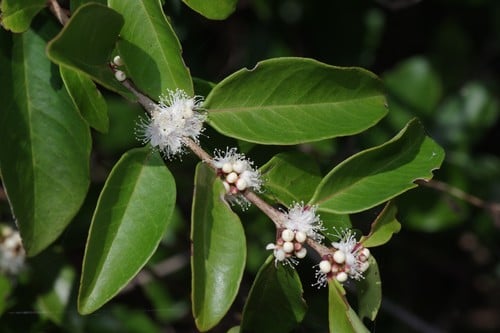
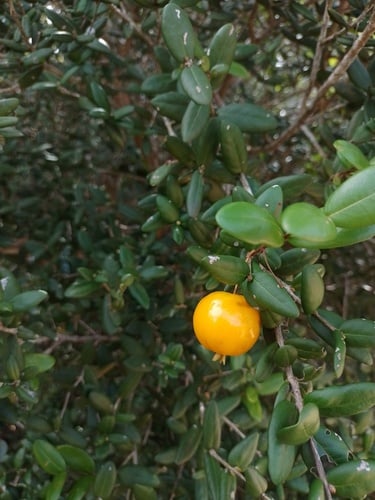
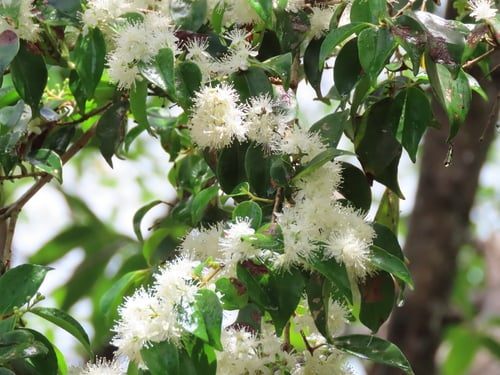
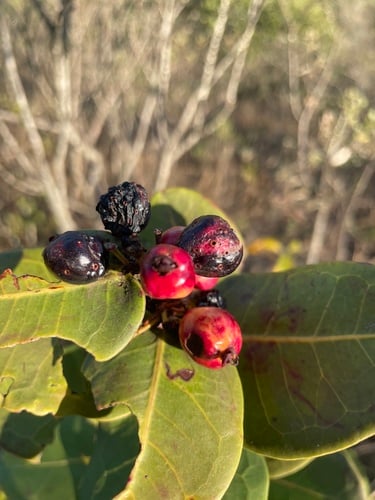
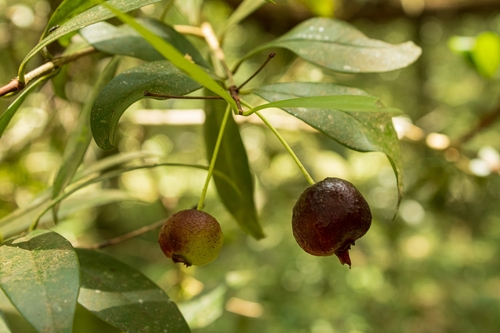
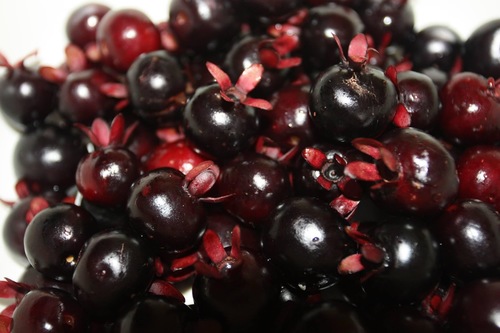
A tree up to 10 m tall and a spread of 5 m. In warm rainforest areas it can grow to 30 m tall. It has a dense crown of leaves. The stem is erect and stout with spreading branches. The leaves are rounded and 9 cm long by 3 cm wide. They are shiny green on the upper surface and paler underneath. New growth is bronze/red. The flowers are small, fluffy and white or cream. They are produced in small clusters in the angles of the upper leaves. The fruit can be rounded or oval. They are pink to dark red in colour and 2 cm across. The fruit are edible. They contain 1 seed.
Edible Uses
The fruit is eaten raw or made into jellies. Crisp and juicy, its flavour ranges from delicious to mediocre. The reddish-pink to red, obovoid fruit measures about 15–25mm long and 15mm in diameter and contains a large seed.
Traditional Uses
The fruit are eaten raw. It can be cooked. They can be used for jelly, syrups, preserves, or baked in pies and tarts. They are also used for drinks. The seeds can be roasted and eaten.
Medicinal Uses
None known
Distribution
A tropical plant. It grows in coastal regions and rainforest areas in north and eastern Australia. They will grow on a variety of soils. They need to be well drained. It does best if soils are humus rich. They can be grown in temperate regions and can withstand moderate frost. It is damaged by drought. It can grow in slight shade or full sun. In the Cairns Botanical Gardens. Adelaide Botanical Gardens. It suits hardiness zones 9-12. Arboretum Tasmania.
Where It Grows
Australia*, Canada, Hawaii, North America, Pacific, Tasmania, USA,
Cultivation
They are grown from seed. Seed are sown in autumn. Seed often germinate slowly and irregularly. Plants can also be grown from cuttings. Often a large number of the fruit are seedless.
Propagation
Seed is best sown fresh. Either the whole fruit can be sown or the seed separated from the flesh first. Germination usually takes 1–2 months but may be slow and spasmodic, especially if seed is not sown fresh. Cuttings of firm, current season's growth can also be taken.
Other Uses
The plant has a very dense growth habit and responds well to trimming, making it suitable as a hedge — the cultivar 'Brilliant' is particularly popular for this use. The reddish or yellowish wood is light, elastic and seasons well; it has been used for making oars, boat building, and was traditionally used to make boomerangs and shields. As with other Syzygium species, the heartwood is golden brown, greyish brown or brown with pink or purplish glints, not clearly demarcated from the 1–4cm wide sapwood band. The texture is fine, with slightly interlocked grain that is sometimes wavy or irregular, and resin deposits are present. The wood is heavy, moderately hard and somewhat durable — moderately resistant to fungi and termites but susceptible to dry wood borers. It seasons slowly with a high risk of checking and distortion, though once dry it is moderately stable in service. It works well with ordinary tools; nailing and screwing are good provided the wood is pre-bored; gluing is satisfactory. Uses include musical instruments, tool handles, furniture components, shipbuilding, heavy carpentry, flooring and joinery.
Production
In the southern hemisphere flowering is January to March and fruit are ripe from December to April. Plants produce in 3 years.
Synonyms
Also Known As
Creek cherry, Creek lilly Pilly, Galangara, Scrub cherry, Native myrtle
References (36)
- Anon., 2003, Native Plants for the Fitzroy basin. Society for Growing Australian Plants Inc. (Rockhampton Branch) p 76
- Austral. J. Bot., suppl. 9:55. 1983
- Beasley, J., 2011, Plants of Tropical North Queensland - the compact guide. Footloose publications. p 169
- Bodkin, F., 1991, Encyclopedia Botanica. Cornstalk publishing, p 457
- Caton, J.M. & Hardwick, R. J., 2016, Field Guide to Useful Native Plants from Temperate Australia. Harbour Publishing House. p 204
Show all 36 references Hide references
- Cherikoff V. & Isaacs, J., The Bush Food Handbook. How to gather, grow, process and cook Australian Wild Foods. Ti Tree Press, Australia p 50
- Cooper W & Cooper W T, 1994, Fruits of the Rain Forest. RD Press p 268
- Cooper, W. and Cooper, W., 2004, Fruits of the Australian Tropical Rainforest. Nokomis Editions, Victoria, Australia. p 359
- Cundall, P., (ed.), 2004, Gardening Australia: flora: the gardener's bible. ABC Books. p 1392
- Facciola, S., 1998, Cornucopia 2: a Source Book of Edible Plants. Kampong Publications, p 160
- Gouldstone, S., 1978, Australian and New Zealand Guide to food bearing plants. Books for Pleasure. p 27
- Gouldstone, S., 1983, Growing your own Food-bearing Plants in Australia. Macmillan p 86 (As Eugenia myrtifolia)
- Greig, D., 1996, Flowering Natives for Home Gardens. Angus & Robertson. p 311
- Hardwick, R.J., 2000, Nature's Larder. A Field Guide to the Native Food Plants of the NSW South Coast. Homosapien Books. p 75
- Haslam, S., 2004, Noosa's Native Plants. Noosa Integrated Catchment Assn. Inc. p 360
- Hastings Advance Community College, 2017, Uses for Native Plants of the Mornington Peninsula. 86pp. p 72
- Hibbert, M., 2002, The Aussie Plant Finder 2002, Florilegium. p 296
- Hyland, B. P. M., 1983. Austral. J. Bot. 9:55.
- Jackes, B.R., 2001, Plants of the Tropics. Rainforest to Heath. An Identification Guide. James Cook University. p 69
- Jones D, L, 1986, Ornamental Rainforest Plants in Australia, Reed Books, p 75, 340
- Lazarides, M. & Hince, B., 1993, Handbook of Economic Plants of Australia, CSIRO. p 232
- Low, T., 1991, Wild Food Plants of Australia. Australian Nature FieldGuide, Angus & Robertson. p 76
- Low, T., 1992, Bush Tucker. Australia’s Wild Food Harvest. Angus & Robertson. p 63
- Melzer, R. & Plumb, J., 2011, Plants of Capricornia. Belgamba, Rockhampton. p 265
- Nicholson, N & H., 1996, Australian Rainforest Plants 3, Terania Rainforest Publishing. NSW. p 58
- Pearson, S. & A., 1992, Rainforest Plants of Eastern Australia. Kangaroo Press p 106 (As Eugenia australis)
- Radke, P & A, Sankowsky, G & N., 1993, Growing Australian Tropical Plants. Frith & Frith, Australia. p 58
- Recher, P, 2001, Fruit Spirit Botanical Gardens Plant Index. www.nrg.com.au/~recher/ seedlist.html p 3
- Robins, J., 1996, Wild Lime. Cooking from the Bush food garden. Allen & Unwin p
- Ryan, M. (Ed.), 2003, Wild Plants of Greater Brisbane. Queensland Museum. p 294
- Smith, K & I., 1999, Grow your own bushfoods. New Holland. Australia. p 49
- Stanley, T. D. & Ross, E. M., 1986, Flora of south-eastern Queensland Volume 2. Queensland Government p 211
- Staples, G.W. and Herbst, D.R., 2005, A tropical Garden Flora. Bishop Museum Press, Honolulu, Hawaii. p 430
- Townsend, K., 1994, Across the Top. Gardening with Australian Plants in the tropics. Society for Growing Australian Plants, Townsville Branch Inc. p 342
- Williams, J.B., Harden, G.J., and McDonald, W.J.F., 1984, Trees and shrubs in rainforests of New South Wales and Southern Queensland. Univ. of New England, Armidale. p 109, 112
- Yallakool Reserve Plant List July 1, 2009 Off internet