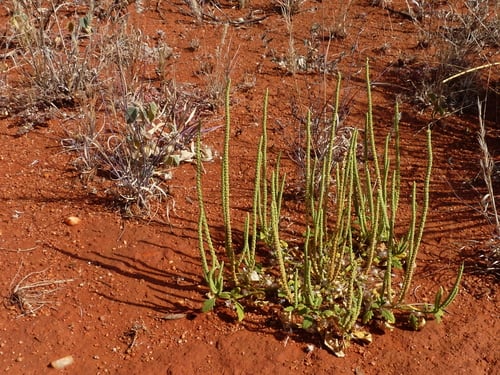
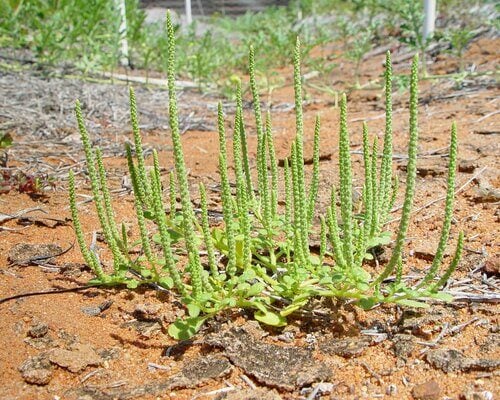
Suaeda californica
S. Watson
Broom Seepweed, California Seablite
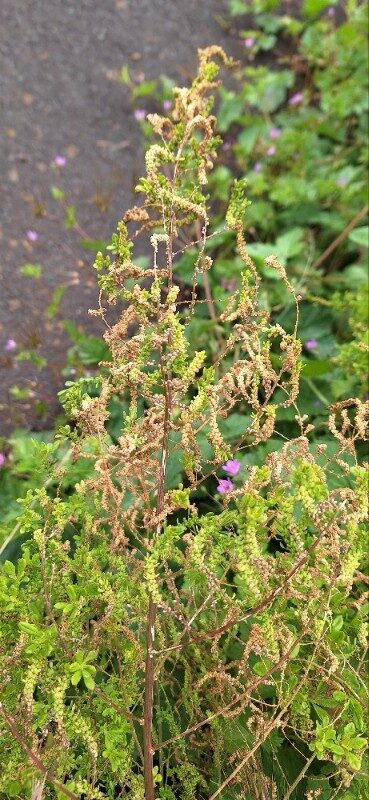
iNaturalist· cc-by-nc
(c) bobstafford805, some rights reserved (CC BY-NC)
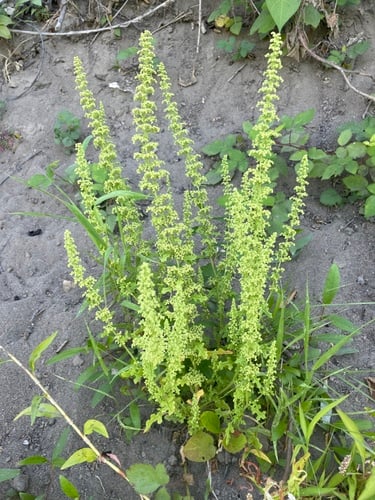
iNaturalist· cc-by-nc
(c) bobstafford805, some rights reserved (CC BY-NC)
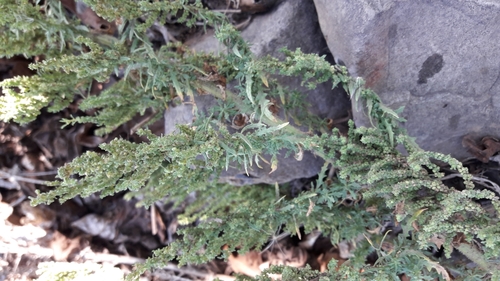
iNaturalist· cc-by-nc
(c) Damon Tighe, some rights reserved (CC BY-NC), uploaded by Damon Tighe
Summary
Source: WikipediaSuaeda californica is a rare species of flowering plant in the amaranth family known by the common name California seablite. It is now endemic to San Luis Obispo County, California, where it is known from a few occurrences in the marshes around Morro Bay. Historical populations around San Francisco Bay have been extirpated, though it has been reintroduced to multiple sites in the area.
Description
A shrub growing to 0.6 m tall, hermaphroditic and wind-pollinated. Flowers from August to September with seeds ripening September to October. Tolerates light sandy, medium loamy, and heavy clay soils with mildly acid to basic pH, including saline conditions. Requires full sun and moist soil. Tolerates maritime exposure.
Edible Uses
One report indicates that either the seed or the leaves are edible, though no further detail is given.
Medicinal Uses
None known.
Known Hazards
It once occurred around the San Francisco Bay, but any historical populations there are now extirpated. Some carefully tended populations have been planted as re-introductions at locations around the San Francisco Bay. It probably once grew along the Petaluma River north of the bay, as remains of the species have been found in adobe bricks there. By 1991 the total remaining number of individuals was estimated to be below 500, and the plant was federally listed as an endangered species of the United States in 1994.
Distribution
It is a Mediterranean climate plant.
Where It Grows
North America, USA,
Cultivation
We have very little information on this species and do not know if it will be hardy in Britain, though judging by its native range it could succeed outdoors at least in the milder parts of this country. Suaeda californica is an endangered species with a current distribution only on the margins of Morro Bay in San Luis Obispo County and a re-established colony in San Francisco Bay. It dislikes shade, see the plants native range for other ideas on its cultivation needs.
Propagation
No specific information is available for this species, but outdoor sowing in mid spring in situ would likely succeed. Seed should only just be covered. If seed quantity is limited, sowing in a cold frame in winter is safer. Prick seedlings out into individual pots when large enough to handle and plant out in early summer.
Other Uses
None known.
Notes
Also put in the family Chenopodiaceae.
References (4)
- Beckstrom-Sternberg, Stephen M., and James A. Duke. "The Foodplant Database." http://probe.nalusda.gov:8300/cgi-bin/browse/foodplantdb.(ACEDB version 4.0 - data version July 1994) (As Dondia californica)
- Plants for a Future database, The Field, Penpol, Lostwithiel, Cornwall, PL22 0NG, UK. http://www.scs.leeds.ac.uk/pfaf/
- Proc. Amer. Acad. Arts 9:89. 1874
- World Checklist of Useful Plant Species 2020. Royal Botanic Gardens, Kew